1,267 posters, 47 videos, 13 topics, 4 sessions, 853 authors
ePostersLive by SciGen Technologies S.A. All rights reserved.
SOHO 2026 Annual Meeting
September 9 - 12, 2026 | George R. Brown Convention Center, Houston, Texas

CT - 1677
Extranodal Involvement and Hepatobiliary Dysfunction as Determinants of Outcome After CAR T-Cell Therapy
Poster Presenter
Authors
Part of Topic
Cellular Therapy (CT)
Extranodal involvement and hepatobiliary dysfunction as determinants of outcome after car T-cell therapy
Background: Extranodal involvement is present in over 60% of patients with relapsed/refractory large B-cell lymphoma (R/R LBCL) receiving CD19-directed CAR T-cell therapy, yet the prognostic impact of specific extranodal (EN) sites remains incompletely characterized.1 A recent multicenter analysis by Iacoboni et al. identified liver involvement as a high-risk site,2 but peritoneal disease, ascites, and markers of hepatobiliary dysfunction were not separately evaluated.
Method: We performed a retrospective analysis of 522 R/R LBCL patients (318 with EN involvement). Outcomes were compared across liver (n=43), peritoneal (n=39), and GI (n=37) involvement among other EN sites. Subgroup analyses were done for ascites (n=19), elevated bilirubin (n=9), and cirrhosis (n=8). Outcomes were interpreted in the context of previously published site-specific findings reported by Iacoboni et al. (n=516).
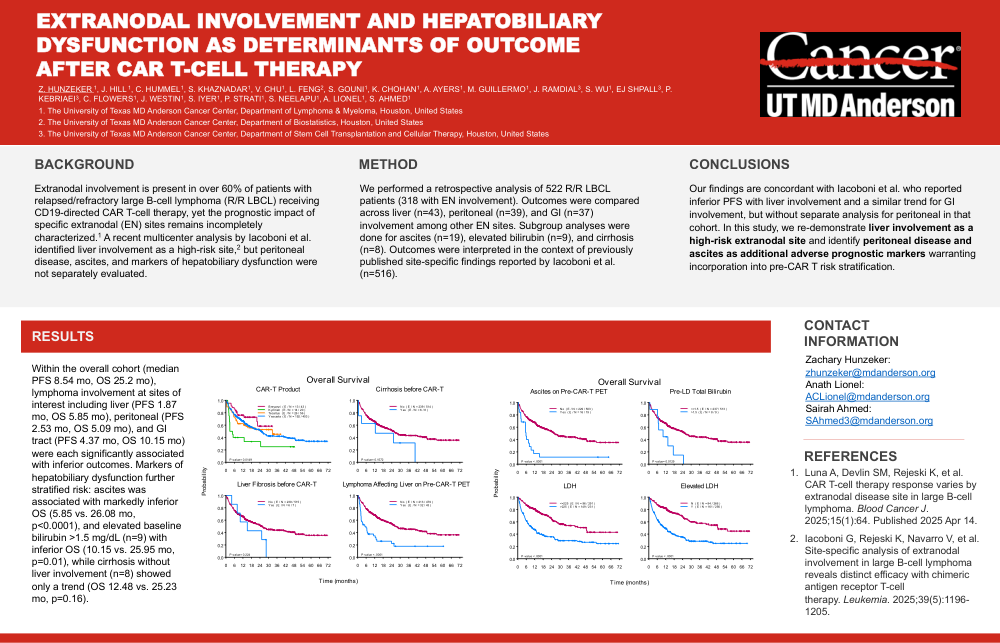
Results: Within the overall cohort (median PFS 8.54 mo, OS 25.2 mo), lymphoma involvement at sites of interest including liver (PFS 1.87 mo, OS 5.85 mo), peritoneal (PFS 2.53 mo, OS 5.09 mo), and GI tract (PFS 4.37 mo, OS 10.15 mo) were each significantly associated with inferior outcomes. Markers of hepatobiliary dysfunction further stratified risk: ascites was associated with markedly inferior OS (5.85 vs. 26.08 mo, p<0.0001), and elevated baseline bilirubin >1.5 mg/dL (n=9) with inferior OS (10.15 vs. 25.95 mo, p=0.01), while cirrhosis without liver involvement (n=8) showed only a trend (OS 12.48 vs. 25.23 mo, p=0.16).
Conclusions: Our findings are concordant with Iacoboni et al. who reported inferior PFS with liver involvement and a similar trend for GI involvement, but without separate analysis for peritoneal in that cohort. In this study, we re-demonstrate liver involvement as a high-risk extranodal site and identify peritoneal disease and ascites as additional adverse prognostic markers warranting incorporation into pre-CAR T risk stratification.