1,267 posters, 47 videos, 13 topics, 4 sessions, 853 authors
ePostersLive by SciGen Technologies S.A. All rights reserved.
SOHO 2026 Annual Meeting
September 9 - 12, 2026 | George R. Brown Convention Center, Houston, Texas

MDS - 1661
Long-Term Risk of Clonal Evolution and Infectious Outcomes With Eltrombopag Plus Immunosuppressive Therapy in Idiopathic Aplastic Anemia: A Propensity-Matched Real-World Analysis
Poster Presenter
Authors
Part of Topic
Myelodysplastic Syndromes (MDS)
Background: Idiopathic aplastic anemia (IAA) is a rare immune-mediated bone marrow failure disorder commonly treated with immunosuppressive therapy (IST), including antithymocyte globulin (ATG) and cyclosporine. Eltrombopag, a thrombopoietin receptor agonist, has demonstrated improved hematologic response rates in severe aplastic anemia; however, concerns remain regarding long-term clonal evolution to acute myeloid leukemia (AML) or myelodysplastic syndromes (MDS), as well as infectious complications in immunocompromised patients. This study evaluated the long-term risk of clonal evolution, survival, sepsis-related outcomes, pneumonia, hospitalization, and invasive fungal infections among patients with IAA treated with eltrombopag plus IST compared with IST alone.
Methods: A retrospective cohort study was conducted using the TriNetX Global Collaborative Network, comprising 173 healthcare organizations. Adult patients (≥18 years) with idiopathic aplastic anemia receiving IST were identified as cohort 1 while those receiving eltrombopag and IST made up the second cohort. Patients with preexisting MDS, Fanconi anemia, paroxysmal nocturnal hemoglobinuria, leukemia history, or prior stem cell transplantation were excluded. Propensity score matching (1:1) was performed using demographics, comorbidities, medications, laboratory parameters, and procedural variables, resulting in 186 matched patients per cohort. Outcomes assessed at 1-, 3-, and 5-year follow-up included overall survival, sepsis/infection outcomes, pneumonia, inpatient hospitalization, invasive fungal infections, and clonal evolution to AML or MDS. Kaplan-Meier survival analysis, hazard ratios (HR), risk ratios (RR), and odds ratios (OR) were calculated.
Results:
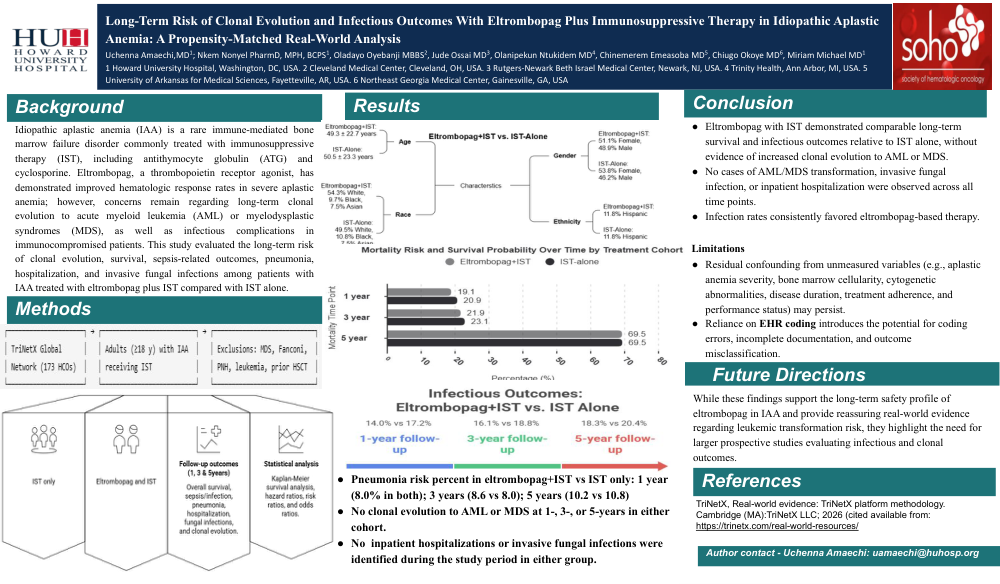
Following propensity score matching, baseline demographic characteristics were well balanced between cohorts. Mean age was 49.3 ± 22.7 years in the eltrombopag cohort and 50.5 ± 23.3 years in the IST-alone cohort. Female patients comprised 51.1% and 53.8% of the cohorts, respectively, while male patients comprised 48.9% and 46.2%. White patients represented 54.3% of the eltrombopag cohort and 49.5% of the IST-alone cohort; Black or African American patients represented 9.7% and 10.8%, respectively, while Asian patients comprised 7.5% in both groups. Hispanic or Latino ethnicity was present in 11.8% of both cohorts. At 1 year, mortality risk was 19.1% in the eltrombopag cohort versus 20.9% in the IST-alone cohort (RR 0.916, p=0.675). At 3 years, mortality risk was 21.9% versus 23.1% (RR 0.947, p=0.780). Five-year Kaplan-Meier survival probabilities remained similar between groups (69.48% vs 69.55%; HR 0.943, 95% CI 0.612–1.455, p=0.792). Sepsis and infection-related outcomes numerically favored eltrombopag across all evaluated time points. Across 1-, 3-, and 5-year follow-up, infectious outcomes consistently trended lower in patients receiving eltrombopag plus IST compared with IST alone (14.0% vs 17.2%, 16.1% vs 18.8%, and 18.3% vs 20.4%, respectively), although differences were not statistically significant. Pneumonia risk remained comparable between cohorts throughout follow-up. At 1 year, pneumonia risk was 8.0% in both cohorts (RR 0.994, p=0.987), while at 3 years the risk was 8.6% versus 8.0% (RR 1.070, p=0.854). At 5 years, pneumonia occurred in 10.2% of patients receiving eltrombopag plus IST and 10.8% receiving IST alone, with no statistically significant difference. Importantly, no clonal evolution to AML or MDS was observed at 1-, 3-, or 5-year follow-up in either cohort. Additionally, no inpatient hospitalizations or invasive fungal infections were identified during the study period in either group.
Conclusions:
In this large real-world propensity-matched analysis of idiopathic aplastic anemia, eltrombopag combined with immunosuppressive therapy demonstrated comparable long-term survival and infectious outcomes relative to IST alone, without evidence of increased clonal evolution to AML or MDS. Importantly, no cases of AML/MDS transformation, invasive fungal infection, or inpatient hospitalization were observed across all analyzed time points. Although differences in sepsis-related outcomes did not reach statistical significance, infection rates consistently numerically favored eltrombopag-based therapy. These findings support the long-term safety profile of eltrombopag in IAA and provide reassuring real-world evidence regarding leukemic transformation risk while highlighting the need for larger prospective studies evaluating infectious and clonal outcomes.