1,267 posters, 47 videos, 13 topics, 4 sessions, 853 authors
ePostersLive by SciGen Technologies S.A. All rights reserved.
SOHO 2026 Annual Meeting
September 9 - 12, 2026 | George R. Brown Convention Center, Houston, Texas

MPN - 1641
Socioeconomic and Geographic Disparities in Survival Outcomes Among Patients with Chronic Myelomonocytic Leukemia: A SEER-Based Analysis
Poster Presenter
Authors
Part of Topic
Myeloproliferative Neoplasms (MPN)
Background
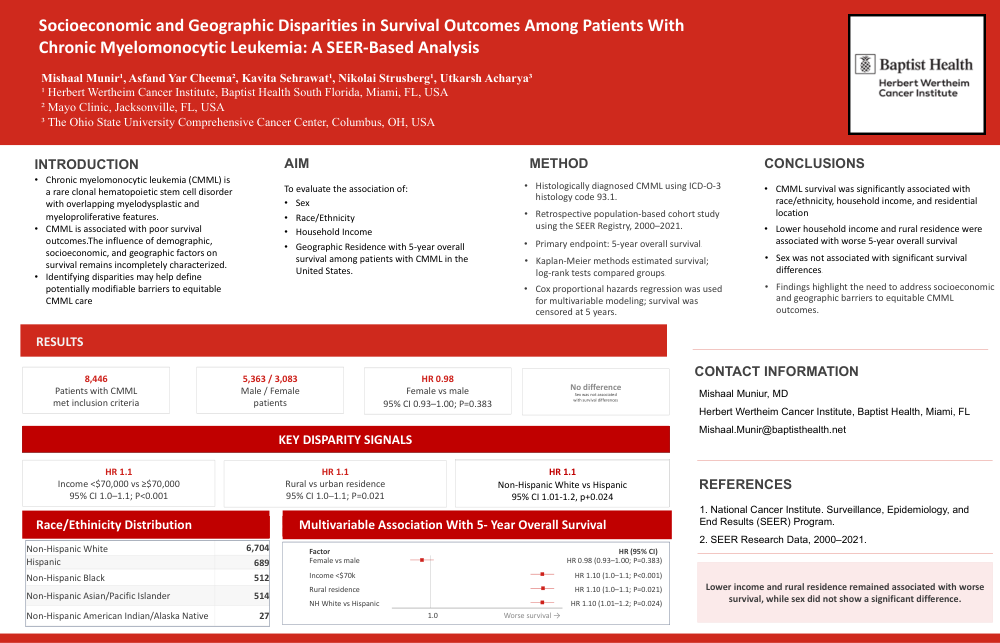
Chronic myelomonocytic leukemia (CMML) is a rare clonal hematopoietic stem cell disorder with overlapping myelodysplastic and myeloproliferative features and poor survival outcomes. However, the impact of demographic, socioeconomic, and geographic disparities on CMML survival remains incompletely characterized. We evaluated the association of sex, race/ethnicity, household income, and living area with 5-year overall survival among patients with CMML in the United States.
Methods
We extracted data on patients with a histological diagnosis of CMML from the Surveillance, Epidemiology, and End Results (SEER) Registry from 2000 to 2021. The primary outcome was 5-year overall survival. CMML was identified using International Classification of Diseases for Oncology, 3rd Edition, histology code 93.1. Patients with missing or unknown race/ethnicity, household income, living area, or survival data were excluded. Kaplan-Meier methods were used to estimate survival, and Cox proportional hazards regression was used for multivariable modeling. Differences between groups were compared using the log-rank test, with survival censored at 5 years.
Results
A total of 8446 patients with CMML met inclusion criteria, including 5363 male patients and 3083 female patients. There was no significant survival difference between male and female patients; compared with male patients, female patients had similar 5-year overall survival (hazard ratio [HR], 0.98; 95% confidence interval [CI], 0.93–1.00; P=0.383). Race/ethnicity included Hispanic (n=689), non-Hispanic White (n=6704), non-Hispanic Black (n=512), non-Hispanic Asian/Pacific Islander (n=514), and non-Hispanic American Indian/Alaska Native patients (n=27). Compared with Hispanic patients, non-Hispanic White patients had significantly worse survival (HR, 1.1; 95% CI, 1.01–1.2; P=0.024), whereas other racial/ethnic groups showed no statistically significant differences. Patients with household income <$70000 had worse survival compared with those with income ≥$70000 (HR, 1.1; 95% CI, 1.0–1.1; P<0.001). Rural residence was also associated with worse survival compared with urban residence (HR, 1.1; 95% CI, 1.0–1.1; P=0.021).
Conclusions
In this SEER-based analysis, CMML survival was significantly associated with race/ethnicity, household income, and residential location, whereras sex was not associated with survival differences. These findings highlight the need to better understand and address socioeconomic and geographic barriers to equitable CMML outcomes.