1,267 posters, 47 videos, 13 topics, 4 sessions, 853 authors
ePostersLive by SciGen Technologies S.A. All rights reserved.
SOHO 2026 Annual Meeting
September 9 - 12, 2026 | George R. Brown Convention Center, Houston, Texas

ABCL - 1615
Venous Thromboembolism Is Associated With Greater 90-Day Morbidity and Inpatient Utilization Among Hospitalized Patients With Diffuse Large B-Cell Lymphoma: A Propensity-Matched TriNetX Analysis
Poster Presenter
Authors
Part of Topic
Aggressive B-Cell Lymphoma (ABCL)
Venous Thromboembolism Is Associated With Greater 90-Day Morbidity and Inpatient Utilization Among Hospitalized Patients With Diffuse Large B-Cell Lymphoma: A Propensity-Matched TriNetX Analysis
Mevlut Ozmen, Ekow Pinkrah, Lavanya Nagarajan, Tanzeela Shuja
Northwestern McHenry Hospital, McHenry, IL, USA
Poster ABCL-1615 | Aggressive B-Cell Lymphoma | SOHO 2026 Annual Meeting, Houston, TX
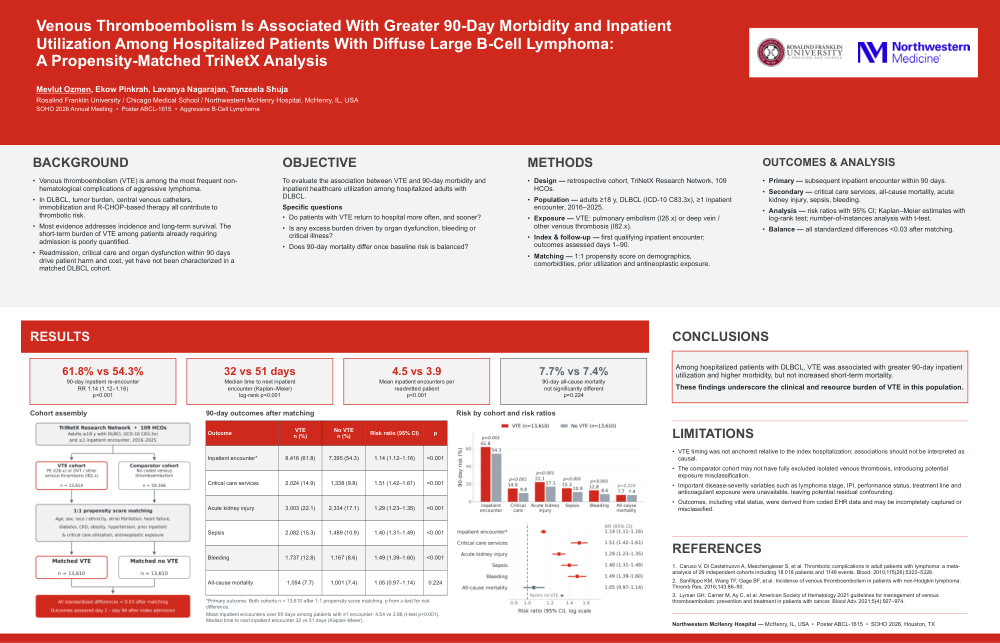
Background: Venous thromboembolism (VTE) is a clinically important complication in patients with malignancy, but its short-term impact among hospitalized patients with diffuse large B-cell lymphoma (DLBCL) remains incompletely characterized. We evaluated the association between VTE and 90-day morbidity and inpatient health care utilization among hospitalized adults with DLBCL.
Methods: We conducted a retrospective cohort study using the TriNetX Research Network. Adults aged 18 years or older with DLBCL and an inpatient encounter between January 1, 2016, and December 31, 2025, were identified. Patients with VTE, defined by diagnosis codes for pulmonary embolism and deep vein or other venous thrombosis, were compared with patients without VTE. Propensity score matching was performed for demographics, comorbidities, baseline health care utilization markers, and antineoplastic therapy exposure. Outcomes were assessed from day 1 through day 90 after index hospitalization. The primary outcome was 90-day inpatient utilization, defined as a subsequent inpatient encounter. Secondary outcomes included critical care services, mortality, acute kidney injury, sepsis, and bleeding.
Results: After propensity score matching, 13,610 patients were included in each cohort. Patients with VTE had greater 90-day inpatient utilization than those without VTE (61.8% vs 54.3%; risk ratio [RR], 1.14; 95% CI, 1.12-1.16; p<0.001). VTE was also associated with higher risks of critical care services (14.9% vs 9.8%; RR, 1.51), acute kidney injury (22.1% vs 17.1%; RR, 1.29), sepsis (15.3% vs 10.9%; RR, 1.40), and bleeding (12.8% vs 8.6%; RR, 1.49; all p<0.001). Ninety-day mortality was not significantly different between groups (7.7% vs 7.4%; RR, 1.05; p=0.224).
Conclusion: Among hospitalized patients with DLBCL, VTE was associated with greater 90-day inpatient utilization and higher morbidity, but not increased short-term mortality. These findings underscore the clinical and resource burden of VTE in this population.
Keywords: diffuse large B-cell lymphoma, DLBCL, aggressive B-cell lymphoma, venous thromboembolism, VTE, pulmonary embolism, deep vein thrombosis, inpatient utilization, readmission, hospitalization, morbidity, critical care, sepsis, acute kidney injury, bleeding, mortality, propensity score matching, real-world evidence, TriNetX, retrospective cohort