1,267 posters, 47 videos, 13 topics, 4 sessions, 853 authors
ePostersLive by SciGen Technologies S.A. All rights reserved.
SOHO 2026 Annual Meeting
September 9 - 12, 2026 | George R. Brown Convention Center, Houston, Texas

AML - 1609
Frontline Antifungal Prophylaxis With Dose-Adjusted Venetoclax Combinations in Patients With Acute Myeloid Leukemia or High-Risk Myelodysplastic Syndromes
Poster Presenter
Authors
Part of Topic
Acute Myeloid Leukemia (AML)
Frontline Antifungal Prophylaxis with Dose-Adjusted Venetoclax Combinations in Patients with Acute Myeloid Leukemia or High-risk Myelodysplastic Syndromes
A.P. ORGAMBIDE-AGUILAR1, F. RÍOS-OLAIS1, R. DEMICHELIS-GÓMEZ1, J.L. ONTIVEROS-AUSTRIA1
1. Instituto Nacional de Ciencias Médicas y Nutrición Salvador Zubirán, Mexico City, Mexico
BACKGROUND
Older or unfit patients with Acute Myeloid Leukemia (AML) are commonly treated with venetoclax-based low-intensity regimens. Due to prolonged neutropenia and invasive fungal infections (IFIs) risk, antifungal prophylaxis is frequently used, although its benefit remains controversial.
At our institution, frontline azole antifungal prophylaxis with concomitant venetoclax dose adjustment is routinely used. We conducted a retrospective analysis to evaluate clinical outcomes associated with this strategy
METHODS
• Single-center retrospective study at a referral hospital in Mexico City.
• Patients (≥18 years) with AML or high-risk myelodysplastic syndrome (MDS),unfit for intensive
• Treatment: frontline venetoclax-based therapy → azacitidine or low-dose cytarabine combined with venetoclax 100 mg/daily, administered 14–28 days + antifungal prophylaxis with an azoleagent
Primary outcomes: overall survival (OS) and adverse events graded according to CTCAE v5.0
• Secondary outcomes: complete remission (CR) rates, cytopenias, IFIs, and event-free survival
CONCLUSIONS
Frontline azole antifungal prophylaxis with concomitant venetoclax dose adjustment was feasible in a highly comorbid population receiving venetoclax-based therapy.
Despite prolonged cytopenias, the 30-day-mortality remained relatively low, while remission rates and survival outcomes were comparable to those reported in pivotal venetoclax-based studies.
RESULTS
43 patients (58.1% male); 83.7% with AML; median age: 70 years (IQR 63–79)
95.3% had significant comorbidity burden
Composite remission rate was 65.1%, including 48.8% CR
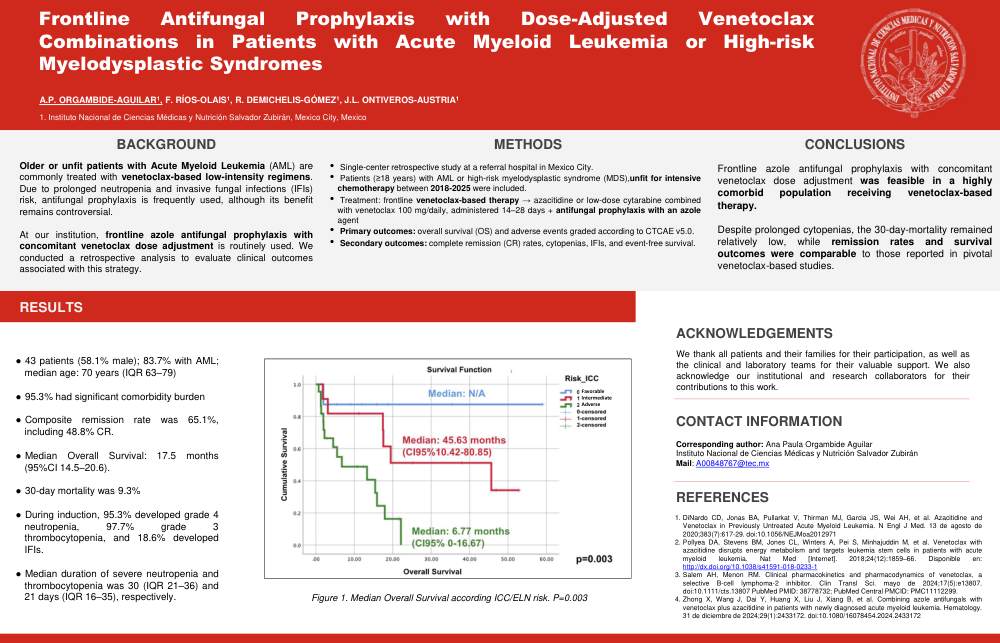
Median Overall Survival: 17.5 months (95%CI 14.5–20.6)
30-day mortality was 9.3%
During induction, 95.3% developed grade 4 neutropenia, 97.7% grade 3 thrombocytopenia, and 18.6% developed IFIs.
Median duration of severe neutropenia and thrombocytopenia was 30 (IQR 21–36) and 21 days (IQR 16–35), respectively.
ACKNOWLEDGEMENTS
We thank all patients and their families for their participation, as well as the clinical and laboratory teams for their valuable support. We also acknowledge our institutional and research collaborators for their contributions to this work.
CONTACT INFORMATION
Corresponding author: Ana Paula Orgambide Aguilar
Instituto Nacional de Ciencias Médicas y Nutrición Salvador Zubirán
Mail: A00848767@tec.mx
REFERENCES
-
DiNardo CD, Jonas BA, Pullarkat V, Thirman MJ, Garcia JS, Wei AH, et al. Azacitidine and Venetoclax in Previously Untreated Acute Myeloid Leukemia. N Engl J Med. 13 de agosto de 2020;383(7):617-29. doi:10.1056/NEJMoa2012971
-
Pollyea DA, Stevens BM, Jones CL, Winters A, Pei S, Minhajuddin M, et al. Venetoclax with azacitidine disrupts energy metabolism and targets leukemia stem cells in patients with acute myeloid leukemia. Nat Med [Internet]. 2018;24(12):1859–66. Disponible en:http://dx.doi.org/10.1038/s41591-018-0233-1
-
Salem AH, Menon RM. Clinical pharmacokinetics and pharmacodynamics of venetoclax, a selective B-cell lymphoma-2 inhibitor. Clin Transl Sci. mayo de 2024;17(5):e13807. doi:10.1111/cts.13807 PubMed PMID: 38778732; PubMed Central PMCID: PMC11112299.
-
Zhong X, Wang J, Dai Y, Huang X, Liu J, Xiang B, et al. Combining azole antifungals with venetoclax plus azacitidine in patients with newly diagnosed acute myeloid leukemia. Hematology. 31 de diciembre de 2024;29(1):2433172. doi:10.1080/16078454.2024.2433172