1,267 posters, 47 videos, 13 topics, 4 sessions, 853 authors
ePostersLive by SciGen Technologies S.A. All rights reserved.
SOHO 2026 Annual Meeting
September 9 - 12, 2026 | George R. Brown Convention Center, Houston, Texas

AML - 1608
Age-Stratified Survival Trends in Acute Myeloid Leukemia Before and After Venetoclax Adoption: A Comprehensive Population-Level and Real-World Analysis
Poster Presenter
Authors
Part of Topic
Acute Myeloid Leukemia (AML)
Age-Stratified Survival Trends in Acute Myeloid Leukemia Before and After Venetoclax Adoption: A Comprehensive Population-Level and Real-World Analysis
Outcomes in older adults with acute myeloid leukemia (AML) have historically been poor because many are ineligible for intensive chemotherapy. The 2018 approval of venetoclax plus hypomethylating agents (VEN+HMA) substantially changed AML treatment, but the population-level survival benefit across age groups remains incompletely defined.
This study evaluated the age-stratified impact of VEN+HMA adoption on population-level overall survival and real-world outcomes in adults with AML. A retrospective, age-stratified comparative effectiveness analysis was performed using SEER and real-world electronic health record data. Adults diagnosed with AML between 2000 and 2022 were included. The pre-venetoclax era (2016–2018) was compared with the post-venetoclax era (2019–2021), with analyses stratified by age 18–59 years and ≥60 years. VEN+HMA was compared with intensive chemotherapy (7+3) or HMA monotherapy. Outcomes included 3-year and median overall survival, 1-year all-cause mortality, and complete remission.
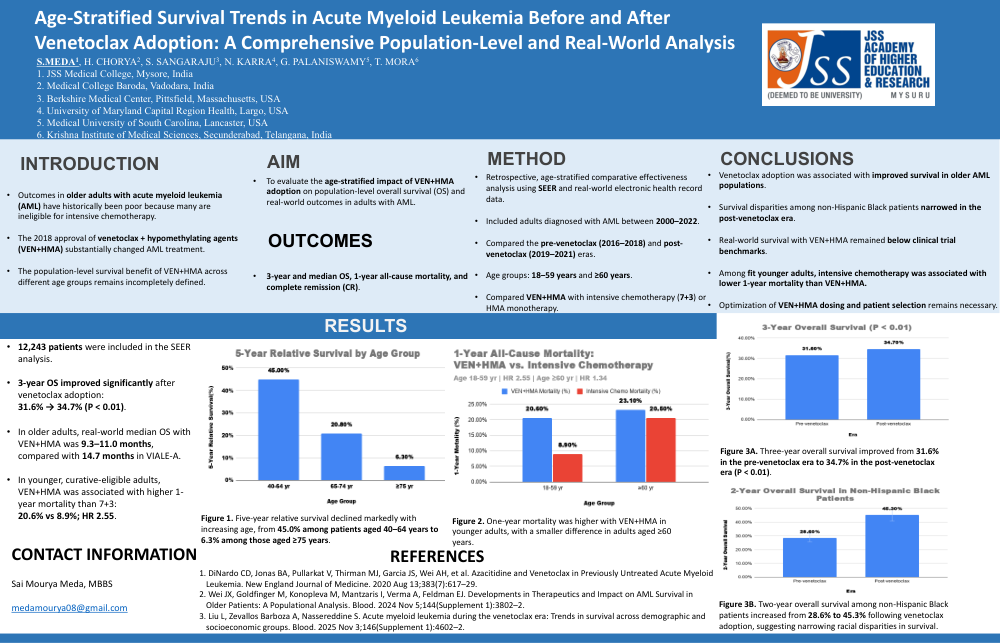
A total of 12,243 patients were included in the SEER analysis. Three-year overall survival improved significantly after venetoclax adoption from 31.6% to 34.7% (P < 0.01). In older adults, real-world median overall survival with VEN+HMA was 9.3–11.0 months compared with 14.7 months in VIALE-A. In younger, curative-eligible adults, VEN+HMA was associated with higher 1-year mortality than 7+3 chemotherapy (20.6% vs 8.9%; HR 2.55). Five-year relative survival declined markedly with increasing age, from 45.0% among patients aged 40–64 years to 6.3% among those aged ≥75 years. Two-year overall survival among non-Hispanic Black patients increased from 28.6% to 45.3% following venetoclax adoption.
Venetoclax adoption was associated with improved survival in older AML populations, while survival disparities among non-Hispanic Black patients narrowed in the post-venetoclax era. Real-world survival with VEN+HMA remained below clinical-trial benchmarks. Among fit younger adults, intensive chemotherapy was associated with lower 1-year mortality than VEN+HMA. Optimization of VEN+HMA dosing and patient selection remains necessary.