1,267 posters, 47 videos, 13 topics, 4 sessions, 853 authors
ePostersLive by SciGen Technologies S.A. All rights reserved.
SOHO 2026 Annual Meeting
September 9 - 12, 2026 | George R. Brown Convention Center, Houston, Texas

AML - 1580
Racial and Ethnic Disparities in Acute Myeloid Leukemia Survival Following Multivariable Adjustment: A SEER Database Analysis (2000-2022)
Poster Presenter
Authors
Part of Topic
Acute Myeloid Leukemia (AML)
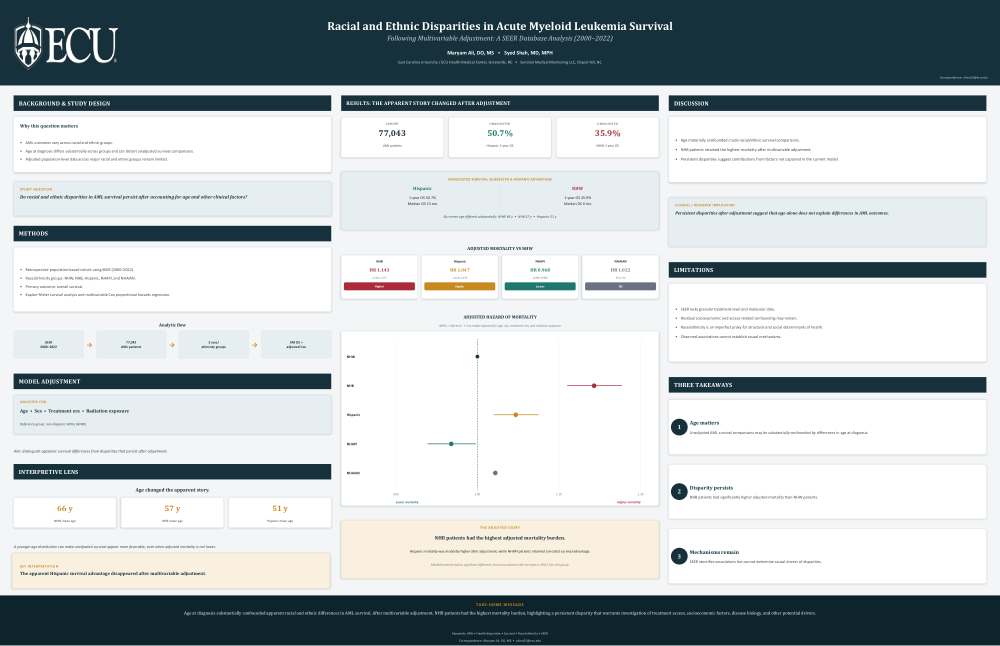
Acute myeloid leukemia (AML) outcomes vary across racial and ethnic groups, but differences in age at diagnosis may substantially influence unadjusted survival comparisons. We evaluated 77,043 patients with AML in the SEER database from 2000–2022 to determine whether racial and ethnic disparities in overall survival persisted after multivariable adjustment.
Unadjusted analyses suggested a marked survival advantage among Hispanic patients compared with non-Hispanic White (NHW) patients, with 1-year overall survival of 50.7% versus 35.9% and median survival of 13 versus 6 months, respectively. However, substantial differences in age at diagnosis were observed: mean age was 66 years among NHW patients, 57 years among non-Hispanic Black (NHB) patients, and 51 years among Hispanic patients.
After adjustment for age, sex, treatment era, and radiation exposure, the apparent Hispanic survival advantage disappeared. Compared with NHW patients, NHB patients had the highest adjusted mortality (HR 1.143, 95% CI 1.110–1.177), while Hispanic patients also had modestly higher mortality (HR 1.047, 95% CI 1.020–1.075). Non-Hispanic Asian/Pacific Islander patients demonstrated modestly lower mortality (HR 0.968, 95% CI 0.939–0.998), while mortality among non-Hispanic American Indian/Alaska Native patients was not significantly different (HR 1.022; P=0.714).
These findings demonstrate that age confounding can substantially alter apparent racial and ethnic differences in AML survival. Importantly, the persistence of excess mortality among NHB patients after adjustment suggests that age alone does not explain observed disparities. Further investigation of treatment access, socioeconomic factors, disease biology, and other potential drivers of inequitable AML outcomes is warranted.