1,267 posters, 47 videos, 13 topics, 4 sessions, 853 authors
ePostersLive by SciGen Technologies S.A. All rights reserved.
SOHO 2026 Annual Meeting
September 9 - 12, 2026 | George R. Brown Convention Center, Houston, Texas

CLL - 1511
Real-World Overall Survival, Richter's Transformation, and Secondary Primary Malignancy Rates in CLL being treated with Fixed-Duration Venetoclax-Based Therapy vs. Indefinite BTK Inhibitor Monotherapy: A TriNetX Propensity-Matched Analysis
Poster Presenter
Authors
Part of Topic
Chronic Lymphocytic Leukemia (CLL)
Introduction:
The CLL treatment landscape is defined by two dominant targeted therapy paradigms: fixed-duration venetoclax-based combinations (venetoclax + obinutuzumab or ofatumumab; Ven-O/Ofa) and indefinite BTK inhibitor (BTKi) monotherapy (ibrutinib, acalabrutinib, zanubrutinib, pirtobrutinib). Real-world comparative data on overall survival (OS), Richter’s transformation (RT), and secondary primary malignancy (SPM) rates across both paradigms remain limited.
Methods:
Using the TriNetX federated research network (112 healthcare organizations), we identified adults with CLL (ICD-10: C91.1; diagnosed January 1990–May 2026) treated with Ven-O/Ofa without BTKi exposure (Cohort 1; n=1,276) or BTKi monotherapy without venetoclax or anti-CD20 therapy (Cohort 2; n=11,549). The index event was initiation of the qualifying regimen. Outcomes were analyzed over 5 years from index. Propensity score matching (1:1) was performed on age, sex, race, diabetes, hyperlipidemia, hypertension, ischemic heart disease, cerebrovascular disease, CKD, liver cirrhosis, and chronic lower respiratory disease, yielding 1,273 patients per arm. Primary outcome was OS by Kaplan-Meier analysis with Cox regression. Secondary outcomes included RT (C83.3x, C85.1x, C85.2x, C85.8x, C88.0) and SPM rates; ie. MDS/AML, lung, prostate, and skin cancer (BCC/SCC), excluding patients with prior SPM.
Results:
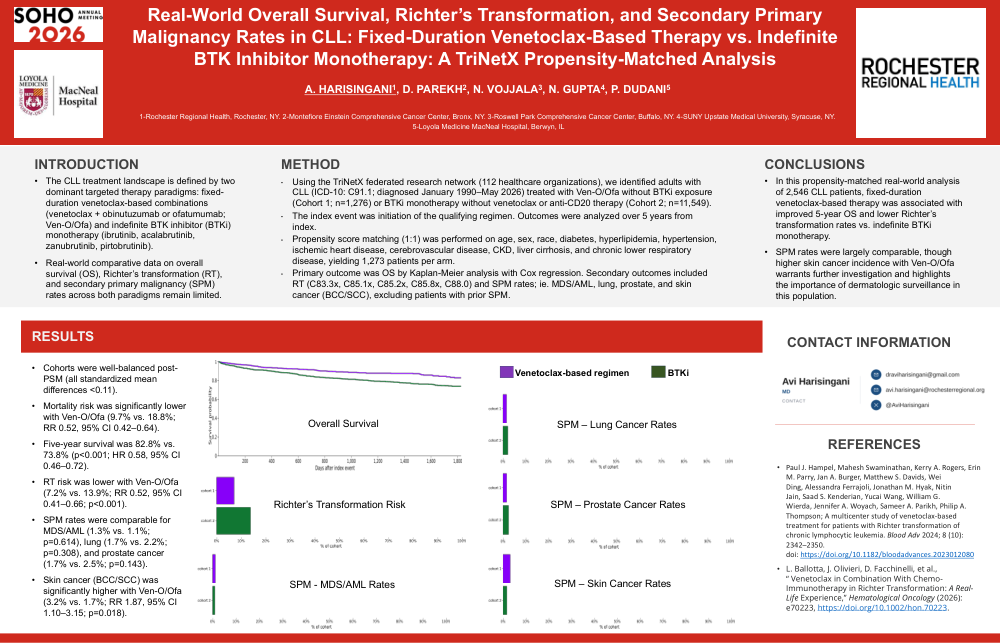
Cohorts were well-balanced post-PSM (all standardized mean differences <0.11). Mortality risk was significantly lower with Ven-O/Ofa (9.7% vs. 18.8%; RR 0.52, 95% CI 0.42–0.64). Five-year survival was 82.8% vs. 73.8% (p<0.001; HR 0.58, 95% CI 0.46–0.72). RT risk was lower with Ven-O/Ofa (7.2% vs. 13.9%; RR 0.52, 95% CI 0.41–0.66; p<0.001). SPM rates were comparable for MDS/AML (1.3% vs. 1.1%; p=0.614), lung (1.7% vs. 2.2%; p=0.308), and prostate cancer (1.7% vs. 2.5%; p=0.143). Skin cancer (BCC/SCC) was significantly higher with Ven-O/Ofa (3.2% vs. 1.7%; RR 1.87, 95% CI 1.10–3.15; p=0.018).
Conclusions:
In this propensity-matched real-world analysis of 2,546 CLL patients, fixed-duration venetoclax-based therapy was associated with improved 5-year OS and lower Richter’s transformation rates vs. indefinite BTKi monotherapy. SPM rates were largely comparable, though higher skin cancer incidence with Ven-O/Ofa warrants further investigation and highlights the importance of dermatologic surveillance in this population.