1,267 posters, 47 videos, 13 topics, 4 sessions, 853 authors
ePostersLive by SciGen Technologies S.A. All rights reserved.
SOHO 2026 Annual Meeting
September 9 - 12, 2026 | George R. Brown Convention Center, Houston, Texas

AML - 1464
Molecular Subtype-Specific Risk of Subsequent Acute Myeloid Leukemia Following Breast Cancer: A Population-Based SEER Analysis
Poster Presenter
Authors
Part of Topic
Acute Myeloid Leukemia (AML)
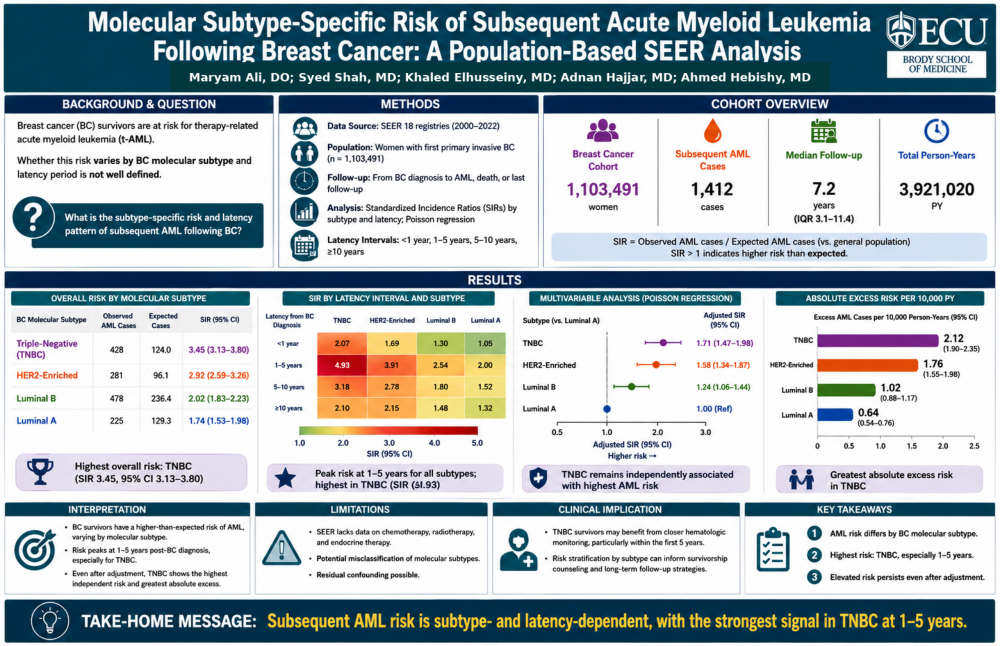
Breast cancer survivors are at increased risk for subsequent acute myeloid leukemia (AML), but whether this risk varies by breast cancer molecular subtype and latency is not well defined.
Using SEER data from 2000–2022, we evaluated 1,103,491 women with a first primary invasive breast cancer and identified 1,412 subsequent AML cases. Standardized incidence ratios (SIRs) were assessed by molecular subtype and latency interval, with multivariable Poisson regression used to compare risk across subtypes.
AML risk differed substantially by breast cancer subtype. Triple-negative breast cancer (TNBC) demonstrated the highest overall risk (SIR 3.45, 95% CI 3.13–3.80), followed by HER2-enriched (SIR 2.92, 95% CI 2.59–3.26), Luminal B (SIR 2.02, 95% CI 1.83–2.23), and Luminal A disease (SIR 1.74, 95% CI 1.53–1.98). Risk peaked 1–5 years after breast cancer diagnosis across all subtypes and was greatest among patients with TNBC (SIR 4.93). After multivariable adjustment, TNBC remained independently associated with the highest AML risk. TNBC also demonstrated the greatest absolute excess risk at 2.12 additional AML cases per 10,000 person-years.
These findings demonstrate that subsequent AML risk after breast cancer is both subtype- and latency-dependent, with the strongest signal among TNBC survivors during the first 1–5 years after diagnosis. Molecular subtype may therefore help inform risk-adapted survivorship counseling and future studies evaluating strategies for hematologic surveillance.