1,267 posters, 47 videos, 13 topics, 4 sessions, 853 authors
ePostersLive by SciGen Technologies S.A. All rights reserved.
SOHO 2026 Annual Meeting
September 9 - 12, 2026 | George R. Brown Convention Center, Houston, Texas

IBCL - 1459
Validation of Baseline Total Metabolic Tumor Volume (TMTV) and Total Lesion Glycolysis (TLG) as Predictors of Early Progression (POD24) in Follicular Lymphoma: A Retrospective Study of 100 Patients in Brazil
Poster Presenter
Authors
Part of Topic
Indolent B-Cell Lymphoma (IBCL)
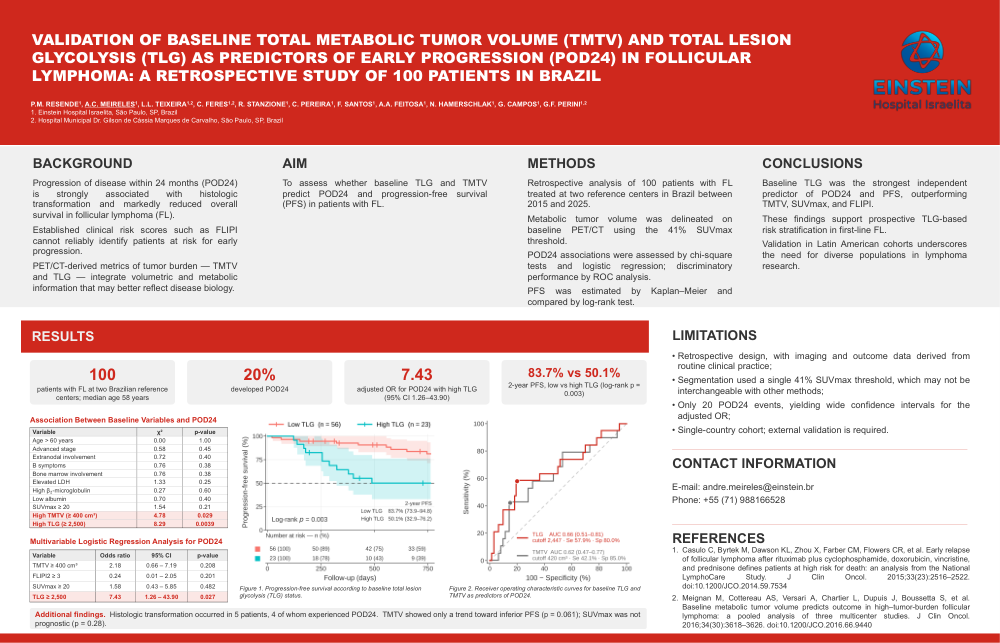
Background: Progression of disease within 24 months (POD24) is strongly associated with histologic transformation and markedly reduced overall survival in follicular lymphoma (FL). Established clinical risk scores such as FLIPI cannot reliably identify patients at risk for early progression. Quantitative PET/CT-derived parameters, including total metabolic tumor volume (TMTV) and total lesion glycolysis (TLG), integrate volumetric and metabolic information that may better reflect disease biology. Validation of these biomarkers in Latin American populations, systematically underrepresented in lymphoma research, is needed.
Objective: To assess whether baseline TLG and TMTV predict POD24 and progression-free survival in FL patients.
Methods: We conducted a retrospective analysis of 100 patients with FL at two reference centers in Brazil between 2015 and 2025. Metabolic tumor volume was delineated using the 41%-SUVmax threshold. POD24 associations were assessed by chi-square tests and logistic regression; discriminatory performance was evaluated by ROC analysis. PFS was estimated by Kaplan-Meier and compared by log-rank test.
Results: Median age was 58 years and POD24 occurred in 20% of patients. Histologic transformation occurred in 5 patients, 4 of whom experienced POD24. On univariate analysis, both high TMTV (cutoff 400 cm³; p=0.029) and high TLG (p=0.0039) were significantly associated with POD24, while FLIPI, SUVmax, stage, LDH, and beta-2 microglobulin were not. On multivariable logistic regression, only high TLG remained independently associated with POD24 (adjusted OR 7.43; 95% CI 1.26 to 43.90; p=0.027). ROC analysis yielded AUC 0.66 for TLG (cutoff 2,447 units; sensitivity 80%, specificity 58%) and AUC 0.62 for TMTV. PFS analysis demonstrated early and sustained separation by TLG status (log-rank p=0.003): 2-year PFS was 83.7% (95% CI 73.9 to 94.8) versus 50.1% (95% CI 32.9 to 76.2). TMTV showed only a trend toward inferior PFS (p=0.061); SUVmax was not prognostic (p=0.28).
Conclusions: In one of the first Latin American series to validate PET-derived tumor burden metrics in FL, baseline TLG was the strongest independent predictor of POD24 and PFS, outperforming TMTV, SUVmax, and FLIPI. These findings support prospective TLG-based risk stratification in first-line FL and underscore the need for diverse populations in lymphoma research.