1,267 posters, 47 videos, 13 topics, 4 sessions, 853 authors
ePostersLive by SciGen Technologies S.A. All rights reserved.
SOHO 2026 Annual Meeting
September 9 - 12, 2026 | George R. Brown Convention Center, Houston, Texas

MM - 1417
Real-World Comparative Survival and Hospitalization Outcomes After CAR-T Relapse in Relapsed/Refractory Multiple Myeloma: Bispecific Antibodies Versus Conventional Chemotherapy
Poster Presenter
Authors
Part of Topic
Multiple Myeloma (MM)
Title:
Real-World Comparative Survival and Hospitalization Outcomes After CAR-T Relapse in Relapsed/Refractory Multiple Myeloma: Bispecific Antibodies Versus Conventional Chemotherapy
Background:
B-cell maturation antigen (BCMA)–directed chimeric antigen receptor T-cell (CAR-T) therapy has significantly improved outcomes in relapsed/refractory multiple myeloma (RRMM). However, a substantial proportion of patients ultimately relapse, and optimal treatment strategies in the post–CAR-T setting remain undefined. Bispecific antibodies (BsAbs) targeting BCMA or GPRC5D and conventional chemotherapy (cCT) regimens are commonly used salvage approaches. Existing retrospective studies suggest overall response rates ranging from 30–60% for BsAbs and 13–69% for cCT, though direct comparative real-world effectiveness data remain limited.
Objective:
To compare overall survival (OS) and hospitalization rates among patients with RRMM treated with BsAbs versus cCT following relapse or progression after BCMA-directed CAR-T therapy.
Methods:
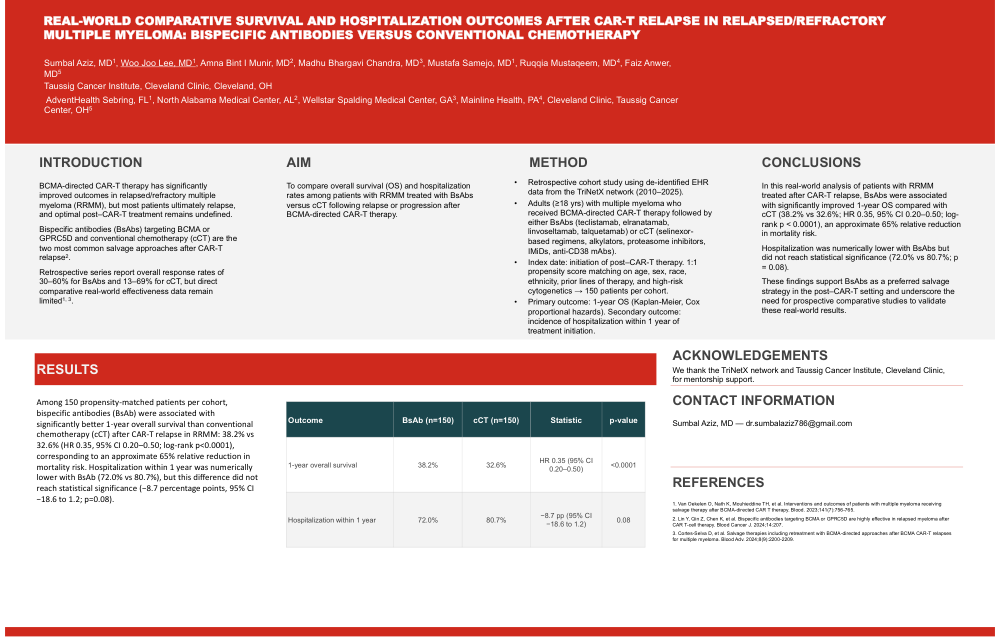
We conducted a retrospective cohort study using de-identified electronic health record data from the TriNetX network (2010–2025). Adult patients (≥18 years) with multiple myeloma who received BCMA-directed CAR-T therapy followed by either BsAbs (teclistamab, elranatamab, linvoseltamab, talquetamab) or cCT (including selinexor-based regimens, alkylators, proteasome inhibitors, immunomodulatory agents, and anti-CD38 monoclonal antibodies) were included. The index date was defined as initiation of post–CAR-T therapy. Propensity score matching (1:1) was performed based on age, sex, race, ethnicity, prior lines of therapy, and high-risk cytogenetic features, yielding 150 patients per cohort. The primary outcome was 1-year OS, assessed using Kaplan-Meier methods and Cox proportional hazards models. The secondary outcome was incidence of hospitalization within 1 year of treatment initiation.
Results:
After matching, 150 patients were included in each cohort. At 1 year, OS probability was higher in the BsAb group compared with the cCT group (38.2% vs 32.6%; log-rank p < 0.0001). Treatment with BsAbs was associated with a significantly reduced hazard of death (HR 0.35, 95% CI 0.20–0.50), corresponding to an approximate 65% relative reduction in mortality risk.Hospitalization within 1 year occurred in 72.0% of patients receiving BsAbs and 80.7% receiving cCT (difference −8.7 percentage points; 95% CI −18.6 to 1.2; p = 0.08), which did not reach statistical significance.
Conclusions:
In this real-world analysis of patients with RRMM treated after CAR-T relapse, BsAbs were associated with significantly improved OS compared with cCT, with a numerically lower but not statistically significant rate of hospitalization. These findings support the use of BsAbs in the post– CAR-T setting and underscore the need for prospective comparative studies to validate these results