1,267 posters, 47 videos, 13 topics, 4 sessions, 853 authors
ePostersLive by SciGen Technologies S.A. All rights reserved.
SOHO 2026 Annual Meeting
September 9 - 12, 2026 | George R. Brown Convention Center, Houston, Texas

CLL - 1401
Rare Intersections: Two Cases Illustrating the Immune Complexity of Chronic Lymphocytic Leukemia Associated With Paraneoplastic Pemphigus With Ocular Involvement and Temozolomide-Induced Autoimmune Cytopenias in Concurrent Lymphoproliferative Disease
Poster Presenter
Authors
Part of Topic
Chronic Lymphocytic Leukemia (CLL)
RARE INTERSECTIONS: TWO CASES ILLUSTRATING THE IMMUNE COMPLEXITY OF CHRONIC LYMPHOCYTIC LEUKEMIA (CLL) ASSOCIATED WITH PARANEOPLASTIC PEMPHIGUS WITH OCULAR DEVASTATION AND TEMOZOLOMIDE-INDUCED AUTOIMMUNE CYTOPENIAS IN CONCURRENT LYMPHOPROLIFERATIVE DISEASE.
R. RUIZ VEGA, O. BORJA-MONTES, O. BISHR, J. BURCHER, M. AL-NAZER, M. TARIQ.
University of Florida, Gainesville, Florida, USA
INTRODUCTION
Chronic lymphocytic leukemia (CLL) creates a uniquely dysregulated immune environment capable of
precipitating catastrophic paraneoplastic and treatment- related autoimmune sequelae that extend well beyond conventional hematologic management. We present two cases that together expose critical, underrecognized vulnerabilities at the interface of CLL and immune- mediated end-organ injury, each highlighting distinct but complementary lessons for the hematology and oncology community.
CASE 1
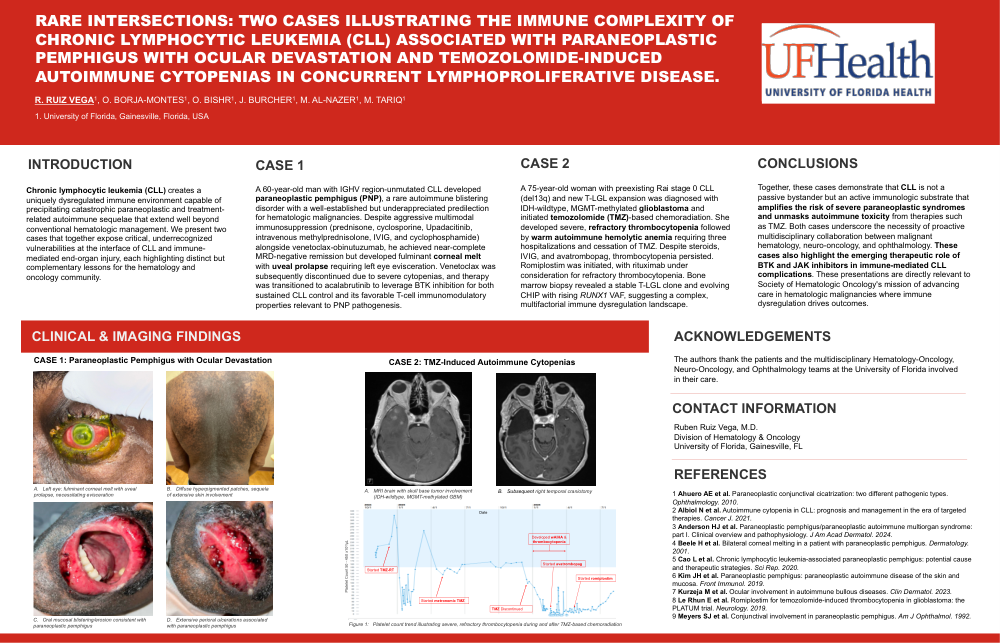
A 60-year-old man with IGHV region-unmutated CLL developed paraneoplastic pemphigus (PNP), a rare autoimmune blistering
disorder with a well-established but underappreciated predilection for hematologic malignancies. Despite aggressive multimodal immunosuppression (prednisone, cyclosporine, Upadacitinib, intravenous methylprednisolone, IVIG, and cyclophosphamide) alongside venetoclax-obinutuzumab, he achieved near-complete MRD-negative remission but developed fulminant corneal melt with uveal prolapse requiring left eye evisceration. Venetoclax was subsequently discontinued due to severe cytopenias, and therapy was transitioned to acalabrutinib to leverage BTK inhibition for both sustained CLL control and its favorable T-cell immunomodulatory properties relevant to PNP pathogenesis.
CASE 2
A 75-year-old woman with preexisting Rai stage 0 CLL (del13q) and new T-LGL expansion was diagnosed with IDH-wildtype, MGMT-methylated glioblastoma and initiated temozolomide (TMZ)-based chemoradiation. She developed severe, refractory thrombocytopenia followed by warm autoimmune hemolytic anemia requiring three hospitalizations and cessation of TMZ. Despite steroids, IVIG, and avatrombopag, thrombocytopenia persisted. Romiplostim was initiated, with rituximab under consideration for refractory thrombocytopenia. Bone marrow biopsy revealed a stable T-LGL clone and evolving CHIP with rising RUNX1 VAF, suggesting a complex, multifactorial immune dysregulation landscape.
CONCLUSIONS
Together, these cases demonstrate that CLL is not a passive bystander but an active immunologic substrate that amplifies the risk of severe paraneoplastic syndromes and unmasks autoimmune toxicity from therapies such as TMZ. Both cases underscore the necessity of proactive multidisciplinary collaboration between malignant hematology, neuro-oncology, and ophthalmology. These cases also highlight the emerging therapeutic role of BTK and JAK inhibitors in immune-mediated CLL complications. These presentations are directly relevant to Society of Hematologic Oncology's mission of advancing care in hematologic malignancies where immune dysregulation drives outcomes.
CLINICAL & IMAGING FINDINGS
CASE 1: Paraneoplastic Pemphigus with Ocular Devastation
CASE 2: TMZ-Induced Autoimmune Cytopenias
ACKNOWLEDGEMENTS
The authors thank the patients and the multidisciplinary Hematology-Oncology, Neuro-Oncology, and Ophthalmology teams at the University of Florida involved in their care.
CONTACT INFORMATION
Ruben Ruiz Vega, M.D.
Division of Hematology & Oncology University of Florida, Gainesville, FL
REFERENCES
1 Ahuero AE et al. Paraneoplastic conjunctival cicatrization: two different pathogenic types. Ophthalmology. 2010.
2 Albiol N et al. Autoimmune cytopenia in CLL: prognosis and management in the era of targeted therapies. Cancer J. 2021.
3 Anderson HJ et al. Paraneoplastic pemphigus/paraneoplastic autoimmune multiorgan syndrome: part I. Clinical overview and pathophysiology. J Am Acad Dermatol. 2024.
4 Beele H et al. Bilateral corneal melting in a patient with paraneoplastic pemphigus. Dermatology. 2001.
5 Cao L et al. Chronic lymphocytic leukemia-associated paraneoplastic pemphigus: potential cause and therapeutic strategies. Sci Rep. 2020.
6 Kim JH et al. Paraneoplastic pemphigus: paraneoplastic autoimmune disease of the skin and mucosa. Front Immunol. 2019.
7 Kurzeja M et al. Ocular involvement in autoimmune bullous diseases. Clin Dermatol. 2023.
8 Le Rhun E et al. Romiplostim for temozolomide-induced thrombocytopenia in glioblastoma: the PLATUM trial. Neurology. 2019.
9 Meyers SJ et al. Conjunctival involvement in paraneoplastic pemphigus. Am J Ophthalmol. 1992.