1,267 posters, 47 videos, 13 topics, 4 sessions, 853 authors
ePostersLive by SciGen Technologies S.A. All rights reserved.
SOHO 2026 Annual Meeting
September 9 - 12, 2026 | George R. Brown Convention Center, Houston, Texas

MM - 1400
Disseminated Intravascular Coagulation in Multiple Myeloma: A Nationwide Analysis of Mortality, Organ Failure, and Healthcare Utilization
Poster Presenter
Authors
Part of Topic
Multiple Myeloma (MM)
Disseminated intravascular coagulation (DIC) is an uncommon but severe hematologic complication in multiple myeloma (MM). Its impact on in-hospital mortality, clinical complications, and resource utilization remains poorly characterized at a national level.
We aimed to compare outcomes of hospitalized MM patients with and without DIC using a National Inpatient Sample (NIS) database.
Data Source: Cross-sectional analysis of the 2018–2021 NIS, incorporating discharge weights to generate nationally representative estimates.
Study Cohort: Adult hospitalizations (age ≥18 years) with a primary or secondary diagnosis of multiple myeloma (ICD-10-CM C90.0) were identified and stratified by DIC status (D65).
Outcomes: Primary outcomes were in-hospital mortality, LOS, and inflation-adjusted hospital charges. Secondary outcomes included major organ complications, thrombotic and bleeding events, shock, and non-home discharge.
Adjusted Analysis: Survey-weighted regression models adjusted for demographics, admission and hospital characteristics, and relevant comorbidities. Logistic regression was used for binary outcomes and linear regression for continuous outcomes.
Statistical Reporting: Categorical and continuous variables were compared using design-based tests. Results were reported as adjusted odds ratios or β coefficients with 95% CIs. Analyses were performed in R 4.5.0 using the survey package.
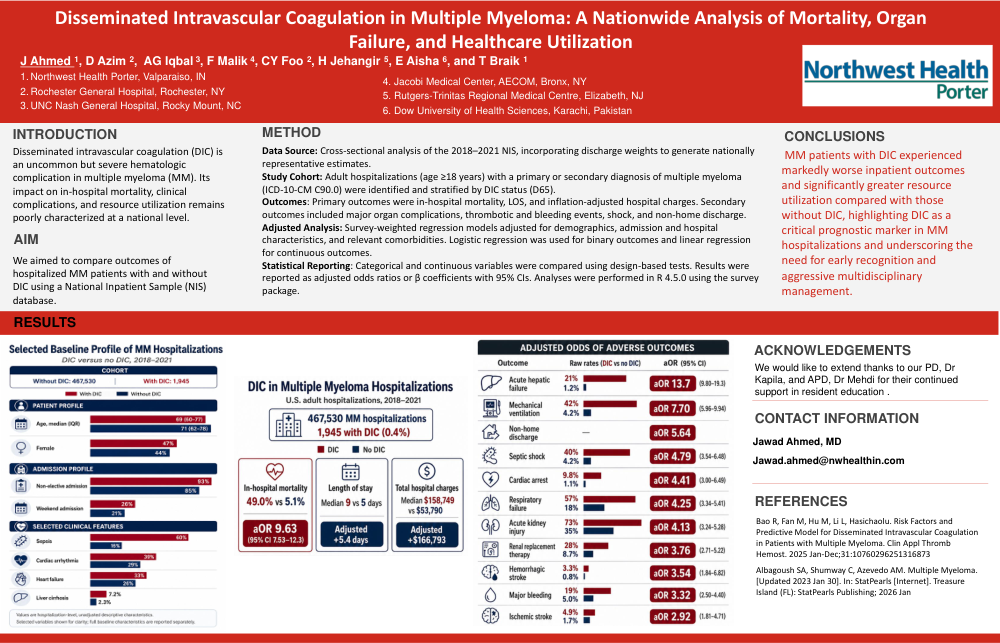
MM patients with DIC experienced markedly worse inpatient outcomes and significantly greater resource utilization compared with those without DIC, highlighting DIC as a critical prognostic marker in MM hospitalizations and underscoring the need for early recognition and aggressive multidisciplinary management.