1,267 posters, 47 videos, 13 topics, 4 sessions, 853 authors
ePostersLive by SciGen Technologies S.A. All rights reserved.
SOHO 2026 Annual Meeting
September 9 - 12, 2026 | George R. Brown Convention Center, Houston, Texas

CLL - 1382
Comparing Ibrutinib With Acalabrutinib and Zanubrutinib in B Cell Malignancies: A Real-World Study of Mortality and Toxicity
Poster Presenter
Authors
Part of Topic
Chronic Lymphocytic Leukemia (CLL)
Title:
Comparing Ibrutinib with Acalabrutinib and Zanubrutinib in B Cell Malignancies: A Real-World Study of Mortality and Toxicity
Authors:
Vidhi Bhanushali, MBBS¹; Urveesh Sharma, MBBS¹; Keshav Garg, MD¹; Arnav Lakkimsetti, MBBS¹; Rhytha Kasiraj, MBBS¹; Sruthi Vellanki, MD²; Ankur Varma, MD, MPH²
Affiliations:
¹ Division of Internal Medicine, University of Arkansas for Medical Sciences, Little Rock, AR, USA
² Division of Hematology–Oncology, University of Arkansas for Medical Sciences, Little Rock, AR, USA
Background:
Covalent Bruton tyrosine kinase (BTK) inhibitors are widely used to treat B cell malignancies. Second-generation BTK inhibitors have demonstrated improved tolerability in clinical trials, but comparative real-world data on mortality and major toxicities remain limited. This study compared mortality and toxicity outcomes with ibrutinib versus acalabrutinib and zanubrutinib.
Methods:
A retrospective cohort study was performed using the TriNetX Global Collaborative Network. Adults with Chronic lymphocytic leukemia, Waldenström macroglobulinemia, or mantle cell lymphoma who received ibrutinib or acalabrutinib/zanubrutinib were included, excluding patients with prior BTK inhibitor exposure. Propensity score matching was used to balance demographics, cardiovascular comorbidities, bleeding risk factors, and anticoagulant or antiplatelet use, yielding 3,804 patients in each cohort. The primary outcome was all-cause mortality. Secondary outcomes included atrial fibrillation or flutter, heart failure, gastrointestinal hemorrhage, acute respiratory failure, emergency endotracheal intubation, arthralgia, myalgia, and other hemorrhage, analyzed with Kaplan–Meier methods and Cox proportional hazards models.
Results:
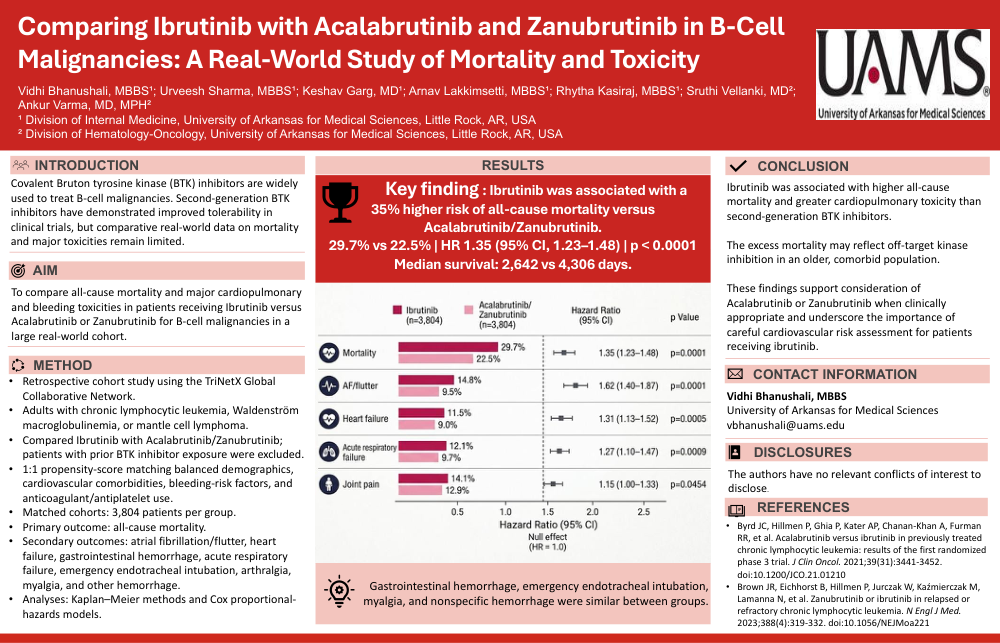
After matching, ibrutinib was associated with higher all-cause mortality than acalabrutinib/zanubrutinib (29.7% vs 22.5%; HR 1.35, 95% CI 1.23 to 1.48; p<0.0001), with shorter median survival and lower survival probability at the end of follow-up. Ibrutinib-treated patients had higher rates of atrial fibrillation or flutter (14.8% vs 9.5%; HR 1.62, 95% CI 1.40 to 1.87; p<0.0001), heart failure (11.5% vs 9.0%; HR 1.31, 95% CI 1.13 to 1.52; p=0.0005), acute respiratory failure (12.1% vs 9.7%; HR 1.27, 95% CI 1.10 to 1.47; p=0.0009), and joint pain (14.1% vs 12.9%; HR 1.15, 95% CI 1.00 to 1.33; p=0.0454). Rates of gastrointestinal hemorrhage, emergency endotracheal intubation, myalgia, and nonspecific hemorrhage were low and did not differ significantly between groups.
Conclusions:
In this large, propensity-matched real-world cohort of patients with B cell malignancies, ibrutinib was associated with higher mortality and greater cardiopulmonary toxicity than acalabrutinib and zanubrutinib. The excess mortality with ibrutinib may reflect off-target kinase inhibition and the resulting burden of atrial fibrillation, heart failure, and respiratory complications in an older, comorbid population. These findings support preferential use of second-generation BTK inhibitors when feasible and underscore the need for careful cardiovascular risk assessment in patients receiving ibrutinib.
Keywords: B cell malignancies; Bruton tyrosine kinase inhibitor; ibrutinib; acalabrutinib; zanubrutinib; mortality; cardiotoxicity;