1,267 posters, 47 videos, 13 topics, 4 sessions, 853 authors
ePostersLive by SciGen Technologies S.A. All rights reserved.
SOHO 2026 Annual Meeting
September 9 - 12, 2026 | George R. Brown Convention Center, Houston, Texas

IBCL - 1337
Epidemiology and Hospital Utilization in Peripheral T-Cell Lymphoma: A Retrospective Study From National Inpatient Sample 2023
Poster Presenter
Authors
Part of Topic
Indolent B-Cell Lymphoma (IBCL)
Introduction
Peripheral T-cell lymphomas (PTCL) represent a heterogeneous group of non-Hodgkin
lymphomas comprising approximately 10-15% of all NHL cases, characterized by
aggressive clinical behavior and poor prognosis. Despite therapeutic advances
including novel agents and consolidative autologous stem cell transplant, real-world
data on hospitalization patterns, healthcare resource utilization, and outcomes remain
limited.
Aims
The objective of this study was to use National Inpatient Statistics (NIS) 2023 to
evaluate the demographic, epidemiology, and clinical outcome of PTCL.
Methods
This retrospective study utilized the 2023 National Inpatient Sample (NIS) to identify
adult patients (≥18 years) with PTCL using ICD-10-CM codes. Patient demographics,
hospital characteristics, comorbidity burden, treatment patterns, length of stay,
hospitalization costs, and in-hospital mortality were analyzed. Multivariable logistic and
linear regression models identified predictors of clinical outcomes and healthcare
utilization. Analyses incorporated NIS discharge weights to generate national estimates.
Results
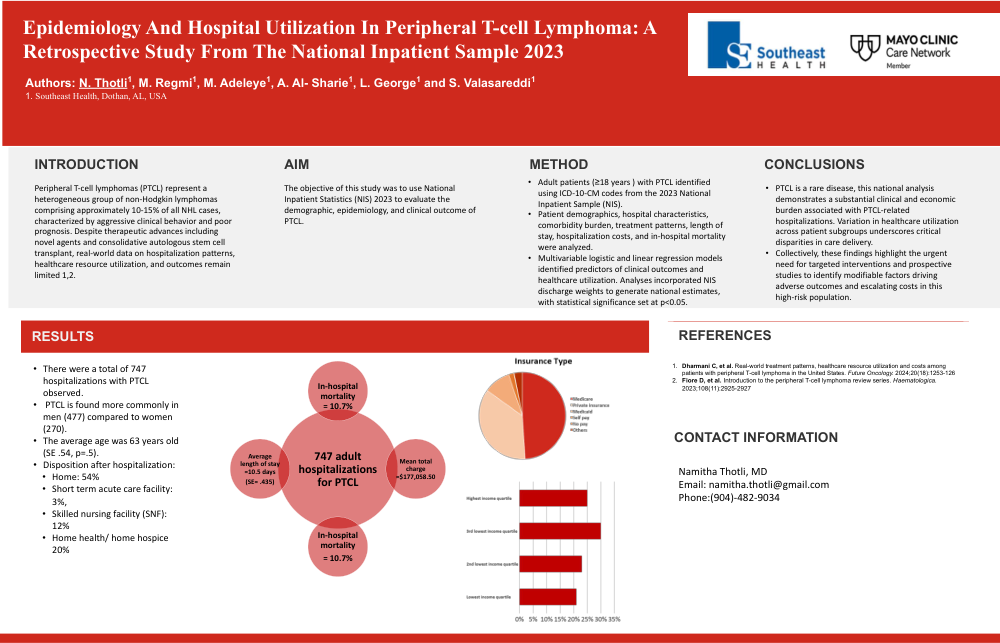
There were a total of 747 hospitalizations with PTCL observed. PTCL is found more
commonly in men (477) compared to women (270). The average age was 63 years old
(SE .54, p=.5). Average Length of stay was 10.5 days (SE= .435). In-hospital mortality
was 10.7%. Mean total charge was $177,058.50. Insurance type was Medicare 49%,
Medicaid 10%, private insurance 36%, self pay 2%, no pay .13%, others 3%. Median
household income national quartile showed, lowest income quartile was 21%, 2 nd lowest
income quartile was 23%, 3 rd lowest income quartile was 30%, and the highest income
quartile was 25%, p=.1. Location/status of hospitalizations were rural 3.21%, urban non-
teaching 7%, urban teaching 90%. Disposition of hospitalization were home 54%,
transferred to short term acute care facility, 3%, 12% to skilled nursing facility (SNF),
transferred to home health/ home hospice 20%, left against medical advice .5%.
Conclusion
PTCL is a rare disease, this national analysis demonstrates a substantial clinical and
economic burden associated with PTCL-related hospitalizations. Variation in healthcare
utilization across patient subgroups underscores critical disparities in care delivery.
Collectively, these findings highlight the urgent need for targeted interventions and
prospective studies to identify modifiable factors driving adverse outcomes and
escalating costs in this high-risk population.