1,267 posters, 47 videos, 13 topics, 4 sessions, 853 authors
ePostersLive by SciGen Technologies S.A. All rights reserved.
SOHO 2026 Annual Meeting
September 9 - 12, 2026 | George R. Brown Convention Center, Houston, Texas

MM - 1334
Multiple Myeloma Management in North Africa: Real-World Evidence and Outcomes From a 140 Patient Tunisian Cohort
Poster Presenter
Authors
Part of Topic
Multiple Myeloma (MM)
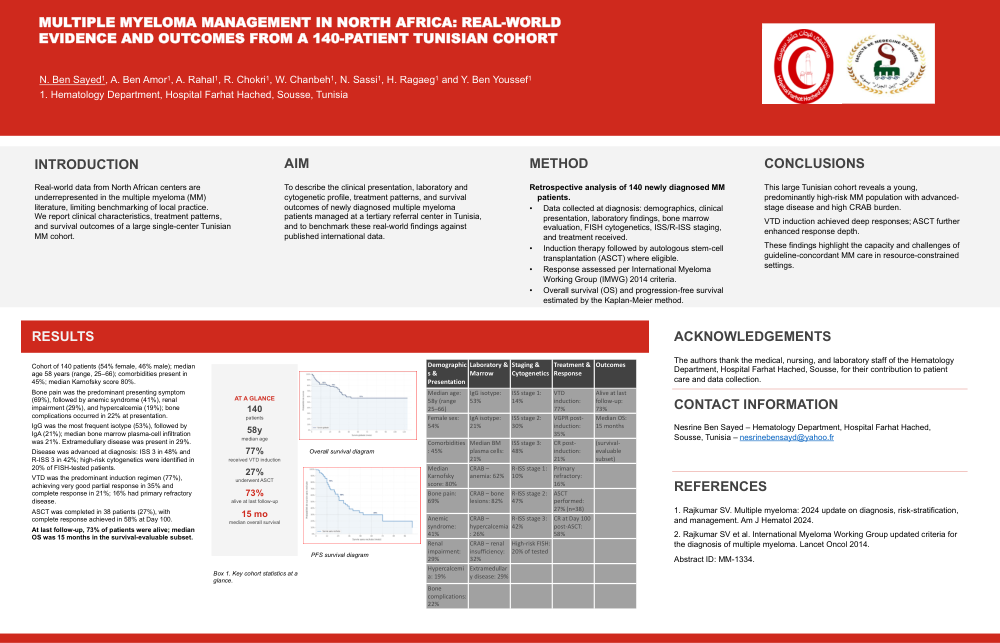
Multiple Myeloma Management in North Africa: Real-World Evidence and Outcomes From a 140-Patient Tunisian Cohort
Nesrine Ben Sayed1 , Ameni Ben Amor1 , Amira Rahal1 , Rouaa Chokri1 , Wafa Chanbeh1 , Nadia Sassi1 , Haifa Ragaeg1 , Yosra Ben Youssef1
1 Hematology Department, Hospital Farhat Hached, Sousse, Tunisia
Abstract Background Real-world data from North African centers are underrepresented in the multiple myeloma (MM) literature, limiting benchmarking of local practice. We report clinical characteristics, treatment patterns, and survival outcomes of a large single-center Tunisian MM cohort.
Methods Retrospective analysis of 140 newly diagnosed MM patients. Data collected at diagnosis included demographics, clinical presentation, laboratory findings, bone marrow evaluation, fluorescence in situ hybridization (FISH), International Staging System (ISS) and revised ISS (R-ISS) staging, and treatment. Induction was followed by autologous stem-cell transplantation (ASCT) where eligible. Response assessed per International Myeloma Working Group 2014. Overall survival (OS) and progression-free survival estimated by Kaplan-Meier.
Results The cohort comprised 140 patients (54% female, 46% male); median age 58 (range, 25–66) years. Comorbidities were present in 45%. Median Karnofsky score was 80%. Bone pain was the predominant presenting symptom (69%), followed by anemic syndrome (41%), renal impairment (29%), and hypercalcemia (19%). Bone complications occurred in 22% at presentation. Immunoglobulin (Ig)G was the most frequent isotype (53%), followed by IgA (21%). Median bone marrow plasma-cell infiltration was 21%. Calcium elevation/renal insufficiency/anemia/ bone lesions (CRAB) criteria included anemia (62%), bone involvement (82%), hypercalcemia (26%), and renal insufficiency (32%). Extramedullary disease was present in 29%. ISS staging: ISS 3 in 48%, ISS 2 in 30%, ISS 1 in 14%. R-ISS staging: R-ISS 3 in 42%, R-ISS 2 in 47%, R-ISS 1 in 10%. High-risk cytogenetics were identified in 20% of FISH-tested patients. Bortezomib-thalidomide-dexamethasone (VTD) was the predominant induction regimen (77%). Post-induction responses included very good partial response in 35%, complete response (CR) in 21%, and primary refractory disease in 16%. ASCT was completed in 38 patients (27%), with CR achieved in 58% at Day 100. At last follow-up, 73% of patients were alive. Median OS was 15 months in the survival-evaluable subset.
Conclusion This large Tunisian cohort reveals a young, predominantly high-risk MM population with advanced-stage disease and high CRAB burden. VTD induction achieved deep responses; ASCT further enhanced response depth. These findings highlight the capacity and challenges of guideline-concordant MM care in resource-constrained settings.
Keywords MM, multiple myeloma, trasplant elligible, age