1,267 posters, 47 videos, 13 topics, 4 sessions, 853 authors
ePostersLive by SciGen Technologies S.A. All rights reserved.
SOHO 2026 Annual Meeting
September 9 - 12, 2026 | George R. Brown Convention Center, Houston, Texas

MM - 1301
NGS Based Assessments of Treatment Response in Patients With Multiple Myeloma Treated With Bispecific T Cell Engagers
Poster Presenter
Authors
Part of Topic
Multiple Myeloma (MM)
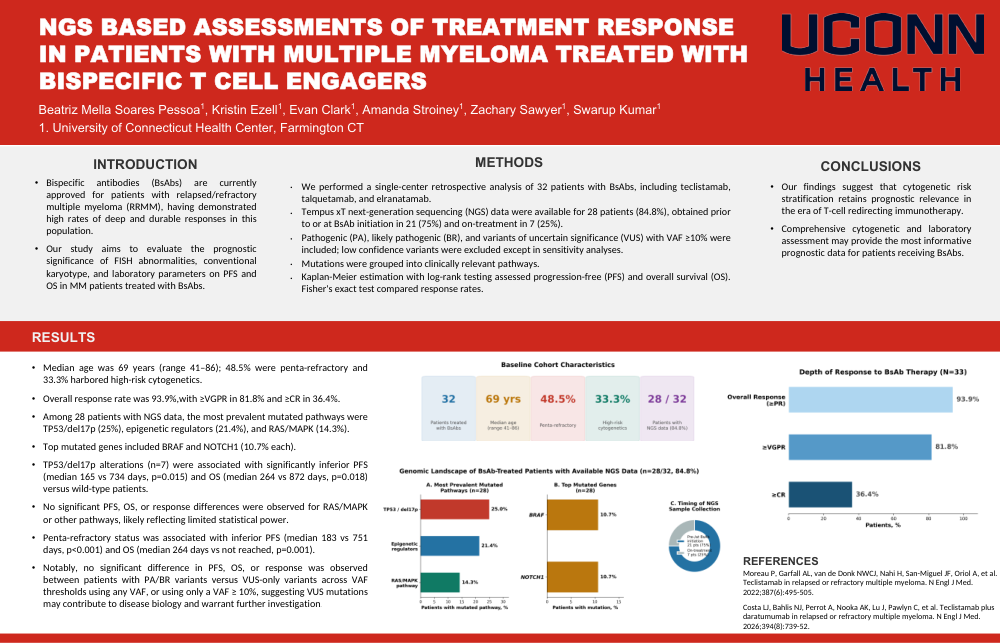
Background: Bispecific antibodies (BsAbs) are currently approved for patients with relapsed/refractory multiple myeloma (RRMM), having demonstrated high rates of deep and durable responses in this population. Our study evaluates the prognostic significance of FISH abnormalities, conventional karyotype, and laboratory parameters on PFS and OS in MM patients treated with BsAbs.
Methods: We performed a single-center retrospective analysis of 32 patients with BsAbs, including teclistamab, talquetamab, and elranatamab. Tempus xT next-generation sequencing (NGS) data were available for 28 patients (84.8%), obtained prior to or at BsAb initiation in 21 (75%) and on-treatment in 7 (25%). Pathogenic (PA), likely pathogenic (BR), and variants of uncertain significance (VUS) with VAF ≥10% were included; low confidence variants were excluded except in sensitivity analyses. Mutations were grouped into clinically relevant pathways. Kaplan-Meier estimation with log-rank testing assessed progression-free (PFS) and overall survival (OS). Fisher's exact test compared response rates.
Results: Median age was 69 years (range 41–86); 48.5% were penta-refractory and 33.3% harbored high-risk cytogenetics. Overall response rate was 93.9%,with ≥VGPR in 81.8% and ≥CR in 36.4%. Among 28 patients with NGS data,the most prevalent mutated pathways were TP53/del17p (25%), epigenetic regulators (21.4%), and RAS/MAPK (14.3%); top mutated genes included BRAF and NOTCH1 (10.7% each). TP53/del17p alterations (n=7) were associated with significantly inferior PFS (median 165 vs 734 days, p=0.015) and OS (median 264 vs 872 days, p=0.018) versus wild-type patients. No significant PFS, OS, or response differences were observed for RAS/MAPK or other pathways, likely reflecting limited statistical power. Penta-refractory status was associated with inferior PFS (median 183 vs 751 days, p<0.001) and OS (median 264 days vs not reached, p=0.001). Notably, no significant difference in PFS, OS, or response was observed between patients with PA/BR variants versus VUS-only variants across VAF thresholds using any VAF, or using only a VAF ≥ 10%, suggesting VUS mutations may contribute to disease biology and warrant further investigation.
Conclusions: Our findings suggest that cytogenetic risk stratification retains prognostic relevance in the era of T-cell redirecting immunotherapy. Comprehensive cytogenetic and laboratory assessment may provide the most informative prognostic data for patients receiving BsAbs.