1,267 posters, 47 videos, 13 topics, 4 sessions, 853 authors
ePostersLive by SciGen Technologies S.A. All rights reserved.
SOHO 2026 Annual Meeting
September 9 - 12, 2026 | George R. Brown Convention Center, Houston, Texas

MM - 1300
Facial Palsy Reports With BCMAΧCD3 and GPRC5DΧCD3 Bispecific Antibodies in Relapsed/Refractory Multiple Myeloma: A FAERS Disproportionality Analysis
Poster Presenter
Authors
Part of Topic
Multiple Myeloma (MM)
Facial Palsy Reports With BCMA×CD3 and GPRC5D×CD3 Bispecific Antibodies In Relapsed/Refractory Multiple Myeloma: A FAERS Disproportionality Analysis
Mohammad Awadallah¹, Mohannad Wahdan², Mimith Mohan John³, Renusri Ede⁴, Izuchukwu Anaesiuba⁵, Sajida Bella6
INTRODUCTION:
BCMA and GPRC5D are two distinct transmembrane receptor proteins that are often expressed at high levels on the surface of malignant plasma cells.
BCMAxCD3 and GPRC5DxCD3 are bispecific antibodies that engage T-cells to malignant plasma cells; these agents have been approved for refractory/relapsed multiple myeloma (RRMM).
Neurotoxicity, particularly ICANS, is a well-recognized adverse effect secondary to these agents; however, facial palsy, as a discrete cranial neuropathy, has not been specifically reported in trial safety data.
A 2024 Elranatamab case series described 3 incidences of lower motor neuron facial palsy preceding severe neurologic toxicity
AIM:
To evaluate facial palsy reporting signals associated with BCMA×CD3 and GPRC5D×CD3-directed bispecific antibodies in the FAERS database
DISCUSSION:
Prior FAERS searches identified broad neurologic signals—including ICANS and neurotoxicity—however, it did not report facial palsy as a discrete signal; our event-specific analysis therefore refines the neuologic safety phenotype (Zhou et al. 2025).
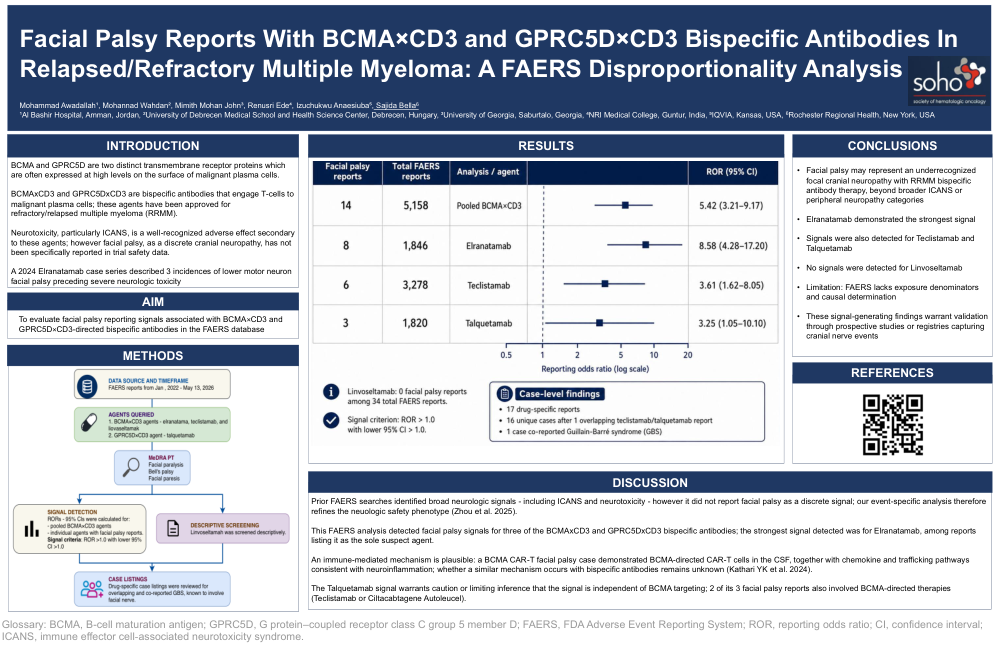
This FAERS analysis detected facial palsy signals for three of the BCMAxCD3 and GPRC5DxCD3 bispecific antibodies; the strongest signal detected was for Elranatamab, among reports listing it as the sole suspect agent.
An immune-mediated mechanism is plausible: a BCMA CAR-T facial palsy case demonstrated BCMA-directed CAR-T cells in the CSF, together with chemokine and trafficking pathways consistent with neuroinflammation; whether a similar mechanism occurs with bispecific antibodies remains unknown (Kathari YK et al. 2024).
The Talquetamab signal warrants caution or limiting inference that the signal is independent of BCMA targeting; 2 of its 3 facial palsy reports also involved BCMA-directed therapies (Teclistamab or Ciltacabtagene Autoleucel).
CONCLUSIONS
•Facial palsy may represent an underrecognized focal cranial neuropathy with RRMM bispecific antibody therapy, beyond broader ICANS or peripheral neuropathy categories.
•Elranatamab demonstrated the strongest signal.
•Signals were also detected for Teclistamab and Talquetamab.
•No signals were detected for Linvoseltamab.
•Limitation: FAERS lacks exposure denominators and causal determination.
•These signal-generating findings warrant validation through prospective studies or registries capturing cranial nerve events.