1,267 posters, 47 videos, 13 topics, 4 sessions, 853 authors
ePostersLive by SciGen Technologies S.A. All rights reserved.
SOHO 2026 Annual Meeting
September 9 - 12, 2026 | George R. Brown Convention Center, Houston, Texas

AML - 1292
DNMT3A as an Epigenetic Scaffold in Acute Myeloid Leukemia: Synergistic Mutational Landscapes and Therapeutic Implications
Poster Presenter
Authors
Part of Topic
Acute Myeloid Leukemia (AML)
Background: Acute myeloid leukemia (AML) is a genetically heterogeneous hematologic malignancy in which recurrent molecular abnormalities influence prognosis. The somatic mutation of DNMT3A, primarily affecting the R882 hotspot, induces a dominant-negative effect on de novo DNA methylation, leading to focal hypomethylation and hematopoietic stem cell expansion. In acute myeloid leukemia (AML), the interplay between this epigenetic "landscaping" mutation and proliferative "driver" mutations dictates clinical resistance and therapeutic opportunities.
Materials and Methods: Ten AML patients (median age 62) underwent profiling via a 32-gene somatic myeloid panel on a Genemind Genolab M Analyzer. Raw FASTQ reads underwent Trimmomatic QC and BWA-MEM alignment to hg19. GATK was used for quality recalibration and duplicate marking. Variant calling utilized a MuTect2/VarScan2 pipeline (limit of detection: 2% VAF). Annotation via Ensembl VEP filtered germline polymorphisms against gnomAD v4.1.0. Pathogenicity followed AMP/ASCO/CAP and ClinGen/CGC/VICC consensus.
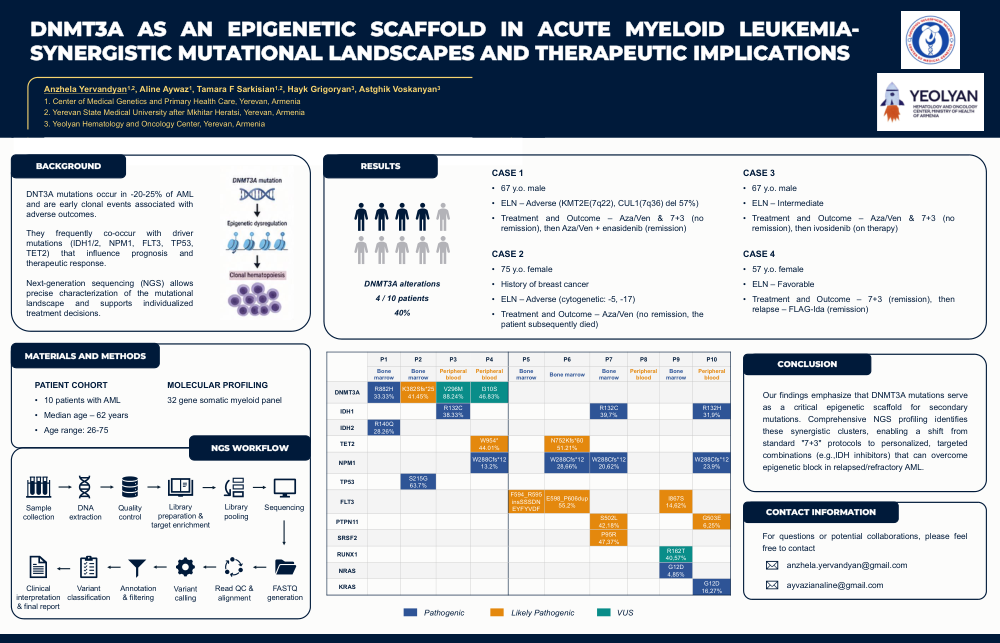
Results: DNMT3A mutations occurred in 40% (n=4) of the cohort, illustrating distinct epigenetic-proliferative synergies:
- Epigenetic-Metabolic Interaction: Patient 1 (DNMT3A, p.R882H, VAF33.33%) and Patient 3 (DNMT3A, VUS, p.V296M, VAF88.24%) both harbored co-occurring IDH2 (p.R140Q, VAF28.26%), IDH1 (p.R132C, VAF38.33%), respectively. This "double-epigenetic hit" creates a profound differentiation block. In Patient 1, the identification of IDH2 allowed for a triple-combination therapy (Aza/Ven + Enasidenib), successfully achieving clinical remission after intensive chemotherapy failure. Patient 4 exhibited a multi-hit epigenetic landscape (DNMT3A, VUS, p.I310S, VAF46,83%) (TET2, likely pathogenic, p.W954*, VAF44,01%) alongside an NPM1 insertion (p.W288Cfs*12, VAF13.2%) , which correlated with an aggressive clonal relapse 6 months post-remission, requiring FLAG-IDA bridge to allogeneic stem cell transplantation.
- Clonal Priming in t-AML: Patient 2 presented with therapy-related AML (t-AML) following prior cytotoxic breast cancer therapy. NGS revealed TP53 (p.S215G, VAF63.7%) and likely pathogenic DNMT3A frameshift (VAF41.45%) co-occurring with complex cytogenetic deletions (-5, -17), driving primary chemo-refractoriness and disease-associated mortality.
Conclusions: Our findings emphasize that DNMT3A mutations serve as a critical epigenetic scaffold for secondary mutations. Comprehensive NGS profiling identifies these synergistic clusters, enabling a shift from standard "7+3" protocols to personalized, targeted combinations (e.g.,IDH inhibitors) that can overcome epigenetic block in relapsed/refractory AML.