1,267 posters, 47 videos, 13 topics, 4 sessions, 853 authors
ePostersLive by SciGen Technologies S.A. All rights reserved.
SOHO 2026 Annual Meeting
September 9 - 12, 2026 | George R. Brown Convention Center, Houston, Texas

AML - 1273
Hematologic Malignancy Diagnosed During Pregnancy: A Single-Center Retrospective Series
Poster Presenter
Authors
Part of Topic
Acute Myeloid Leukemia (AML)
Video
HEMATOLOGIC MALIGNANCY DIAGNOSED DURING PREGNANCY
A. BOLLA¹, E. SOTO-LANZA¹, R. ASSI¹
¹ Indiana University School of Medicine, Indianapolis, IN
INTRODUCTION
• Hematologic malignancies diagnosed during pregnancy are rare, and evidence guiding treatment remains limited.
• Current guidance generally supports standard disease-directed therapy beyond the first trimester when clinically feasible.
• However, real-world data on treatment during pregnancy and associated maternal, pregnancy, and neonatal outcomes remain limited.
AIM
To evaluate maternal, pregnancy, and neonatal outcomes in patients with hematologic malignancy diagnosed during pregnancy according to receipt of systemic therapy during ongoing pregnancy.
METHODS
• Categorical variables were compared using Fisher’s exact test.
• Continuous variables were compared using parametric or nonparametric testing.
• All analyses are considered exploratory given small sample size.
COHORT
14 Pregnant Patients Diagnosed with Malignancy
Received Systemic Therapy During Pregnancy (6)
AML/APL (2)
Lymphoma (3)
ALL (1)
No Systemic Therapy During Pregnancy (8)
AML/APL (4)
Lymphoma (3)
ALL (1)
Retrospective Cohort, Indiana University, 2004-2026
RESULTS
Figure 1. Gestational Age at Diagnosis
Systemic Therapy: 19.3 weeks
No Systemic Therapy: 12.0 weeks
Table 1. Pregnancy Outcomes by Treatment Strategy
Systemic Therapy (n=6) | No Systemic Therapy (n=8) | p-value
Live Birth | 83.3% | 12.5% | 0.026
Pregnancy Termination | 0.0% | 62.5% | 0.075
Miscarriage/Blighted Ovum | 0.0% | 25.0% | 0.487
Table 2. Neonatal Outcomes by Treatment Strategy*
Systemic Therapy (n=5) | No Systemic Therapy (n=1) | p-value
Preterm Birth | 80.0% | 100.0% | 0.999
Congenital Anomalies | 20.0% | 0.0% | 0.999
NICU Admission | 20.0% | 0.0% | 0.999
*Among 6 live births
Figure 2. Live Birth Rate by Treatment Strategy
Systemic Therapy (n=6): 83%
No Systemic Therapy (n=8): 12.50%
p = 0.026
Table 3. Maternal Disease Outcomes By Treatment
Systemic Therapy (n=6) | No Systemic Therapy (n=8) | p-value
Complete Remission | 66.7% | 100.0% | 0.165
Relapse | 33.3% | 25.0% | 0.999
Death During Follow Up | 33.3% | 50.0% | 0.627
CONCLUSIONS
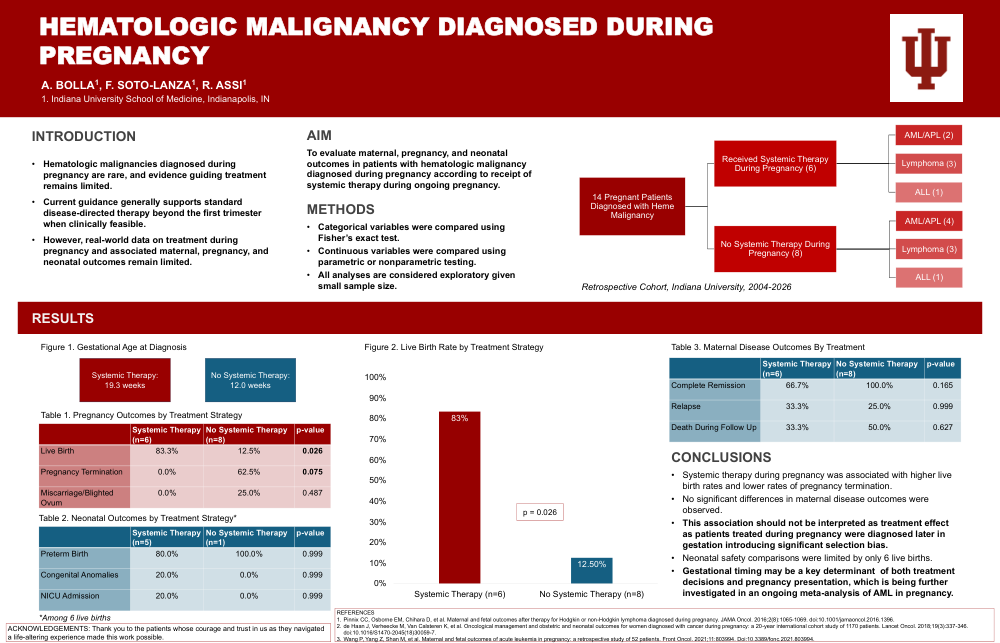
• Systemic therapy during pregnancy was associated with higher live birth rates and lower rates of pregnancy termination.
• No significant differences in maternal disease outcomes were observed.
• This association should not be interpreted as treatment effect as patients treated during pregnancy were diagnosed later in gestation introducing significant selection bias.
• Neonatal safety comparisons were limited by only 6 live births.
• Gestational timing may be a key determinant of both treatment decisions and pregnancy presentation, which is being further investigated in an ongoing meta-analysis of AML in pregnancy.
REFERENCES
- Pinnix CC, Osborne EM, Chihara D, et al. Maternal and fetal outcomes after therapy for Hodgkin or non-Hodgkin lymphoma diagnosed during pregnancy. JAMA Oncol. 2016;2(8):1065-1069. doi:10.1001/jamaoncol.2016.1396.
- de Haan J, Verheecke M, Van Calsteren K, et al. Oncological management and obstetric and neonatal outcomes for women diagnosed with cancer during pregnancy: a 20-year international cohort study of 1170 patients. Lancet Oncol. 2018;19(3):337-346. doi:10.1016/S1470-2045(18)30059-7. S
- Wang P, Yang Z, Shan M, et al. Maternal and fetal outcomes of acute leukemia in pregnancy: a retrospective study of 52 patients. Front Oncol. 2021;11:803994. doi:10.3389/fonc.2021.803994. P
ACKNOWLEDGEMENTS
Thank you to the patients whose courage and trust in us as they navigated a life-altering experience made this work possible.