1,267 posters, 47 videos, 13 topics, 4 sessions, 853 authors
ePostersLive by SciGen Technologies S.A. All rights reserved.
SOHO 2026 Annual Meeting
September 9 - 12, 2026 | George R. Brown Convention Center, Houston, Texas

CML - 1247
Atherothrombotic adverse effects of tyrosine kinase inhibitors in patients with chronic myeloid leukemia
Poster Presenter
Authors
Part of Topic
Chronic Myeloid Leukemia (CML)
Atherothrombotic adverse effects of tyrosine kinase inhibitors in patients with chronic myeloid leukemia
INTRODUCTION
Tyrosine kinase inhibitors (TKI) have significantly improved the prognosis of patients with chronic myeloid leukemia (CML); however, their use is associated with a risk of atherothrombotic adverse effects (ATAE).
AIM
To determine the incidence, profile, and risk factors of ATAE in patients with CML receiving TKI, taking into account cardiovascular (CV) risk stratification.
MATERIALS AND METHODS
159 patients with CML were analyzed. Demographic characteristics, risk categories according to the HFA-ICOS scale and CV risk according to the 2021 European Society of Cardiology (ESC) stratification, TKI therapy, lipid profile, vascular remodeling parameters, and incidence of ATAE were assessed. Predictors of ATAE and event-free survival (EFS) in patients with different CV risk were identified.
RESULTS
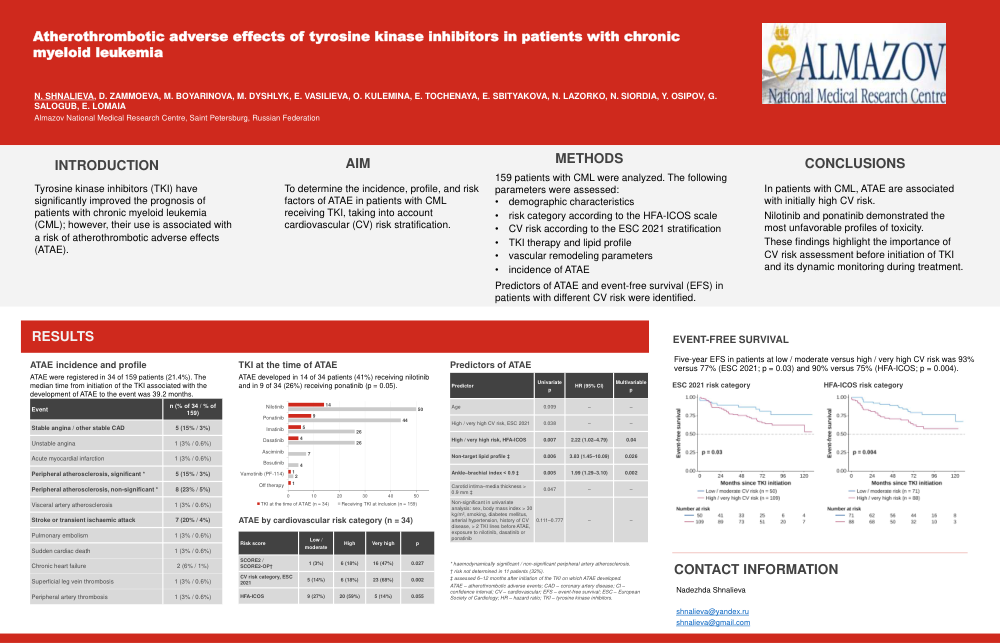
26 patients (16%) were receiving imatinib, 50 (31%) nilotinib, 26 (16%) dasatinib, 4 (3%) bosutinib, 44 (28%) ponatinib, 7 (6%) asciminib, and 2 (1%) vamotinib. ATAE were registered in 34 (21.4%) patients. The median time from initiation of TKI associated with the development of ATAE to the event was 39.2 months. ATAE developed in 14/34 patients (41%) on nilotinib and in 9/34 patients (26%) on ponatinib (p=0.05).
ATAE were significantly more frequent in patients with high and very high risk categories according to the ESC (86%) and HFA-ICOS scale (74%). In univariate analysis, predictors of ATAE included age (p=0.009), ESC and HFA-ICOS risk category (low/moderate vs high/very high risk) (p=0.038 and p=0.007, respectively), failure to achieve target low-density lipoprotein cholesterol (LDL-C) (p=0.006), reduction of the ankle-brachial index (ABI) <0.9 (p=0.005). In the multivariate model, predictors of ATAE included non-target LDL-C (p=0.026), ABI reduction <0.9 (p=0.002), and high/very high HFA-ICOS risk category (p=0.04).
5-year EFS patients with low/moderate and high/very high CV risk (ESC 2021) was 93% and 77% (p=0.03), respectively; 5-year EFS in low/moderate and high/very high risk groups (HFA-ICOS) was 90% and 75% (p=0.004), respectively.
CONCLUSION
In patients with CML, ATAE are associated with initially high CV risk. Nilotinib and ponatinib demonstrated the most unfavorable profiles of toxicity. These findings highlight the importance of CV risk assessment before initiation of TKI and its dynamic monitoring during treatment.