1,267 posters, 47 videos, 13 topics, 4 sessions, 853 authors
ePostersLive by SciGen Technologies S.A. All rights reserved.
SOHO 2026 Annual Meeting
September 9 - 12, 2026 | George R. Brown Convention Center, Houston, Texas

MM - 1232
In-Hospital Outcomes and Resource Utilization of Admissions With Sepsis Across Hematologic Malignancy Subtypes: A National Inpatient Sample Analysis (2016-2022)
Poster Presenter
Authors
Part of Topic
Multiple Myeloma (MM)
Introduction
Sepsis remains a leading cause of in-hospital death, and patients with hematologic malignancies (HM) are among the most vulnerable. Disease-related immune dysfunction, cytotoxic therapy, neutropenia, and indwelling access devices all raise both susceptibility and severity. Despite this, most national sepsis outcome data treat HM as a single category. Whether sepsis carries a different prognostic weight in leukemia versus lymphoma versus plasma cell neoplasm/myeloma, and whether that weight differs when the malignancy is the reason for admission rather than an incidental comorbidity, has not been characterized at scale. Subtype-resolved estimates are needed to target early recognition and escalation protocols to the populations at highest risk.
Aim
To quantify the independent association between sepsis and in-hospital mortality, length of stay (LOS), and total hospital charges among adults hospitalized with hematologic malignancies, and to determine how these associations differ across HM subtypes and by whether the malignancy was the primary admitting diagnosis.
Method
Retrospective cross-sectional analysis of the National Inpatient Sample (2016–2022), the largest all-payer U.S. inpatient database. We identified adult hospitalizations with a hematologic malignancy diagnosis, excluding elective admissions and encounters with hospice or comfort-care designations. Cohorts were built two ways: (leukemia, lymphoma, or plasma cell neoplasm/myeloma in any diagnosis field, defined hierarchically) and primary-diagnosis-only (HM first-listed). Exposure was a coded sepsis diagnosis; outcomes were in-hospital mortality, length of stay, and total charges. Survey-weighted logistic and linear regression; applying NIS discharge weights, strata, and clustering adjusted for age, sex, race/ethnicity, admission year, weekend admission, hospital region, location/teaching status, bed size, primary payer, ZIP income quartile, Charlson Comorbidity Index, and acute MI.
Conclusion
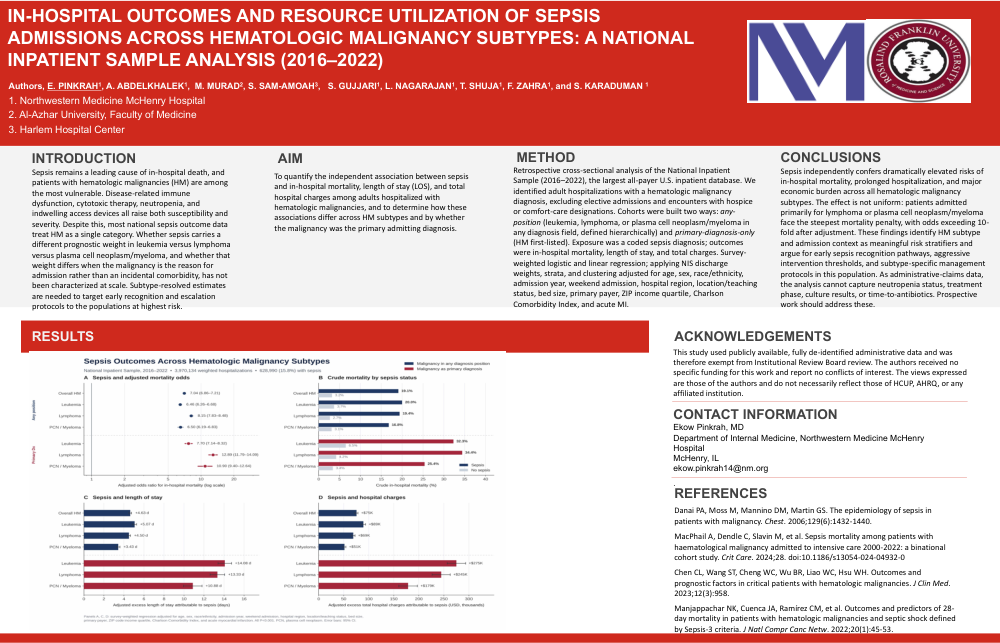
Sepsis independently confers dramatically elevated risks of in-hospital mortality, prolonged hospitalization, and major economic burden across all hematologic malignancy subtypes. The effect is not uniform: patients admitted primarily for lymphoma or plasma cell neoplasm/myeloma face the steepest mortality penalty, with odds exceeding 10-fold after adjustment. These findings identify HM subtype and admission context as meaningful risk stratifiers and argue for early sepsis recognition pathways, aggressive intervention thresholds, and subtype-specific management protocols in this population. As administrative-claims data, the analysis cannot capture neutropenia status, treatment phase, culture results, or time-to-antibiotics. Prospective work should address these.