1,267 posters, 47 videos, 13 topics, 4 sessions, 853 authors
ePostersLive by SciGen Technologies S.A. All rights reserved.
SOHO 2026 Annual Meeting
September 9 - 12, 2026 | George R. Brown Convention Center, Houston, Texas

MPN - 1200
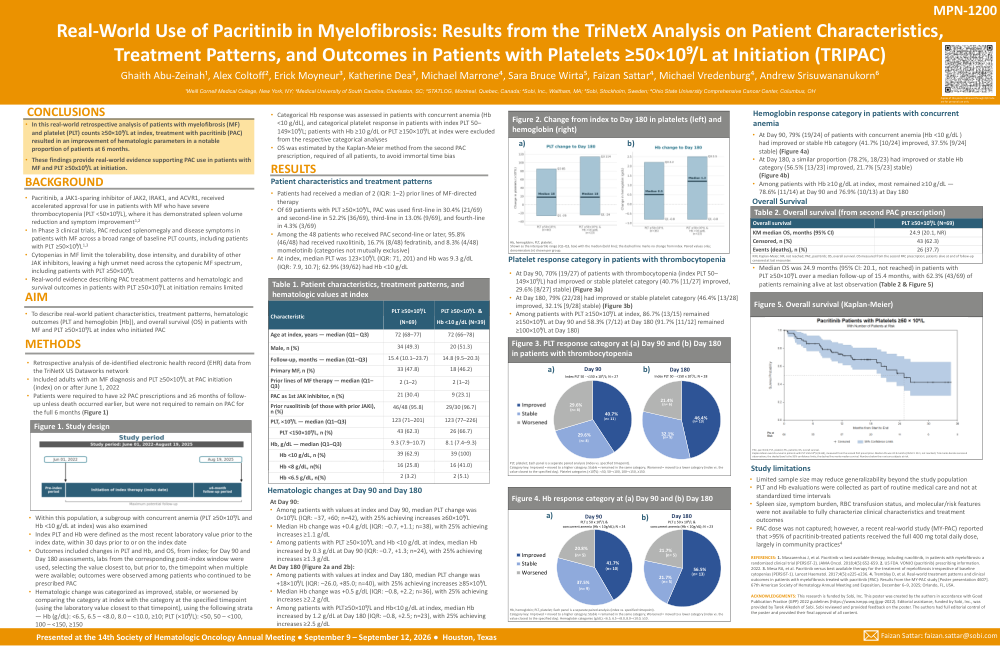
Real-World Use of Pacritinib in Myelofibrosis: Results From the TriNetX Analysis on Patient Characteristics, Treatment Patterns, and Outcomes in Patients With Platelets =50Χ109/L at Initiation (TRIPAC)
Poster Presenter
Authors
Part of Topic
Myeloproliferative Neoplasms (MPN)
Abstract Number: MPN-1200
Real-World Use of Pacritinib in Myelofibrosis: Results from the TriNetX Analysis on Patient Characteristics, Treatment Patterns, and Outcomes in Patients with Platelets ≥50×10⁹/L at Initiation (TRIPAC)
Ghaith Abu-Zeinah¹, Alex Coltoff², Erick Moyneur³, Katherine Dea³, Michael Marrone⁴, Sara Bruce Wirta⁵, Faizan Sattar⁴, Michael Vredenburg⁴, Andrew Srisuwananukorn⁶
¹Weill Cornell Medical College, New York, NY; ²Medical University of South Carolina, Charleston, SC; ³STATLOG, Montreal, Quebec, Canada; ⁴Sobi, Inc., Waltham, MA; ⁵Sobi, Stockholm, Sweden; ⁶Ohio State University Comprehensive Cancer Center, Columbus, OH
Corresponding author: Faizan Sattar — faizan.sattar@sobi.com
Background
- Pacritinib, a JAK1-sparing inhibitor of JAK2, IRAK1, and ACVR1, received accelerated approval for use in patients with MF who have severe thrombocytopenia (PLT <50×10⁹/L), where it has demonstrated spleen volume reduction and symptom improvement.
- In Phase 3 clinical trials, PAC reduced splenomegaly and disease symptoms in patients with MF across a broad range of baseline PLT counts, including patients with PLT ≥50×10⁹/L.
- Cytopenias in MF limit the tolerability, dose intensity, and durability of other JAK inhibitors, leaving a high unmet need across the cytopenic MF spectrum, including patients with PLT ≥50×10⁹/L.
- Real-world evidence describing PAC treatment patterns and hematologic and survival outcomes in patients with PLT ≥50×10⁹/L at initiation remains limited.
Aim
- To describe real-world patient characteristics, treatment patterns, hematologic outcomes (PLT and hemoglobin [Hb]), and overall survival (OS) in patients with MF and PLT ≥50×10⁹/L at index who initiated PAC.
Methods
- Retrospective analysis of de-identified electronic health record (EHR) data from the TriNetX US Dataworks network.
- Included adults with an MF diagnosis and PLT ≥50×10⁹/L at PAC initiation (index) on or after June 1, 2022.
- Patients were required to have ≥2 PAC prescriptions and ≥6 months of follow-up unless death occurred earlier, but were not required to remain on PAC for the full 6 months (Figure 1).
- Within this population, a subgroup with concurrent anemia (PLT ≥50×10⁹/L and Hb <10 g/dL at index) was also examined.
- Index PLT and Hb were defined as the most recent laboratory value prior to the index date, within 30 days prior to or on the index date.
- Outcomes included changes in PLT and Hb, and OS, from index; for Day 90 and Day 180 assessments, labs from the corresponding post-index window were used, selecting the value closest to, but prior to, the timepoint when multiple were available; outcomes were observed among patients who continued to be prescribed PAC.
- Hematologic change was categorized as improved, stable, or worsened by comparing the category at index with the category at the specified timepoint (using the laboratory value closest to that timepoint), using the following strata — Hb (g/dL): <6.5, 6.5–<8.0, 8.0–<10.0, ≥10; PLT (×10⁹/L): <50, 50–<100, 100–<150, ≥150.
- Categorical Hb response was assessed in patients with concurrent anemia (Hb <10 g/dL), and categorical platelet response in patients with index PLT 50–149×10⁹/L; patients with Hb ≥10 g/dL or PLT ≥150×10⁹/L at index were excluded from the respective categorical analyses.
- OS was estimated by the Kaplan-Meier method from the second PAC prescription, required of all patients, to avoid immortal time bias.
Results
Patient characteristics and treatment patterns
- Patients had received a median of 2 (IQR: 1–2) prior lines of MF-directed therapy.
- Of 69 patients with PLT ≥50×10⁹/L, PAC was used first-line in 30.4% (21/69) and second-line in 52.2% (36/69), third-line in 13.0% (9/69), and fourth-line in 4.3% (3/69).
- Among the 48 patients who received PAC second-line or later, 95.8% (46/48) had received ruxolitinib, 16.7% (8/48) fedratinib, and 8.3% (4/48) momelotinib (categories not mutually exclusive).
- At index, median PLT was 123×10⁹/L (IQR: 71, 201) and Hb was 9.3 g/dL (IQR: 7.9, 10.7); 62.9% (39/62) had Hb <10 g/dL.
Hematologic changes at Day 90 and Day 180
At Day 90:
- Among patients with values at index and Day 90, median PLT change was 0×10⁹/L (IQR: −37, +60; n=42), with 25% achieving increases ≥60×10⁹/L.
- Median Hb change was +0.4 g/dL (IQR: −0.7, +1.1; n=38), with 25% achieving increases ≥1.1 g/dL.
- Among patients with PLT ≥50×10⁹/L and Hb <10 g/dL at index, median Hb increased by 0.3 g/dL at Day 90 (IQR: −0.7, +1.3; n=24), with 25% achieving increases ≥1.3 g/dL.
At Day 180 (Figure 2a and 2b):
- Among patients with values at index and Day 180, median PLT change was +18×10⁹/L (IQR: –26.0, +85.0; n=40), with 25% achieving increases ≥85×10⁹/L.
- Median Hb change was +0.5 g/dL (IQR: –0.8, +2.2; n=36), with 25% achieving increases ≥2.2 g/dL.
- Among patients with PLT ≥50×10⁹/L and Hb <10 g/dL at index, median Hb increased by 1.2 g/dL at Day 180 (IQR: –0.8, +2.5; n=23), with 25% achieving increases ≥2.5 g/dL.
Platelet response category in patients with thrombocytopenia
- At Day 90, 70% (19/27) of patients with thrombocytopenia (index PLT 50–149×10⁹/L) had improved or stable platelet category (40.7% [11/27] improved, 29.6% [8/27] stable) (Figure 3a).
- At Day 180, 79% (22/28) had improved or stable platelet category (46.4% [13/28] improved, 32.1% [9/28] stable) (Figure 3b).
- Among patients with PLT ≥150×10⁹/L at index, 86.7% (13/15) remained ≥150×10⁹/L at Day 90 and 58.3% (7/12) at Day 180 (91.7% [11/12] remained ≥100×10⁹/L at Day 180).
Hemoglobin response category in patients with concurrent anemia
- At Day 90, 79% (19/24) of patients with concurrent anemia (Hb <10 g/dL) had improved or stable Hb category (41.7% [10/24] improved, 37.5% [9/24] stable) (Figure 4a).
- At Day 180, a similar proportion (78.2%, 18/23) had improved or stable Hb category (56.5% [13/23] improved, 21.7% [5/23] stable) (Figure 4b).
- Among patients with Hb ≥10 g/dL at index, most remained ≥10 g/dL — 78.6% (11/14) at Day 90 and 76.9% (10/13) at Day 180.
Overall Survival
- Median OS was 24.9 months (95% CI: 20.1, not reached) in patients with PLT ≥50×10⁹/L over a median follow-up of 15.4 months, with 62.3% (43/69) of patients remaining alive at last observation (Table 2 & Figure 5).
Conclusions
- In this real-world retrospective analysis of patients with myelofibrosis (MF) and platelet (PLT) counts ≥50×10⁹/L at index, treatment with pacritinib (PAC) resulted in an improvement of hematologic parameters in a notable proportion of patients at 6 months.
- These findings provide real-world evidence supporting PAC use in patients with MF and PLT ≥50×10⁹/L at initiation.
Study Limitations
- Limited sample size may reduce generalizability beyond the study population.
- PLT and Hb evaluations were collected as part of routine medical care and not at standardized time intervals.
- Spleen size, symptom burden, RBC transfusion status, and molecular/risk features were not available to fully characterize clinical characteristics and treatment outcomes.
- PAC dose was not captured; however, a recent real-world study (MY-PAC) reported that >95% of pacritinib-treated patients received the full 400 mg total daily dose, largely in community practices.
References
- Mascarenhas J, et al. Pacritinib vs best available therapy, including ruxolitinib, in patients with myelofibrosis: a randomized clinical trial (PERSIST-2). JAMA Oncol. 2018;4(5):652-659.
- US FDA. VONJO (pacritinib) prescribing information. 2022.
- Mesa RA, et al. Pacritinib versus best available therapy for the treatment of myelofibrosis irrespective of baseline cytopenias (PERSIST-1). Lancet Haematol. 2017;4(5):e225-e236.
- Tremblay D, et al. Real-world treatment patterns and clinical outcomes in patients with myelofibrosis treated with pacritinib (PAC): Results from the MY-PAC study [Poster presentation 4607]. 67th American Society of Hematology Annual Meeting and Exposition, December 6–9, 2025; Orlando, FL, USA.
Acknowledgements
This research is funded by Sobi, Inc. This poster was created by the authors in accordance with Good Publication Practice (GPP) 2022 guidelines (https://www.ismpp.org/gpp-2022). Editorial assistance, funded by Sobi, Inc., was provided by Tarek Alkedeh of Sobi. Sobi reviewed and provided feedback on the poster. The authors had full editorial control of the poster and provided their final approval of all content.
Presented at the 14th Society of Hematologic Oncology Annual Meeting ● September 9 – September 12, 2026 ● Houston, Texas