1,267 posters, 47 videos, 13 topics, 4 sessions, 853 authors
ePostersLive by SciGen Technologies S.A. All rights reserved.
SOHO 2026 Annual Meeting
September 9 - 12, 2026 | George R. Brown Convention Center, Houston, Texas

IBCL - 1143
Outcomes of Hairy Cell Leukemia in Resource-Constrained Settings: A Retrospective Single-Center Study From Pakistan
Poster Presenter
Authors
Part of Topic
Indolent B-Cell Lymphoma (IBCL)
Back ground: Hairy cell leukemia (HCL) is a rare, chronic B-celldisorder characterized by-progressive pancytopenia, splenomegaly, recurrent
infections, and the accumulation of abnormal Blymphocytes in the bone marrow, spleen, and peripheral blood. Although treatment with purine analogues has
substantially improved remission rates and long-term survival, evidence regarding clinical presentation, treatment patterns, and outcomes remains limited in resource-constrained settings. Local data are therefore needed to better understand disease characteristics, treatment responses, and challenges in patient management.
Aim: This study aimed to comprehensively evaluate the clinical characteristics, patterns of disease presentation, treatment approaches, therapeutic
responses, and treatment-related toxicities among patients with classical hairy cell leukemia treated at a tertiary care center in Pakistan. It also sought to assess long-term outcomes, including progression-free survival (PFS) and over all survival (OS).
Method: This single-center retrospective cohort study included adult patients diagnosed with classical HCL between January 2010 and January 2026.
Diagnosis was established by peripheral blood morphology, flow cytometry, and/or bone marrowbiopsy according to WHO criteria.
Medical records were reviewed for demographic characteristics , ECOG, presenting complaints,baseline hematologic parameters, treatment details, response assessment, toxicities, relapse, and survival outcomes. Statistical analysis was performed using SPSS version 29. We estimated survival outcomes using Kaplan–Meier analysis.
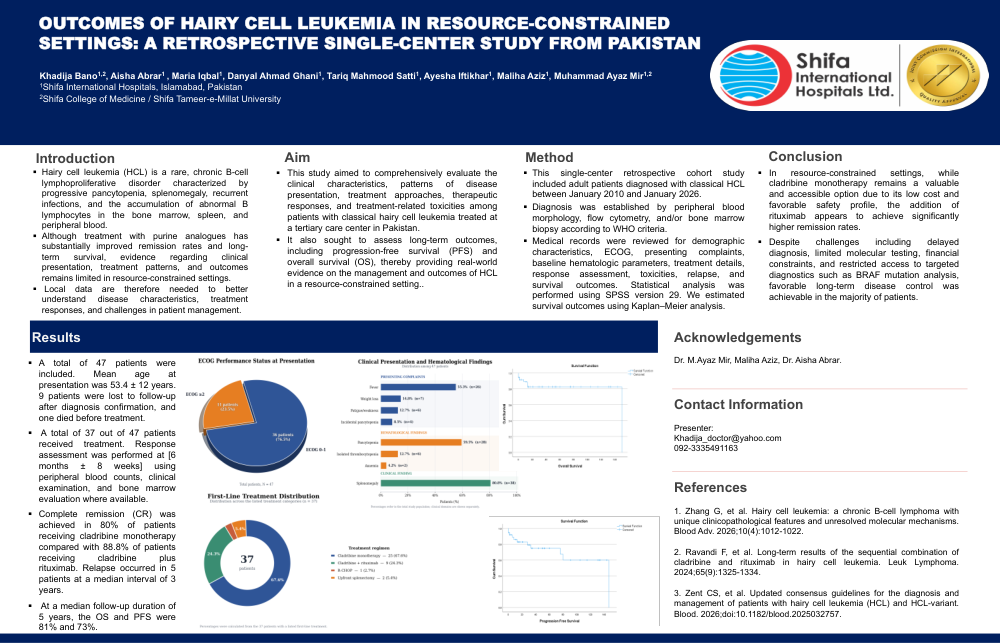
Results: A total of 47 patients were included. Mean age at presentation was 53.4 ± 12 years. 9 patients were lost to follow-up after diagnosis confirmation, and
one died before treatment. A total of 37 out of 47 patients received treatment. Response assessment was performed at [6 months ± 8 weeks] using peripheral blood counts, clinical examination, and bone marrow evaluation where available. Complete remission (CR) was achieved in 80% of patients receiving cladribine mono therapy compared with 88.8% of patients receiving cladribine plus rituximab. Relapse occurred in 5 patients at a median interval of 3 years.
At a median follow-up duration of 5 years, the OS and PFS were 81% and 73%.
Conclusions: In resource-constrained settings, while cladribine monotherapy remains a valuable and accessible option due to its low cost andfavorable safety profile, the addition of rituximab appears to achieve significantly higher remission rates. Despite challenges including delayed diagnosis, limited molecular testing, financial
constraints, and restricted access to targeted diagnostics such as BRAF mutation analysis, favorable long-term disease control was achievable in the majority of patients.