1,267 posters, 47 videos, 13 topics, 4 sessions, 853 authors
ePostersLive by SciGen Technologies S.A. All rights reserved.
SOHO 2026 Annual Meeting
September 9 - 12, 2026 | George R. Brown Convention Center, Houston, Texas

MPN - 1136
Patterns of Clinical Presentation and Outcomes in Polycythemia Vera: A Single-Center Study From a Lower-Middle-Income Country (Pakistan)
Poster Presenter
Authors
Part of Topic
Myeloproliferative Neoplasms (MPN)
Topic:
Patterns of Clinical Presentation and Outcomes in Polycythemia Vera (PV); A Single Centre Study From Lower Middle Income Country, Pakistan
Authors:
Muhammad Fahim, Mehreen Ali Khan, Ammad Akram Ch, Anees ur Rehman, Abdur Rehman
Institute:
Armed Forces Bone Marrow Transplant Centre, Rawalpindi
Background: Polycythemia Vera (PV) is a chronic myeloproliferative neoplasm which features the increased production of red blood cells (RBCs) from abnormal clonal growth of hematopoietic stem cells, causing elevated red cell mass. Janus kinase 2 (JAK 2 V617F) gene mutations have been linked to PV which are seen in over 95% of cases, while Janus kinase-2 (JAK2 Exon 12) genes are present in 2-3% of cases and 1% are un-mutated, leading to aberrant intracellular signaling and clonal hematopoietic proliferation. Data on the clinical presentation and outcomes of PV patients in lower middle-income countries like Pakistan is limited. This study aims to describe the patterns of clinical presentation, laboratory features, and outcomes in patients diagnosed with PV at a single center in Pakistan.
Methods: This was a single-centre, prospective analysis of patients diagnosed with Polycythemia Vera. Data from 34 patients were analyzed for demographic characteristics, clinical symptoms and signs, laboratory parameters (including blood counts and JAK2 mutation status), and treatment outcomes. Descriptive statistics were used to summarize the findings. Survival analysis was performed using the Kaplan-Meier method to estimate overall survival (OS) and progression-free survival (PFS).
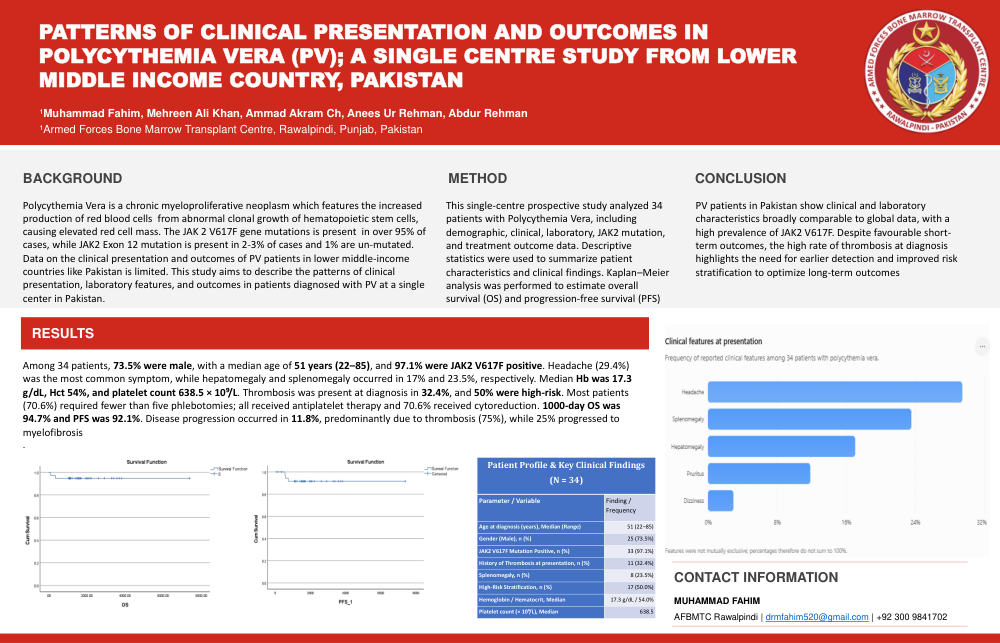
Results: The analysis comprised 34 patients in total. Males were predominant (73.5%) and the median age at diagnosis was 51 years (range 22-85). 97.1% of patients have the JAK2 V617F mutation. Headache (29.4%), pruritus (11.8%) and dizziness (2.9%) were the most frequently reported symptoms. 17 % of patients had hepatomegaly (median liver size 3.35 cm) and 23.5% had splenomegaly (median spleen size 1.76 cm). The median hemoglobin was 17.3 g/dL, hematocrit 54%, and platelet count 638.5 x 10⁹/L. Thrombosis history was present in 32.4% of patients at presentation. Risk stratification placed 50% of patients in the high-risk category. Majority of the patients (70.6%) required fewer than five phlebotomy sessions, while 17.6% and 11.8% required 5–10 and >10 sessions, respectively. All of the patients received antiplatelet and 70.6% patients received cytoreductive therapy as well, while 2.9% each received Jak2 inhibitors and HSCT respectively. The 1000 day overall survival was 94.7 % [Figure 1] and 1000 day progression free survival was 92.1 % [Figure 2], while 4(11.80%) showed progression with 3 (75%) to thrombosis and 1 (25%) to myelofibrosis.
Conclusion: The clinical and laboratory profile of PV patients in our setting from Pakistan is largely similar to global data, with a high prevalence of the JAK2 V617F mutation. A significant proportion of patients present with intermediate to advanced disease features such as splenomegaly and a history of thrombosis. While short-term outcomes appear favorable, the high rate of thrombosis at diagnosis underscores the need for earlier detection and improved risk stratification to optimize management and improve long-term outcomes in this context.