1,267 posters, 47 videos, 13 topics, 4 sessions, 853 authors
ePostersLive by SciGen Technologies S.A. All rights reserved.
SOHO 2026 Annual Meeting
September 9 - 12, 2026 | George R. Brown Convention Center, Houston, Texas

CLL - 1118
Early Outcomes of a Multistakeholder Treatment Access Program for Chronic Lymphocytic Leukemia in Armenia, Ethiopia, and Nepal
Poster Presenter
Authors
Part of Topic
Chronic Lymphocytic Leukemia (CLL)
EARLY OUTCOMES OF A MULTISTAKEHOLDER TREATMENT ACCESS PROGRAM FOR CHRONIC LYMPHOCYTIC LEUKEMIA IN ARMENIA, ETHIOPIA, AND NEPAL
L. Herzog1, A. Annamalay1, K. Meliksetyan2, F. Tadesse3, M. Lama4, M. Ong1, C. Scheepers1, P. Garcia-Gonzalez1
1. The Max Foundation, Seattle, WA, USA
2. Yeolyan Hematology and Oncology Center, Yerevan, Armenia
3. Black Lion Hospital, Addis Ababa, Ethiopia
4. Patan Hospital, Lalitpur, Nepal
CONTEXT
Targeted therapies have transformed outcomes for chronic lymphocytic leukemia (CLL), yet access remains limited in many low- and middle-income countries (LMICs). To address these gaps, The Max Foundation established a multistakeholder treatment access program providing no-cost zanubrutinib, a second-generation Bruton tyrosine kinase inhibitor, to eligible patients in Armenia, Ethiopia, and Nepal.
OBJECTIVE
To describe patient reach, treatment patterns, and early outcomes among enrolled patients.
DESIGN
Retrospective descriptive analysis of routinely collected program data from December 2023 to May 2026. Patient-level data were extracted from The Max Foundation’s Patient Access Tracking System and analyzed descriptively.
SETTING
The program operates in partnership with Yeolyan Hematology and Oncology Center in Armenia, Black Lion Hospital in Ethiopia, and Patan Hospital in Nepal.
PATIENTS
Patients with confirmed CLL diagnosis and approved for program support were included.
CLL Patients Initiating Treatment Through the Program: December 1, 2023 to May 31, 2026
|
|
n |
% |
|
Gender |
||
|
Male |
178 |
58.4 |
|
Female |
127 |
41.6 |
|
Country |
||
|
Armenia |
126 |
41.3 |
|
Ethiopia |
115 |
37.7 |
|
Nepal |
64 |
21.0 |
|
Age group |
||
|
19-49 |
43 |
14.1 |
|
50-59 |
74 |
24.3 |
|
60-69 |
120 |
39.3 |
|
70+ |
68 |
22.3 |
|
Program status* |
||
|
Active in treatment |
250 |
82.0 |
|
Closed |
55 |
18.0 |
|
Lost to follow up |
25 |
8.2 |
|
Passed away |
18 |
5.9 |
|
Clinical reason |
7 |
2.3 |
|
Administrative reason† |
5 |
1.6 |
|
Treatment history |
||
|
Relapsed/refactory |
111 |
36.4 |
|
Treatment naïve |
194 |
63.6 |
*as of May 31, 2026
† does not meet program criteria = 4, review information not provided = 1
INTERVENTION
The program provided no-cost access to zanubrutinib through the Max Access Solutions model. Health system strengthening activities included institutional capacity assessment, importation and supply chain coordination, physician engagement, clinical and pharmacovigilance training, and patient monitoring. A holistic, patient-centered approach addressed treatment needs and social, practical, and emotional factors affecting patients’ ability to start and remain on treatment.
MAIN OUCTOME MEAURES
Outcomes included enrollment, demographic and treatment characteristics, treatment-naïve status, status at last follow-up, time-on treatment, discontinuation, and reasons for closure
where available.
RESULTS
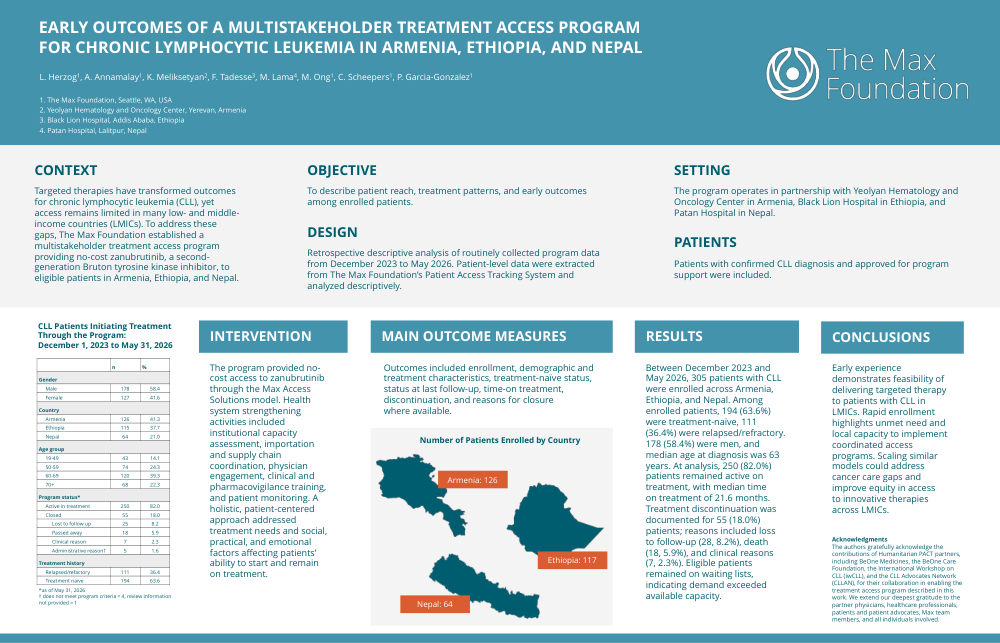
Between December 2023 and May 2026, 305 patients with CLL were enrolled across Armenia, Ethiopia, and Nepal. Among enrolled patients, 194 (63.6%) were treatment-naïve, 111 (36.4%) were relapsed/refractory. 178 (58.4%) were men, and median age at diagnosis was 63 years. At analysis, 250 (82.0%) patients remained active on treatment, with median time
on treatment of 21.6 months. Treatment discontinuation was documented for 55 (18.0%) patients; reasons included loss to follow-up (28, 8.2%), death (18, 5.9%), and clinical reasons (7, 2.3%). Eligible patients remained on waiting lists, indicating demand exceeded available capacity.
CONCLUSIONS
Early experience demonstrates feasibility of delivering targeted therapy to patients with CLL in LMICs. Rapid enrollment highlights unmet need and local capacity to implement coordinated access programs. Scaling similar models could address cancer care gaps and improve equity in access to innovative therapies across LMICs.
Acknowledgments
The authors gratefully acknowledge the contributions of Humanitarian PACT partners, including BeOne Medicines, the BeOne Care Foundation, the International Workshop on CLL (iwCLL), and the CLL Advocates Network (CLLAN), for their collaboration in enabling the treatment access program described in this work. We extend our deepest gratitude to the partner physicians, healthcare professionals, patients and patient advocates, Max team members, and all individuals involved.