1,267 posters, 47 videos, 13 topics, 4 sessions, 853 authors
ePostersLive by SciGen Technologies S.A. All rights reserved.
SOHO 2026 Annual Meeting
September 9 - 12, 2026 | George R. Brown Convention Center, Houston, Texas

MPN - 1106
Hematological Profile in Nonhuman Primates of Epetraborole, a Novel Boron-Containing Candidate for Oral Treatment of Polycythemia Vera
Poster Presenter
Authors
Part of Topic
Myeloproliferative Neoplasms (MPN)
INTRODUCTION:
Polycythemia vera (PV) is a rare, chronic disease with severe and sometimes life‑threatening complications. Deaths may occur due to secondary malignancies or thromboembolic events. PV is a clonal hematopoietic stem cell disorder caused by a Janus kinase 2 (JAK2) mutation leading to the overproduction of red blood cells (RBCs). PV can present as isolated erythrocytosis, leukocytosis, or thrombocytosis or as splenomegaly or myelofibrosis. The current proven risk reduction strategy for PV patients primarily aims to maintain hematocrit (Hct) levels below target thresholds through therapeutic phlebotomy and cytoreductive therapies such as hydroxyurea. However, not all PV patients achieve adequate hematologic control with existing treatment approaches, highlighting the need for additional therapeutic options. Epetraborole (EBO), a novel boron-containing small molecule, specifically decreases erythropoiesis in nonhuman primates (NHPs). This effect, limited to the erythroid cell line, suggests a potential for EBO as a therapeutic agent in treating PV.
METHODS:
A 39-week GLP toxicology study with toxicokinetics and a 4-week recovery period was conducted in healthy male and female NHPs. Oral EBO (0, 50, 150, 450 mg/kg) was administered once daily (QD) to 72 NHPs (n=9/gender/group). NHPs were sacrificed on Days 92 (n=3/gender/group), 274 (n=4/gender/group), and 302 (n=2/gender/group). Standard toxicological parameters were evaluated. For hematology parameters, blood samples were collected at baseline, on dosing Days 26, 88, 180, 271, and at recovery period Day 299. Bone marrow histopathology evaluations were conducted at termination and at the end of the recovery period.
Statistical Analyses: The homogeneity of the group variances was evaluated using the Levene’s test at the 0.05 significance level. If differences between group variances were not found to be significant (p>0.05), then a parametric one-way analysis of variance (ANOVA) was performed. When significant differences among the means were indicated by ANOVA test (p≤0.05), the Dunnett’s test was used to perform the group mean comparisons between the control group and each treated group.
RESULTS:
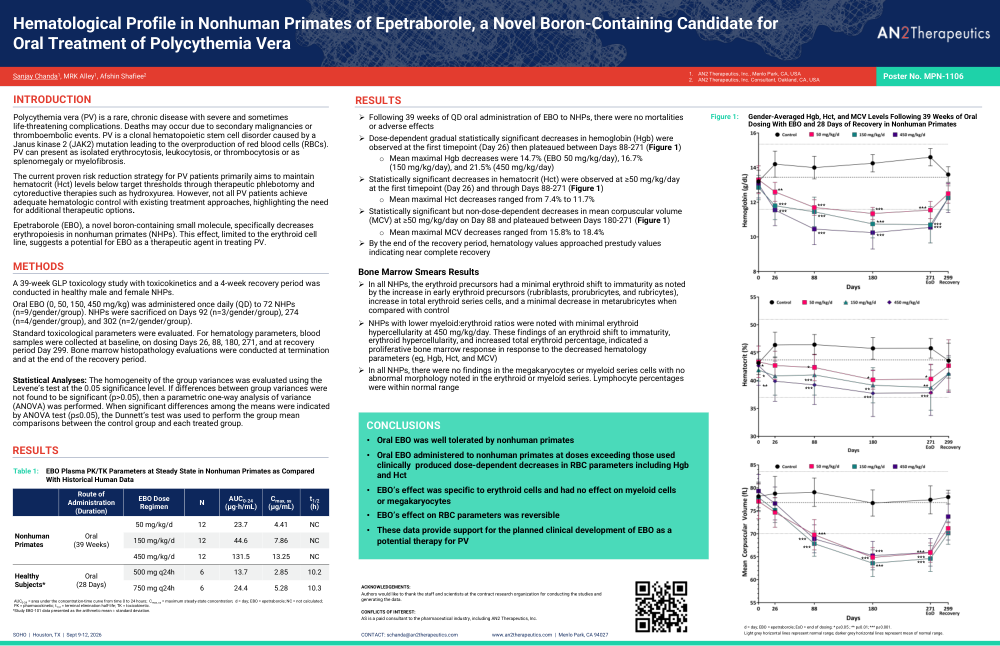
Following 39 weeks of QD oral administration of EBO to NHPs, there were no mortalities or adverse effects. Dose-dependent gradual statistically significant decreases in hemoglobin (Hgb) were observed at the first timepoint (Day 26) then plateaued between Days 88-271 (Figure 1). Mean maximal Hgb decreases were 14.7% (EBO 50 mg/kg/day), 16.7% (150 mg/kg/day), and 21.5% (450 mg/kg/day). Statistically significant decreases in hematocrit (Hct) were observed at ≥50 mg/kg/day at the first timepoint (Day 26) and through Days 88-271 (Figure 1). Mean maximal Hct decreases ranged from 7.4% to 11.7%. Statistically significant but non-dose-dependent decreases in mean corpuscular volume (MCV) at ≥50 mg/kg/day on Day 88 and plateaued between Days 180-271 (Figure 1). Mean maximal MCV decreases ranged from 15.8% to 18.4%. By the end of the recovery period, hematology values approached prestudy values indicating near complete recovery.
Bone Marrow Smears Results: In all NHPs, the erythroid precursors had a minimal erythroid shift to immaturity as noted by the increase in early erythroid precursors (rubriblasts, prorubricytes, and rubricytes), increase in total erythroid series cells, and a minimal decrease in metarubricytes when compared with control. NHPs with lower myeloid:erythroid ratios were noted with minimal erythroid hypercellularity at 450 mg/kg/day. These findings of an erythroid shift to immaturity, erythroid hypercellularity, and increased total erythroid percentage, indicated a proliferative bone marrow response in response to the decreased hematology parameters (eg, Hgb, Hct, and MCV). In all NHPs, there were no findings in the megakaryocytes or myeloid series cells with no abnormal morphology noted in the erythroid or myeloid series. Lymphocyte percentages were within normal range.
CONCLUSIONS:
Oral EBO was well tolerated by nonhuman primates. Oral EBO administered to nonhuman primates at doses exceeding those used clinically produced dose-dependent decreases in RBC parameters including Hgb and Hct. EBO’s effect was specific to erythroid cells and had no effect on myeloid cells or megakaryocytes. EBO’s effect on RBC parameters was reversible. These data provide support for the planned clinical development of EBO as a potential therapy for PV.