1,267 posters, 47 videos, 13 topics, 4 sessions, 853 authors
ePostersLive by SciGen Technologies S.A. All rights reserved.
SOHO 2026 Annual Meeting
September 9 - 12, 2026 | George R. Brown Convention Center, Houston, Texas

MM - 1088
T-Cell Exhaustion-Based Transcriptomic Signature Predicts Multiple Myeloma Survival and Reveals Montelukast as an Immunomodulatory Repositioning Candidate
Poster Presenter
Authors
Part of Topic
Multiple Myeloma (MM)
Background. Despite the transformative impact of BCMA-directed cellular immunotherapies on multiple myeloma (MM), a substantial proportion of patients fail to achieve durable responses. Pre-existing T-cell exhaustion in the bone marrow (BM) niche is increasingly recognised as a contributing factor. We assembled a literature-derived T-cell exhaustion gene
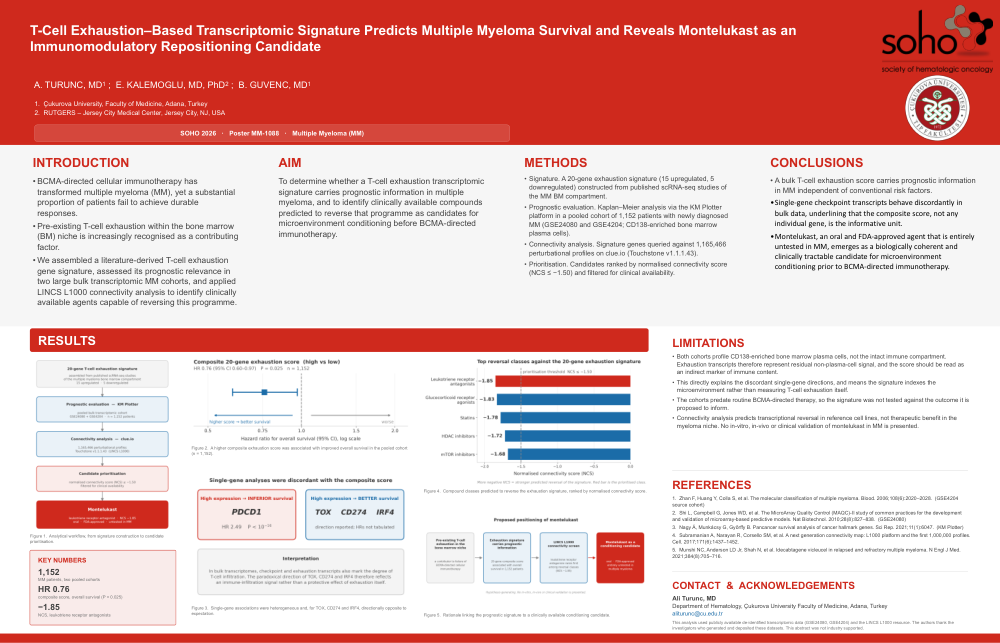
Methods. A 20-gene exhaustion signature was constructed from published scRNA-seq studies of the MM BM compartment. Prognostic performance was evaluated by Kaplan– Meier analysis in a pooled cohort of 1,152 MM patients (GSE24080 and GSE4204) via the KM Plotter platform. The 15 upregulated and 5 downregulated signature genes were queried against 1,165,466 perturbational profiles on clue.io (Touchstone v1.1.1.43). Candidate compounds were prioritised by normalised connectivity score (NCS ≤ −1.50) and filtered for clinical availability.
Results. The composite 20-gene score was associated with significantly improved overall survival (OS) in the pooled cohort (HR 0.76, 95% CI 0.60–0.97, P = 0.025, n = 1,152). Singlegene analyses were heterogeneous: high PDCD1 predicted inferior OS (HR 2.49, P < 10⁻¹⁶), whereas high TOX, CD274, and IRF4 paradoxically associated with better outcome, reflecting immune infiltration signals in bulk data. LINCS L1000 identified leukotriene receptor antagonists (NCS −1.85), glucocorticoid receptor agonists (NCS −1.83), statins (NCS −1.78), HDAC inhibitors (NCS −1.72), and mTOR inhibitors (NCS −1.68) as the top reversal classes.
Conclusions. A bulk T-cell exhaustion score carries prognostic information in MM independent of conventional risk factors. Montelukast — oral, FDA-approved, and entirely untested in MM — emerges as a biologically coherent and clinically tractable candidate for microenvironment conditioning prior to BCMA-directed immunotherapy.