1,267 posters, 47 videos, 13 topics, 4 sessions, 853 authors
ePostersLive by SciGen Technologies S.A. All rights reserved.
SOHO 2026 Annual Meeting
September 9 - 12, 2026 | George R. Brown Convention Center, Houston, Texas

MM - 1086
GLP-1 Receptor Agonists and Venous Thromboembolism Risk in Multiple Myeloma
Poster Presenter
Authors
Part of Topic
Multiple Myeloma (MM)
GLP-1 Receptor Agonists and Venous Thromboembolism Risk in Multiple Myeloma
BACKGROUND
• Multiple myeloma (MM) carries a substantially elevated risk of venous thromboembolism (VTE), driven by disease biology and by therapy related factors.
• GLP-1 receptor agonists (GLP-1 RAs) may influence thrombotic risk through platelet inhibition and endothelial modulation.
• Thromboprophylaxis in MM is guided by risk scores with modest discrimination, so identifying modifiable exposures that shift thrombotic risk is clinically relevant.
• The association of GLP-1 RA exposure with VTE in MM has not previously been evaluated.
METHODS
• Design: retrospective cohort, TriNetX US Collaborative Network.
• Population: adults ≥18 years with MM.
• Exposure: semaglutide, liraglutide, dulaglutide, exenatide or tirzepatide within 3 months before or after MM diagnosis.
• Excluded: baseline anticoagulation; prior VTE.
• Matching: sex, race, diabetes, obesity, atrial fibrillation, hypertensive disease, use of: thalidomide, lenalidomide, pomalidomide, dexamethasone - 860 pairs.
• Analysis: Risk ratio, Cox hazard ratio, Kaplan-Meier VTE-free survival.
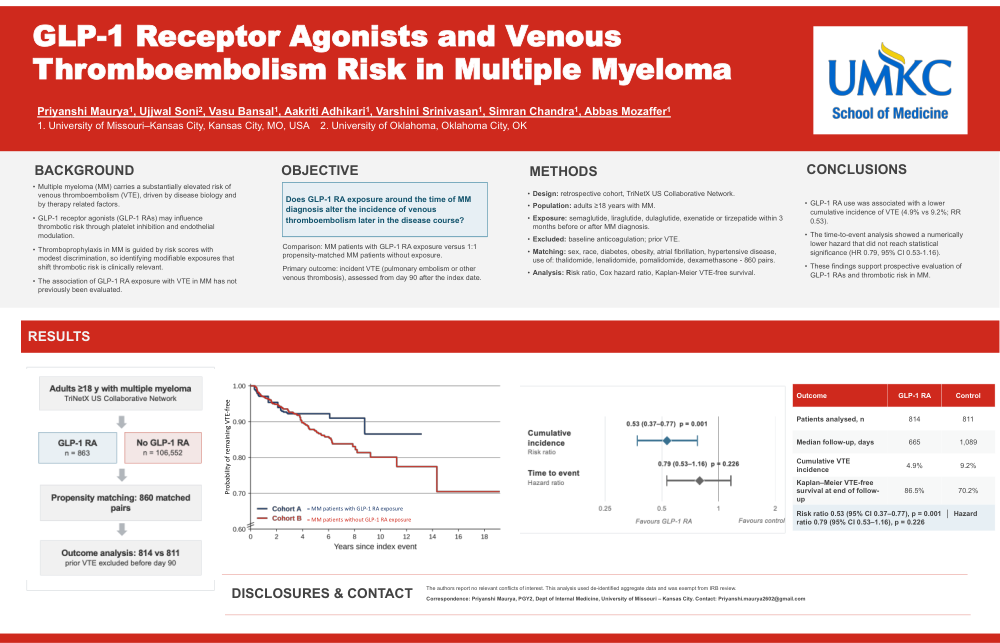
Comparison: MM patients with GLP-1 RA exposure versus 1:1 propensity-matched MM patients without exposure.
Primary outcome: incident VTE (pulmonary embolism or other venous thrombosis), assessed from day 90 after the index date.
CONCLUSION
• GLP-1 RA use was associated with a lower cumulative incidence of VTE (4.9% vs 9.2%; RR 0.53).
• The time-to-event analysis showed a numerically lower hazard that did not reach statistical significance (HR 0.79, 95% CI 0.53-1.16).
• These findings support prospective evaluation of GLP-1 RAs and thrombotic risk in MM.