1,267 posters, 47 videos, 13 topics, 4 sessions, 853 authors
ePostersLive by SciGen Technologies S.A. All rights reserved.
SOHO 2026 Annual Meeting
September 9 - 12, 2026 | George R. Brown Convention Center, Houston, Texas

ABCL - 986
Impact of Statin Use on Treatment Response and Survival in Diffuse Large B-Cell Lymphoma: A Systematic Review and Meta-Analysis of Cohort Studies
Poster Presenter
Authors
Part of Topic
Aggressive B-Cell Lymphoma (ABCL)
INTRODUCTION
Early data demonstrated a potential decrease in cancer risk with the use of statins, although the data on diffuse large B-cell lymphoma (DLBCL) is still inconclusive.Statins can cause apoptosis in cancer cells and inhibit their growth.While in vitro studies showed negative effects of statin attributed to a marked reduction in rituximab binding to CD20 on the cell surface, preclinical and retrospective studies showed no significant effect on the outcomes of patients with DLBCL.
AIM
This systematic review and meta-analysis were conducted to investigate whether statin use significantly affects the survival of DLBCL patients.
METHOD
Related cohort studies were obtained by searching PubMed, Scopus, EBSCO, Google Scholar, and Cochrane Library in the English language until January 27, 2026. Study characteristics and outcome data were extracted independently by two authors. The random-effects model was used for the meta-analysis, accounting for potential between-study heterogeneity.
RESULTS
The search yielded 55 citations from five databases, with 49 excluded, leaving six studies for quantitative analysis and two studies included in the qualitative review. The participants were comparable across all included studies, and the majority are >60 years old, male, diagnosed at an early stage, had a low IPI score, and demonstrated good performance status. All were initiated on a statin before the start of rituximab-based chemoimmunotherapy.
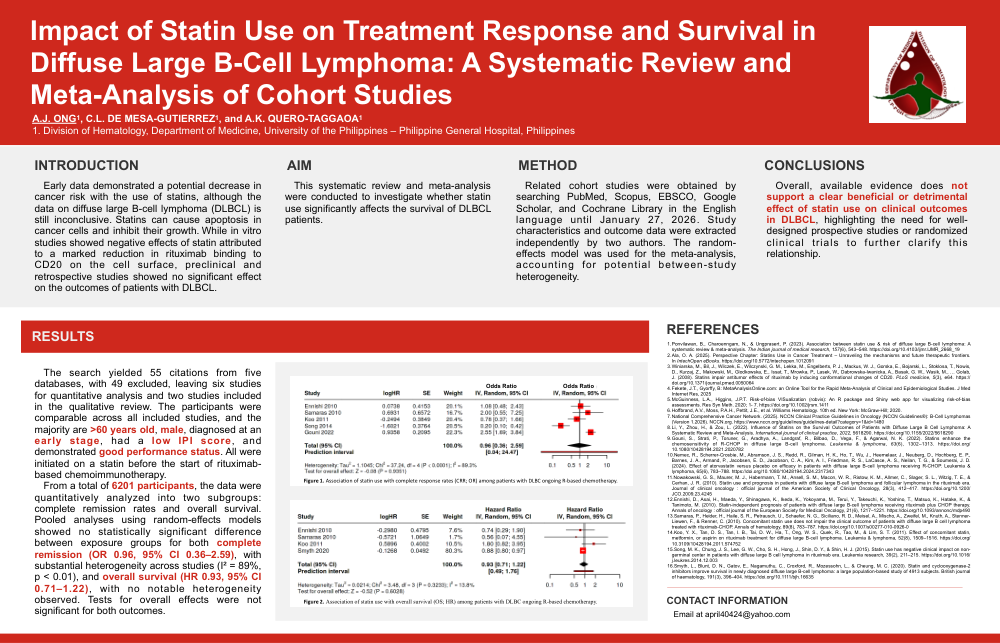
From a total of 6201 participants, the data were quantitatively analyzed into two subgroups: complete remission rates and overall survival. Pooled analyses using random-effects models showed no statistically significant difference between exposure groups for both complete remission (OR 0.96, 95% CI 0.36–2.59), with substantial heterogeneity across studies (I² = 89%, p < 0.01), and overall survival (HR 0.93, 95% CI 0.71–1.22), with no notable heterogeneity observed. Tests for overall effects were not significant for both outcomes.
CONCLUSIONS
Overall, available evidence does not support a clear beneficial or detrimental effect of statin use on clinical outcomes in DLBCL, highlighting the need for well-designed prospective studies or randomized clinical trials to further clarify this relationship.