1,267 posters, 47 videos, 13 topics, 4 sessions, 853 authors
ePostersLive by SciGen Technologies S.A. All rights reserved.
SOHO 2026 Annual Meeting
September 9 - 12, 2026 | George R. Brown Convention Center, Houston, Texas

AML - 971
MRD-Adjusted Therapeutic Index of Menin Inhibitors in NPM1-Mutated and KMT2A-Rearranged Acute Myeloid Leukemia: A Genotype-Stratified Systematic Review and Meta-Analysis
Poster Presenter
Authors
Part of Topic
Acute Myeloid Leukemia (AML)
MRD-Adjusted Therapeutic Index of Menin Inhibitors in NPM1-Mutated and KMT2A-Rearranged Acute Myeloid Leukemia: A Genotype-Stratified Systematic Review and Meta-Analysis
Menin inhibitors are targeted therapies for NPM1-mutated and KMT2A-rearranged acute myeloid leukemia. This study evaluated efficacy, measurable residual disease response, toxicity, and transplant bridging with menin inhibitors.
A genotype-stratified systematic review and interim pooled analysis of prospective trial and regulatory-reported cohorts was performed. Random-effects models were used for pooled proportions.
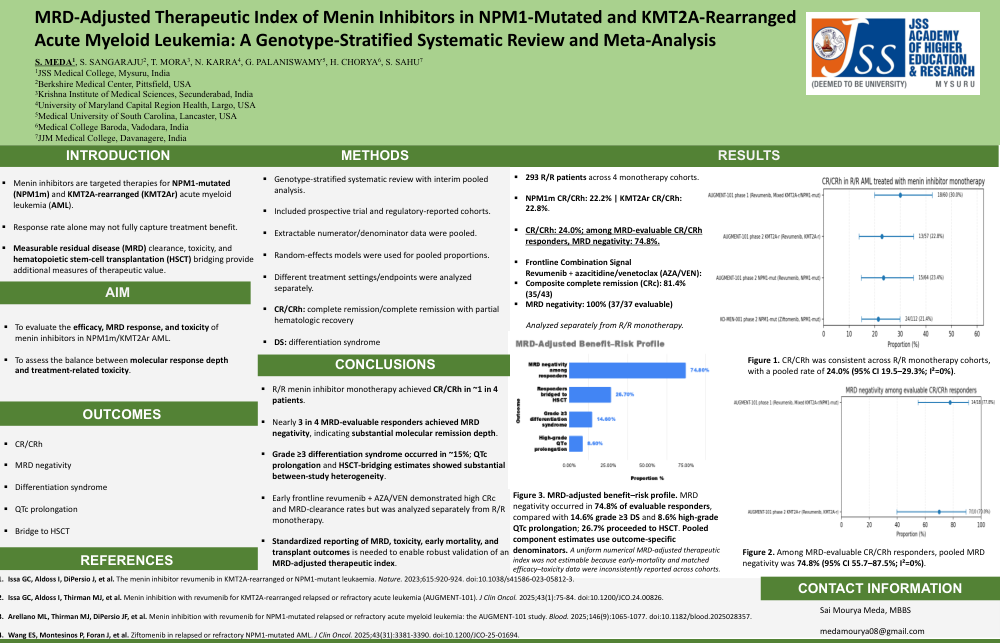
Across 293 relapsed/refractory patients from 4 menin inhibitor monotherapy cohorts, pooled CR/CRh was 24.0% (95% CI 19.5–29.3%; I²=0%). NPM1-mutated CR/CRh was 22.2%, while KMT2A-rearranged CR/CRh was 22.8%. Among MRD-evaluable CR/CRh responders, pooled MRD negativity was 74.8% (95% CI 55.7–87.5%; I²=0%).
Grade ≥3 differentiation syndrome occurred in 14.6%, high-grade QTc prolongation in 8.6%, and 26.7% of responders proceeded to hematopoietic stem-cell transplantation. In a separately analyzed frontline cohort receiving revumenib plus azacitidine/venetoclax, composite complete remission was 81.4% and MRD negativity was 100% among evaluable patients.
Menin inhibitor monotherapy achieved CR/CRh in approximately one-quarter of relapsed/refractory patients, while nearly three-quarters of MRD-evaluable responders achieved MRD negativity. Standardized reporting of MRD, toxicity, early mortality, and transplant outcomes is needed to enable robust validation of an MRD-adjusted therapeutic index.