1,267 posters, 47 videos, 13 topics, 4 sessions, 853 authors
ePostersLive by SciGen Technologies S.A. All rights reserved.
SOHO 2026 Annual Meeting
September 9 - 12, 2026 | George R. Brown Convention Center, Houston, Texas

MM - 940
Tocilizumab for Teclistamab-Related Cytokine Release Syndrome: Real-World Survival Outcomes in Relapsed/Refractory Multiple Myeloma
Poster Presenter
Authors
Part of Topic
Multiple Myeloma (MM)
Introduction
Teclistamab, a bispecific antibody targeting B-cell maturation antigen (BCMA), has demonstrated substantial activity in relapsed or refractory multiple myeloma (RRMM), but its use is frequently complicated by cytokine release syndrome (CRS). Tocilizumab is widely used to manage CRS, yet its impact on clinical outcomes among patients receiving teclistamab remains uncertain.
Methods
We conducted a retrospective cohort study using de-identified data from the TriNetX Research Network, which at the time of analysis included 155,670,170 patients across 173 healthcare organizations. Adults aged ≥18 years with RRMM treated with teclistamab who developed CRS were identified. Overall survival (OS) was estimated using Kaplan–Meier methods, with log-rank testing for between-group comparisons. Propensity score matching was performed to balance age, comorbidities, and number of prior treatment lines between patients who did and did not receive tocilizumab.
Results
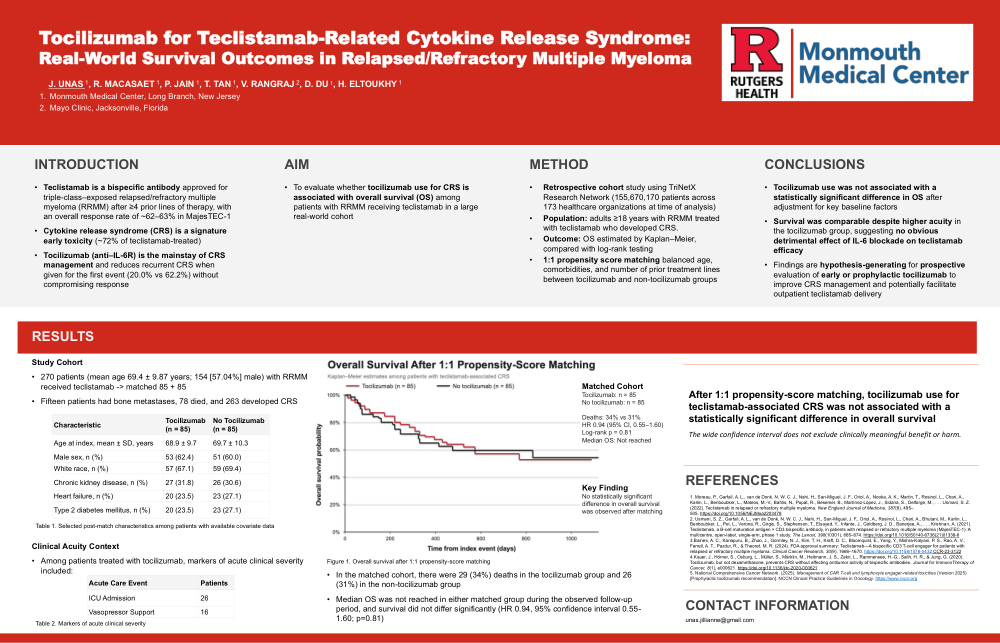
A total of 270 patients with RRMM received teclistamab (mean age 69.4 ± 9.87 years; 154 [57.04%] male). Fifteen patients had bone metastases, 78 died, and 263 developed CRS; 26 required intensive care unit admission, and 16 tocilizumab-treated patients needed vasopressor support.
Following 1:1 propensity score matching, 85 patients were included in each group. In the matched cohort, there were 29 deaths in the tocilizumab group and 26 in the non-tocilizumab group. Median OS over a 5-year observation window was not reached in either group, and survival did not differ significantly (HR 0.94, 95% confidence interval 0.55-1.60; p=0.81).
Discussion
In this large real-world cohort of patients receiving teclistamab for RRMM, tocilizumab use for CRS management was not associated with a detectable difference in OS after adjustment for key baseline factors. Despite evidence of higher acuity in the tocilizumab group, survival outcomes appeared comparable, suggesting no obvious detrimental effect of interleukin-6 blockade on teclistamab efficacy. However, residual confounding, including unmeasured differences in CRS severity, disease burden, and performance status, as well as limited sample size and event numbers, constrain definitive conclusions. These findings should be viewed as hypothesis-generating and support further prospective evaluation of early or prophylactic tocilizumab to optimize the safety and feasibility of teclistamab-based therapy, particularly in outpatient settings.