1,267 posters, 47 videos, 13 topics, 4 sessions, 853 authors
ePostersLive by SciGen Technologies S.A. All rights reserved.
SOHO 2026 Annual Meeting
September 9 - 12, 2026 | George R. Brown Convention Center, Houston, Texas

CT - 886
Comparative Inpatient Outcomes Among FDA-Approved Chimeric Antigen Receptor T-Cell Products: An Analysis of the National Inpatient Sample
Poster Presenter
Authors
Part of Topic
Cellular Therapy (CT)
CT-886 - Comparative Inpatient Outcomes Among FDA-Approved Chimeric Antigen Receptor T-Cell Products: An Analysis of the National Inpatient Sample
BACKGROUND
- Comparative national data on inpatient outcomes for individual FDA-approved CAR T-cell products remain limited.
- There exists a knowledge gap in understanding variations in severe inpatient toxicities and resource demands between different CAR-T therapies.
- Understanding these differences is significant for informing inpatient risk stratification and healthcare resource planning.
- This study aims to compare severe inpatient toxicities and resource-intensive complications among FDA-approved CAR-T products using a national inpatient sample.
METHODS
- Retrospective cross-sectional analysis of the 2022-2023 Healthcare Cost and Utilization Project National Inpatient Sample.
- CAR-T hospitalizations were identified via product-specific ICD-10-PCS procedure codes; toxicities and complications were identified using ICD-10-CM diagnostic codes.
- The primary outcome was a composite severe inpatient toxicity including in-hospital mortality, grade ≥3 cytokine release syndrome (CRS), or grade ≥3 immune effector cell-associated neurotoxicity syndrome (ICANS).
- Secondary outcomes encompassed individual toxicity components, shock, febrile neutropenia, tumor lysis syndrome, mechanical ventilation, dialysis, and transfusion.
- Survey-weighted estimates and multivariable survey logistic regression adjusted for age, sex, Elixhauser mortality score, underlying indication, and calendar year.
- Statistical significance was set at P < .05 for the primary outcome and Bonferroni-adjusted P < .0033 for 15 secondary outcomes.
RESULTS
Patient Characteristics and Composite Severe Toxicity
- We analyzed 1,622 unweighted CAR-T hospitalizations, representing 8,110 weighted hospitalizations nationally.
- Median patient age was 64.3 years (IQR, 56.1–71.0); 62.9% were male.
- Composite severe toxicity occurred in 13.5% of hospitalizations; in-hospital mortality was 1.7%.
Individual Toxicity and Complication Frequencies
- Grade ≥3 CRS occurred in 3.6%, grade ≥3 ICANS in 10.7%, shock in 3.1%, febrile neutropenia in 24.5%, and tumor lysis syndrome in 1.4%.
- Mechanical ventilation was required in 2.3%, dialysis in 1.5%, and transfusion in 8.3% of weighted hospitalizations.
Adjusted Odds of Toxicities by CAR-T Product
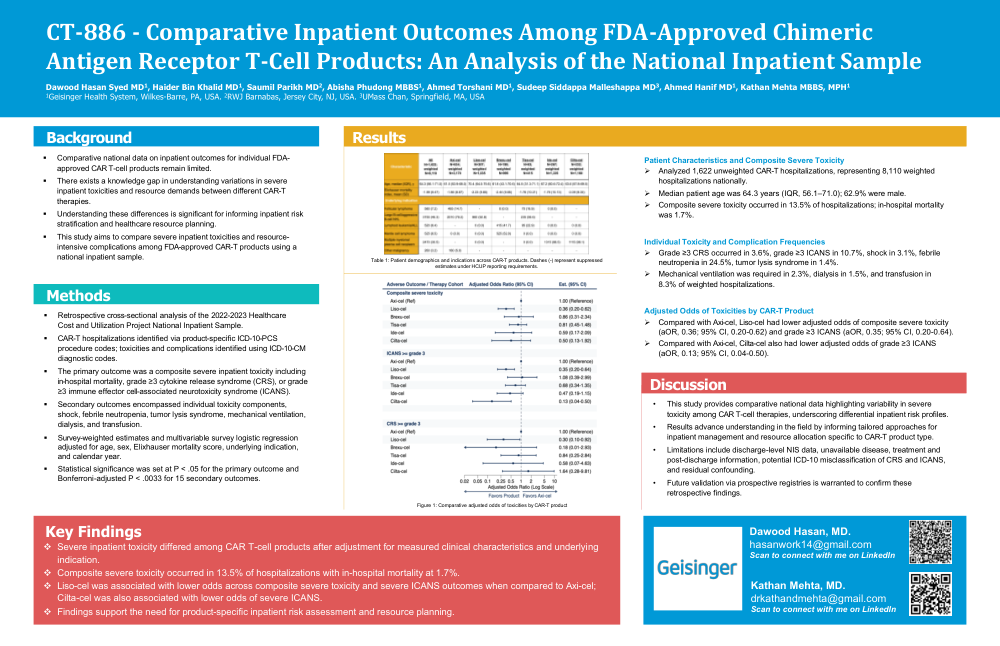
- Compared with Axi-cel, Liso-cel had lower adjusted odds of composite severe toxicity (aOR, 0.36; 95% CI, 0.20-0.62) and grade ≥3 ICANS (aOR, 0.35; 95% CI, 0.20-0.64).
- Compared with Axi-cel, Cilta-cel also had lower adjusted odds of grade ≥3 ICANS (aOR, 0.13; 95% CI, 0.04-0.50).
DISCUSSION
- This study provides comparative national data highlighting variability in severe toxicity among CAR T-cell therapies, underscoring differential inpatient risk profiles.
- Results advance understanding in the field by informing tailored approaches for inpatient management and resource allocation specific to CAR-T product type.
- Limitations include discharge-level NIS data, unavailable disease, treatment and post-discharge information, potential ICD-10 misclassification of CRS and ICANS, and residual confounding.
- Future validation via prospective registries is warranted to confirm these retrospective findings.
KEY FINDINGS
- Severe inpatient toxicity differed among CAR T-cell products after adjustment for measured clinical characteristics and underlying indication.
- Composite severe toxicity occurred in 13.5% of hospitalizations with in-hospital mortality at 1.7%.
- Liso-cel was associated with lower odds across composite severe toxicity and severe ICANS outcomes when compared with Axi-cel; Cilta-cel was also associated with lower odds of severe ICANS.
- Findings support the need for product-specific inpatient risk assessment and resource planning.