1,267 posters, 47 videos, 13 topics, 4 sessions, 853 authors
ePostersLive by SciGen Technologies S.A. All rights reserved.
SOHO 2026 Annual Meeting
September 9 - 12, 2026 | George R. Brown Convention Center, Houston, Texas

MM - 881
Real-World Safety Profile of Ciltacabtagene Autoleucel in Triple-Class Refractory Multiple Myeloma: A TriNetX Analysis.
Poster Presenter
Authors
Part of Topic
Multiple Myeloma (MM)
Real-World Safety Profile of Ciltacabtagene Autoleucel in Triple-Class Refractory Multiple Myeloma: A TriNetX Analysis
Hira Cheema MD, Syed Naqvi MD, Carolina Schinke MD, Maurizio Zangari MD, Sharmilan Thanendrarajan MD, Frits Van Rhee MD
UAMS, Little Rock, AR, USA
Abstract
Background
Real-world safety data for ciltacabtagene autoleucel (CARVYKTI) in triple-class refractory relapsed/refractory multiple myeloma (RRMM) remain limited.
Methods
We performed a retrospective cohort study using data from the TriNetX global collaborative network. Adult patients with triple-class refractory RRMM treated with ciltacabtagene autoleucel were identified using standardized coding data. Patients receiving idecabtagene vicleucel were excluded. Outcomes included grade ≥3 cytokine release syndrome (CRS), grade ≥3 immune effector cell–associated neurotoxicity syndrome (ICANS), cytopenias, infections, gastrointestinal toxicities, neurologic complications, and secondary hematologic malignancies.
Results
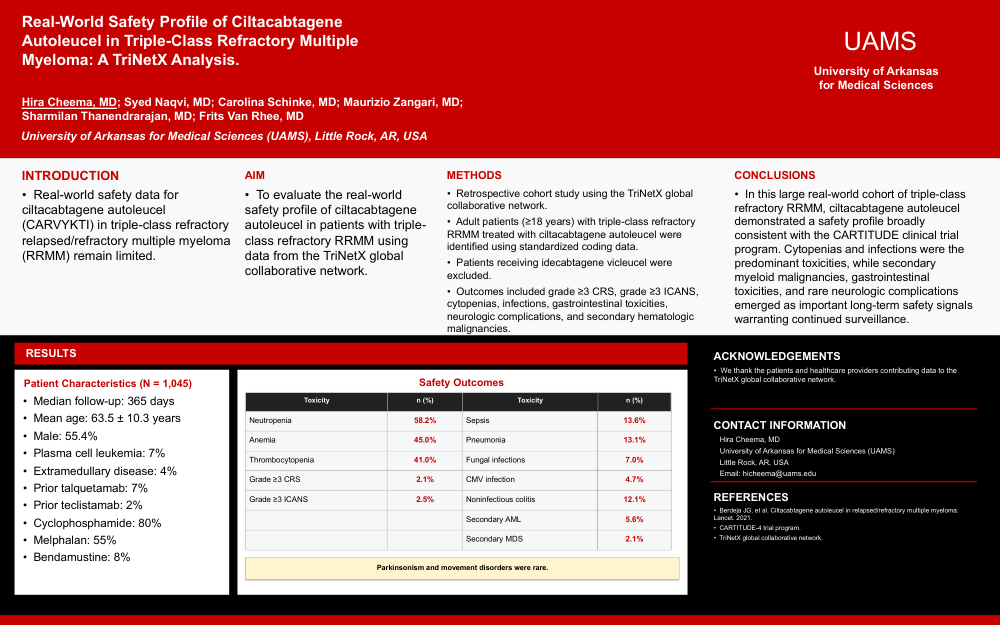
A total of 1045 patients were included, with a median follow-up of 365 days. Mean age was 63.5±10.3 years, and 55.4% were male. Plasma cell leukemia and extramedullary disease were present in 7% and 4% of patients, respectively. Prior exposure to talquetamab and teclistamab occurred in 7% and 2% of patients, respectively. Prior exposure to alkylating agents was common, including cyclophosphamide (80%), melphalan (55%), and bendamustine (8%). Severe thrombocytopenia (41%), neutropenia (58.2%), and anemia (45%) were the most common toxicities, consistent with the findings of the CARTITUDE trial program. Grade ≥3 CRS and grade ≥3 ICANS occurred in 2.1% and 2.5% of patients, respectively, comparable to the CARTITUDE-4 percentages. Infectious complications included sepsis (13.6%), pneumonia (13.1%), fungal infections (7.0%), and cytomegalovirus infection (4.7%). Noninfectious colitis occurred in 12.1% of patients. Secondary hematologic malignancies included acute myeloid leukemia (5.6%) and myelodysplastic syndromes (2.1%). Parkinsonism and movement disorders were rare.
Conclusions
In this large real-world cohort of patients with triple-class refractory RRMM, ciltacabtagene autoleucel demonstrated a safety profile broadly consistent with the safety profile observed in the CARTITUDE clinical trial program. Cytopenias and infections were the predominant toxicities, while secondary myeloid malignancies, gastrointestinal toxicities, and rare neurologic complications emerged as important long-term safety signals warranting continued surveillance.