1,267 posters, 47 videos, 13 topics, 4 sessions, 853 authors
ePostersLive by SciGen Technologies S.A. All rights reserved.
SOHO 2026 Annual Meeting
September 9 - 12, 2026 | George R. Brown Convention Center, Houston, Texas

ABCL - 853
Vispa-cel, an Allogeneic Anti-CD19 CAR-T Cell Therapy with a PD-1 Knockout, in Patients with Relapsed/Refractory B Cell Non-Hodgkin Lymphoma (ANTLER Phase 1 Clinical Trial)
Poster Presenter
Authors
Part of Topic
Aggressive B-Cell Lymphoma (ABCL)
Video
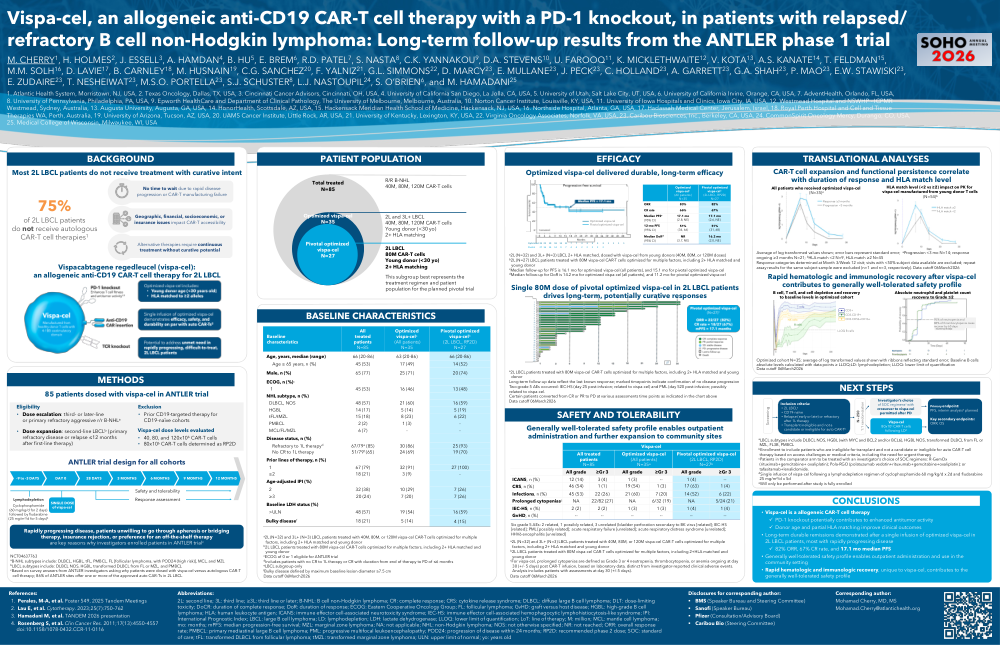
Vispa-cel, an allogeneic anti-CD19 CAR-T cell therapy with a PD-1 knockout, in patients with relapsed/ refractory B cell non-Hodgkin lymphoma: Long-term follow-up results from the ANTLER phase 1 trial
Background
Most 2L LBCL patients do not receive treatment with curative intent
- 75% of 2L LBCL patients do not receive autologous CAR-T cell therapies
- No time to wait due to rapid disease progression or CAR-T manufacturing failure
- Geographic, financial, socioeconomic, or insurance issues impact CAR-T accessibility
- Alternative therapies require continuous treatment without curative potential
Vispacabtagene regedleucel (vispa-cel): an allogeneic anti-CD19 CAR-T cell therapy for 2L LBCL
- Vispa-cel manufactured from healthy donor T cells with 4-1BB costimulatory domain
- PD-1 knockout enhances T cell fitness and antitumor activity
- Anti-CD19 CAR insertion
- TCR knockout
Optimized vispa-cel includes
- Young donor age (<30 years old)
- HLA matched to ≥2 alleles
Single infusion of optimized vispa-cel demonstrates efficacy, safety, and durability on par with auto CAR-Ts
Potential to address unmet need in rapidly progressing, difficult-to-treat, 2L LBCL patients
Methods
85 patients dosed with vispa-cel in ANTLER trial
Eligibility
- Dose escalation: third- or later-line
or primary refractory aggressive r/r B-NHLa - Dose expansion: second-line LBCLb (primary refractory disease or relapse ≤12 months after first-line therapy)
Exclusion
- Prior CD19-targeted therapy for
CD19-naïve cohorts
Vispa-cel dose levels evaluated
- 40, 80, and 120x106 CAR-T cells
- 80x106 CAR-T cells determined as RP2D
ANTLER trial design for all cohorts
Lymphodepletion: Cyclophosphamide (60 mg/kg/d for 2 days) followed by fludarabine (25 mg/m2/d for 5 days)
Rapidly progressing disease, patients unwilling to go through apheresis or bridging therapy, insurance rejection, or preference for an off-the-shelf therapy are key reasons why investigators enrolled patients in ANTLER trial (NCT04637763)
B-NHL subtypes include: DLBCL, HGBL, tFL, PMBCL, FL [follicular lymphoma, with POD24 (high risk)], MCL, and MZL
LBCL subtypes include: DLBCL NOS, HGBL, transformed DLBCL from FL or MZL, and PMBCL
Based on survey answers from ANTLER investigators asking why patients were dosed with vispa-cel versus autologous CAR-T cell therapy; 86% of ANTLER sites offer one or more of the approved auto CAR-Ts in 2L LBCL
Patient population
Total treated
- R/R B-NHL 40M, 80M, 120M CAR-T cells
Optimized vispa-cel
- 2L and 3L+ LBCL
- 40M, 80M, 120M CAR-T cells
- Young donor (<30 yo)
- 2+ HLA matching
Pivotal optimized vispa-cel
- 2L LBCL
- 80M CAR-T cells
- Young donor (<30 yo)
- 2+ HLA matching
- This subgroup best represents the treatment regimen and patient population for the planned pivotal trial
Baseline characteristics
2L (N=32) and 3L+ (N=3) LBCL patients treated with 40M, 80M, or 120M vispa-cel CAR-T cells optimized for multiple factors, including 2+ HLA matched and young donor
2L LBCL patients treated with 80M vispa-cel CAR-T cells optimized for multiple factors, including 2+ HLA matched and young donor
ECOG of 0 or 1 eligible for ANTLER trial
Includes patients with no CR to 1L therapy or CR with duration from end of therapy to PD of ≤6 months
LBCL subgroup only
Bulky disease defined by maximum baseline lesion diameter ≥7.5 cm
Efficacy
Optimized vispa-cel delivered durable, long-term efficacy
2L (N=32) and 3L+ (N=3) LBCL 2+ HLA matched, dosed with vispa-cel from young donors (40M, 80M, or 120M doses)
2L (N=27) LBCL patients treated with 80M vispa-cel CAR-T cells optimized for multiple factors, including 2+ HLA matched and young donor
Median follow-up for PFS is 16.1 mo for optimized vispa-cel (all patients), and 15.1 mo for pivotal optimized vispa-cel
Median follow-up for DoR is 14.2 mo for optimized vispa-cel (all patients), and 11.2 mo for pivotal optimized vispa-cel
Single 80M dose of pivotal optimized vispa-cel in 2L LBCL patients drives long-term, potentially curative responses
2L LBCL patients treated with 80M vispa-cel CAR-T cells optimized for multiple factors, including 2+ HLA matched and young donor
Long-term follow-up data reflect the last known response; marked timepoints indicate confirmation of no disease progression
Two grade 5 AEs occurred: IEC-HS (day 25 post-infusion; related to vispa-cel) and PML (day 520 post-infusion; possibly related to vispa-cel.
Certain patients converted from CR or PR to PD at various assessments time points as indicated in the chart above
Safety and tolerability
Generally well-tolerated safety profile enables outpatient administration and further expansion to community sites
Six grade 5 AEs: 2 related, 1 possibly related, 3 unrelated (bladder perforation secondary to BK virus [related]; IEC-HS [related]; PML [possibly related]; acute respiratory failure [unrelated]; acute respiratory distress syndrome [unrelated]; HHV6 encephalitis [unrelated]
2L (N=32) and 3L+ (N=3) LBCL patients treated with 40M, 80M, or 120M vispa-cel CAR-T cells optimized for multiple factors, including 2+ HLA matched and young donor
2L LBCL patients treated with 80M vispa-cel CAR-T cells optimized for multiple factors, including 2+HLA matched and young donor
For vispa-cel, prolonged cytopenias are defined as Grade 3 or 4 neutropenia, thrombocytopenia, or anemia ongoing at day 30 (+/- 5 days) post CAR-T infusion, based on laboratory data, distinct from investigator-reported clinical adverse events. Analysis includes patients with assessments at day 30 (+/-5 days).
Translational analyses
CAR-T cell expansion and functional persistence correlate with duration of response and HLA match level
Average of log transformed values shown; error bars represent standard error; aProgression <3 mo N=14; response ongoing ≥3 months N=21; bHLA match <2 N=9, HLA match ≥2 N=45
Response categories determined at Month 3/Week 12 visit; visits with <50% subject data available are excluded; repeat assay results for the same subject sample were excluded (n=1 and n=3, respectively).
Rapid hematologic and immunologic recovery after vispa-cel contributes to generally well-tolerated safety profile
B cell, T cell, and cell depletion and recovery to baseline levels in optimized cohort
Absolute neutrophil and platelet count recovery to Grade ≤2
95% of neutropenia and 88% of thrombocytopenia cases recover by 60 days
Optimized cohort N=35; average of log transformed values shown with ribbons reflecting standard error; Baseline B cells absolute levels calculated with data points ≥ LLOQ;LD: lymphodepletion; LLOQ: lower limit of quantification
Next Steps
LBCL subtypes include DLBCL NOS, HGBL (with MYC and BCL2 and/or BCL6), HGBL NOS, transformed DLBCL from FL or MZL, FL3B, PMBCL
Enrollment to include patients who are ineligible for transplant and not a candidate or ineligible for auto CAR-T cell therapy based on access challenges or medical criteria, including the need for urgent therapy
Patients in the comparator arm to be treated with an investigator’s choice of SOC regimens: R-GemOx (rituximab+gemcitabine+ oxaliplatin); Pola-RGO (polatuzumab vedotin+rituxumab+gemcitabine+oxaliplatin); or tafasitamab+lenalidomide.
Single infusion of vispa-cel following a lymphodepletion regimen of cyclophosphamide 60 mg/kg/d x 2d and fludarabine 25 mg/m2/d x 5d
Will only be performed after study is fully enrolled
Conclusions
- Vispa-cel is a allogeneic CAR-T cell therapy
- PD-1 knockout potentially contributes to enhanced antitumor activity
- Donor age and partial HLA matching improve clinical outcomes
- Long-term durable remissions demonstrated after a single infusion of optimized vispa-cel in 2L LBCL patients, most with rapidly progressing disease; 82% ORR, 67% CR rate, and 17.1 mo median PFS
- Generally well-tolerated safety profile enables outpatient administration and use in the community setting
- Rapid hematologic and immunologic recovery, unique to vispa-cel, contributes to the generally well-tolerated safety profile