1,267 posters, 47 videos, 13 topics, 4 sessions, 853 authors
ePostersLive by SciGen Technologies S.A. All rights reserved.
SOHO 2026 Annual Meeting
September 9 - 12, 2026 | George R. Brown Convention Center, Houston, Texas

MM - 826
National Trends in Pneumonia-Related Admissions Among Patients With Multiple Myeloma
Poster Presenter
Authors
Part of Topic
Multiple Myeloma (MM)
Video
NATIONAL TRENDS IN PNEUMONIA-RELATED ADMISSIONS AMONG PATIENTS WITH MULTIPLE MYELOMA
Authors: J. Brunner 1, K. Seiler 2 , and M. Pianko 3,4
1. Department of Internal Medicine, University of Michigan, Ann Arbor, MI, USA
2. Institute for Healthcare Policy & Innovation, University of Michigan, Ann Arbor, MI, USA
3. Department of Internal Medicine, Division of Hematology & Oncology, University of Michigan, Ann Arbor, MI, USA
4. University of Michigan Rogel Cancer Center, Ann Arbor, MI, USA
INTRODUCTION
Through several disease- and therapy-related mechanisms, multiple myeloma predisposes patients to infection. Among these, respiratory sources predominate.
Survival among patients with multiple myeloma has improved in recent years with increasing utilization of novel, often expensive, therapies, though socio-structural disparities in myeloma care persist.
The health system burden associated with treating infections in this population remains poorly studied.
AIM
Characterize national trends in the volume and proportion of pneumonia-related hospitalizations involving adults with multiple myeloma and associated healthcare utilization metrics.
METHODS
Cohort
Patients >= 18 years
ICD-9/10-CM for pneumonia (any position)
+/- ICD-9/10-CM for multiple myeloma (any position)
Primary Outcomes
Pneumonia-related hospitalizations (2006 – 2019)
Aggregate hospital days
Aggregate in-hospital deaths
Aggregate hospitalization costs (2020 USD)
Secondary Analyses
Frailty (HFRS)
Racial differences
COVID-19-related hospitalizations (2020 – 2022)
Statistical Methods
Survey design-adjusted descriptive and trend analyses
Multivariable logistic regression: in-hospital mortality
Multiple linear regression: length of stay, cost
RESULTS
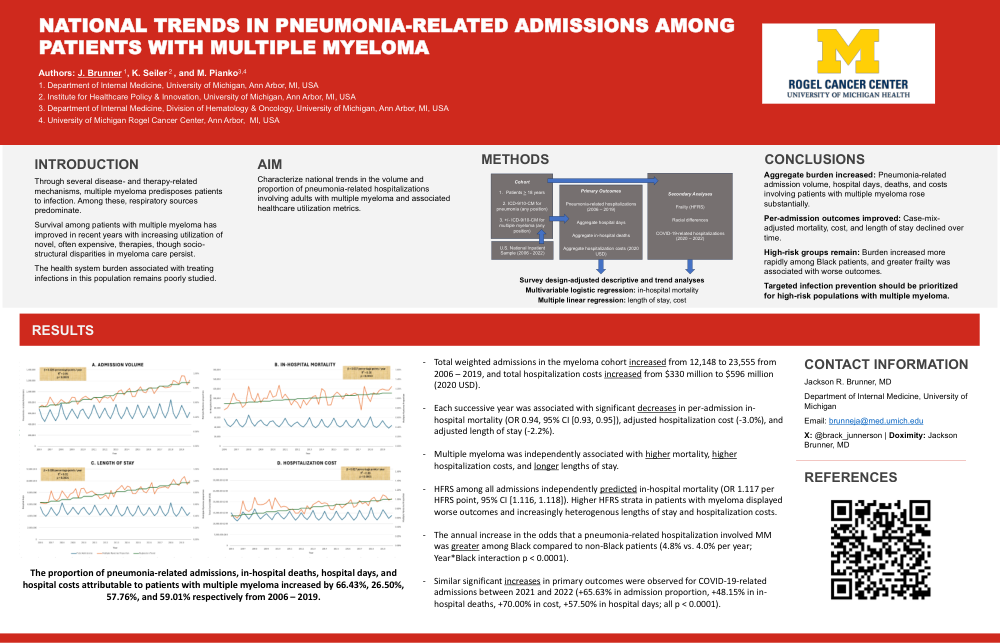
The proportion of pneumonia-related admissions, in-hospital deaths, hospital days, and hospital costs attributable to patients with multiple myeloma increased by 66.43%, 26.50%, 57.76%, and 59.01% respectively from 2006 – 2019.
Total weighted admissions in the myeloma cohort increased from 12,148 to 23,555 from 2006 – 2019, and total hospitalization costs increased from $330 million to $596 million (2020 USD).
Each successive year was associated with significant decreases in per-admission in-hospital mortality (OR 0.94, 95% CI [0.93, 0.95]), adjusted hospitalization cost (-3.0%), and adjusted length of stay (-2.2%).
Multiple myeloma was independently associated with higher mortality, higher hospitalization costs, and longer lengths of stay.
HFRS among all admissions independently predicted in-hospital mortality (OR 1.117 per HFRS point, 95% CI [1.116, 1.118]). Higher HFRS strata in patients with myeloma displayed worse outcomes and increasingly heterogenous lengths of stay and hospitalization costs.
The annual increase in the odds that a pneumonia-related hospitalization involved MM was greater among Black compared to non-Black patients (4.8% vs. 4.0% per year; Year*Black interaction p < 0.0001).
Similar significant increases in primary outcomes were observed for COVID-19-related admissions between 2021 and 2022 (+65.63% in admission proportion, +48.15% in in-hospital deaths, +70.00% in cost, +57.50% in hospital days; all p < 0.0001).
CONCLUSIONS
Aggregate burden increased: Pneumonia-related admission volume, hospital days, deaths, and costs involving patients with multiple myeloma rose substantially.
Per-admission outcomes improved: Case-mix-adjusted mortality, cost, and length of stay declined over time.
High-risk groups remain: Burden increased more rapidly among Black patients, and greater frailty was associated with worse outcomes.
Targeted infection prevention should be prioritized for high-risk populations with multiple myeloma.
REFERENCES: see attached QR code