1,267 posters, 47 videos, 13 topics, 4 sessions, 853 authors
ePostersLive by SciGen Technologies S.A. All rights reserved.
SOHO 2026 Annual Meeting
September 9 - 12, 2026 | George R. Brown Convention Center, Houston, Texas

MM - 795
Treatment-Limiting On-Target Toxicity With Talquetamab/GPRC5D-Directed Therapy in Relapsed/Refractory Multiple Myeloma: A Systematic Review and Meta-Analysis
Poster Presenter
Authors
Part of Topic
Multiple Myeloma (MM)
Abstract
Background
GPRC5D-directed therapy has expanded treatment options for relapsed/refractory multiple myeloma (RRMM),
but characteristic oral, dermatologic, nail, and nutritional toxicities may affect tolerability, dose intensity, and
treatment persistence. We performed a systematic review and meta-analysis to quantify the burden of treatment-
relevant, largely nonhematologic toxicity with talquetamab/GPRC5D-directed therapy in RRMM.
Methods
We systematically searched PubMed/Medline, Cochrane Library, ClinicalTrials.gov, and major hematology/
oncology meeting proceedings, including ASH, ASCO, EHA/HemaSphere, and SOHO, from 2022 to 2026 for
prospective and real-world RRMM studies of GPRC5D-directed therapy reporting extractable toxicity or treatment-limiting
outcomes. Duplicate trial-family reports were adjudicated by preferentially selecting the latest or
most complete source. Registry-only records and nonextractable abstracts were not pooled. Random-effects
logit-transformed pooled proportions were estimated.
Results
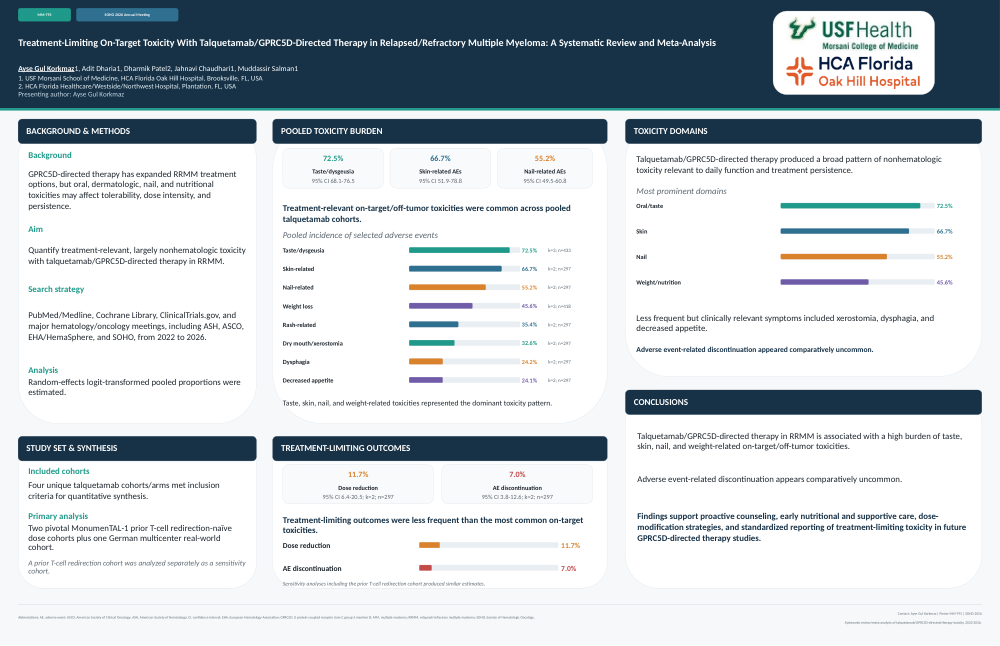
Four unique talquetamab cohorts/arms met inclusion criteria for quantitative synthesis. The primary analysis
included two pivotal MonumenTAL-1 prior T-cell redirection–naïve dose cohorts and one German multicenter
real-world cohort; the prior T-cell redirection cohort was analyzed separately as a sensitivity cohort. Taste-
related adverse events/dysgeusia were most frequent, with a pooled incidence of 72.5% (95% CI, 68.1%–76.5%;
k=3; n=433). Other common toxicities included nonrash skin-related adverse events at 66.7% (51.9%–78.8%;
k=2; n=297), nail-related adverse events at 55.2% (49.5%–60.8%; k=2; n=297), weight loss/decreased weight
at 45.6% (37.5%–53.9%; k=3; n=418), rash-related adverse events at 35.4% (27.4%–44.3%; k=2; n=297), dry
mouth/xerostomia at 32.6% (21.7%–45.8%; k=2; n=297), dysphagia at 24.2% (19.7%–29.4%; k=2; n=297), and
decreased appetite at 24.1% (17.4%–32.4%; k=2; n=297). Treatment-limiting outcomes were less frequent: dose
reduction occurred in 11.7% (6.4%–20.5%; k=2; n=297), and discontinuation due to adverse events occurred
in 7.0% (3.8%–12.6%; k=2; n=297). Sensitivity analyses including the prior T-cell redirection cohort produced
similar estimates.
Conclusions
Talquetamab/GPRC5D-directed therapy in RRMM is associated with a high burden of taste, skin, nail, and
weight-related on-target/off-tumor toxicities, but adverse event–related discontinuation appears comparatively
uncommon. These findings support proactive counseling, early nutritional and supportive care, dose-modification
strategies, and standardized reporting of treatment-limiting toxicity in future GPRC5D-directed therapy
studies.
ASH: American Society of Hematology, ASCO: American Society of Clinical Oncology, CI: confidence interval,
EHA: European Hematology Association, GPRC5D: G protein-coupled receptor class C group 5 member D, MM:
multiple myeloma, SOHO: Society of Hematologic Oncology
Keywords
MM, multiple myeloma, talquetamab, GPRC5D-directed therapy, adverse events, treatment persistence