1,267 posters, 47 videos, 13 topics, 4 sessions, 853 authors
ePostersLive by SciGen Technologies S.A. All rights reserved.
SOHO 2026 Annual Meeting
September 9 - 12, 2026 | George R. Brown Convention Center, Houston, Texas

MM - 766
Isatuximab-Carfilzomib-Dexamethasone Triplet Therapy: Real-World Data Based on the Hungarian Managed Access Program
Poster Presenter
Authors
Part of Topic
Multiple Myeloma (MM)
Context:
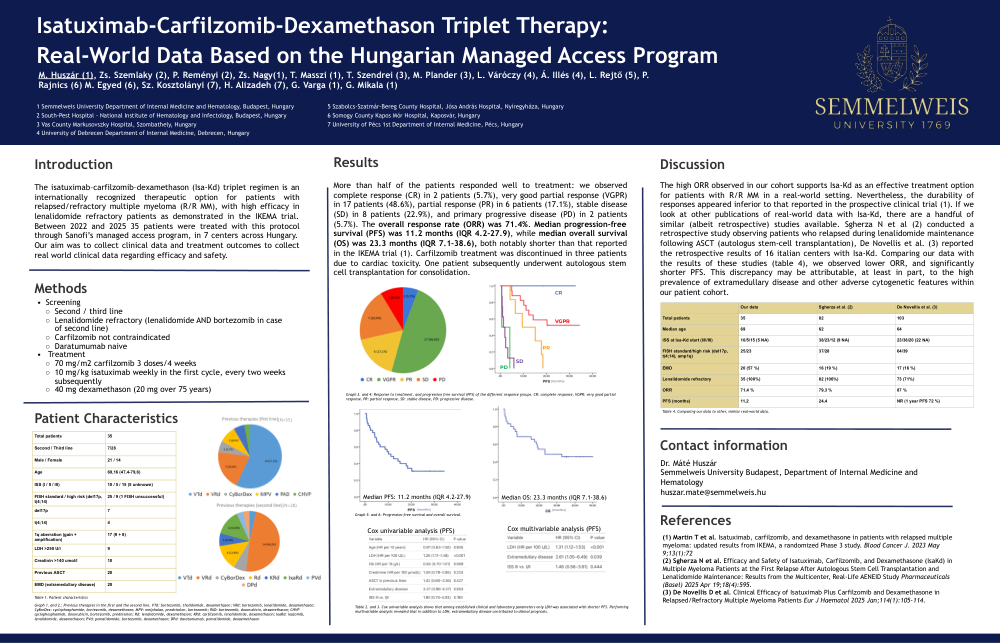
The isatuximab–carfilzomib–dexamethasone (Isa-Kd) triplet regimen is an internationally recognized therapeutic option for patients with relapsed/refractory multiple myeloma (R/RMM), with high efficacy in lenalidomide refractory patients demonstrated in the IKEMA trial. Between 2022 and 2025 35 patients were treated with this protocol through Sanofi’s managed access program, in 7 centers across Hungary. Our aim was to collect clinical data and treatment outcomes to collect real world clinical data regarding efficacy and safety.
Patient Characteristics:
35 patients with R/RMM were enrolled receiving second- or third-line therapy. All patients were refractory to lenalidomide and naïve to daratumumab treatment. The median age of the cohort was 69 years. A considerable proportion of patients exhibited high-risk disease features, including extramedullary disease in 15 cases, del(17p) in 7 cases, 1q gain in 10 cases, and 1q amplification in 7 cases. 20 patients had previous autologous stem cell transplantation.
Results:
More than half of the patients responded well to treatment: we observed complete response (CR) in 2 patients (5.7%), very good partial response (VGPR) in 17 patients (48.6%), partial response (PR) in 6 patients (17.1%), stable disease (SD) in 8 patients (22.9%), and primary progressive disease (PD) in 2 patients (5.7%). The overall response rate (ORR) was 71.4%. Median progression-free survival (PFS) was 11.2 months (IQR 4.2-27.9), notably shorter than that reported in the IKEMA trial, while median overall survival (OS) was 23.3 months (IQR 7.1-38.6). Carfilzomib treatment was discontinued in three patients due to cardiac toxicity. One patient subsequently underwent autologous stem cell transplantation.
Conclusions:
The high ORR observed in our cohort supports Isa-Kd as an effective treatment option for patients with R/RMM in a real-world setting. Nevertheless, the durability of responses appeared inferior to that reported in the prospective clinical trial. This discrepancy may be attributable, at least in part, to the high prevalence of extramedullary disease and other adverse cytogenetic features within our patient cohort.