1,267 posters, 47 videos, 13 topics, 4 sessions, 853 authors
ePostersLive by SciGen Technologies S.A. All rights reserved.
SOHO 2026 Annual Meeting
September 9 - 12, 2026 | George R. Brown Convention Center, Houston, Texas

MDS - 700
Excess Mortality in Myelodysplastic Neoplasms With Ring Sideroblasts Compared With the Spanish General Population a GESMD Registry Study
Poster Presenter
Authors
Part of Topic
Myelodysplastic Syndromes (MDS)
Excess Mortality in Myelodysplastic Neoplasms with Ring Sideroblasts: A GESMD Registry Study.
Authors: PG Gálvez-Zavala1; MC Samaniego-Silva1; D. Valcarcel², M. Arnan³, E. Mora⁴, M. Tormo⁵, A. Almela⁶, A. Garrido⁷, M. Diez Campelo⁸, B. Xicoy⁹, T. Bernal¹⁰, S. García-Avila¹¹, P. Cárcel¹², M. Vara-Pampliega¹³, E. Rivero¹⁴, D. Ivars-Santacreu¹⁵, T. Chen-Liang¹⁶, MT Cedena-Romero¹⁷, J. Bargay¹⁸, J. Sanchez-García¹⁹, MT Orero-Castelló²⁰, M. Diez-Beyá²¹, R. Azibeiro⁸, A. Alfonso-Piérola¹.
¹CCUN, Pamplona; ²HUVH, Barcelona; ³ICO Hospitalet; ⁴H. La Fe, Valencia; ⁵HCU Valencia; ⁶H. León; ⁷H. Sant Pau, Barcelona; ⁸HUS, Salamanca; ⁹ICO Badalona–HGTP; ¹⁰HUCA, Oviedo; ¹¹H. del Mar, Barcelona; ¹²H. La Ribera, Alzira; ¹³H. Cruces, Barakaldo; ¹⁴H. Arnau de Vilanova, Lleida; ¹⁵H. Doctor Peset, Valencia; ¹⁶H. Morales Meseguer, Murcia; ¹⁷H. 12 de Octubre, Madrid; ¹⁸H. Son Llàtzer, Palma; ¹⁹H. Reina Sofía, Córdoba; ²⁰HGU Valencia; ²¹Hospital Clínic, Barcelona.
INTRODUCTION
Myelodysplastic neoplasms with ring sideroblasts (MDS-RS) represent a biologically distinct, generally favorable-risk MDS subtype, frequently associated with SF3B1 mutations.
Despite this favorable profile, patients may still experience excess mortality related to anemia, transfusion burden, cytopenias, adverse cytogenetics, comorbidities, and disease biology.
Relative survival analysis allows estimation of disease-attributable mortality by comparing observed survival with expected survival from the general population.
AIM
To estimate relative survival and excess mortality among patients with MDS-RS compared with the Spanish general population matched by age, sex, and calendar year, and to identify clinical and cytogenetic factors associated with excess mortality.
METHOD
Retrospective multicenter GESMD registry study including adults with MDS-RS, defined as ≥15% bone marrow ring sideroblasts, or ≥5% ring sideroblasts with SF3B1 mutation when available, with <5% bone marrow blasts and <2% peripheral blood blasts. MDS/MPN-RS-T, overlapping myeloid neoplasms, and cases with missing essential survival data were excluded.
Expected survival was derived from Spanish INE life tables matched by sex, attained age, and calendar year. Relative survival was estimated using the Pohar-Perme method. Multivariable excess mortality models were fitted and reported as EHRs with 95% CIs.
RESULTS
A total of 2,095 patients with MDS-RS were included; 784 deaths occurred during a median follow-up of 31.6 months.
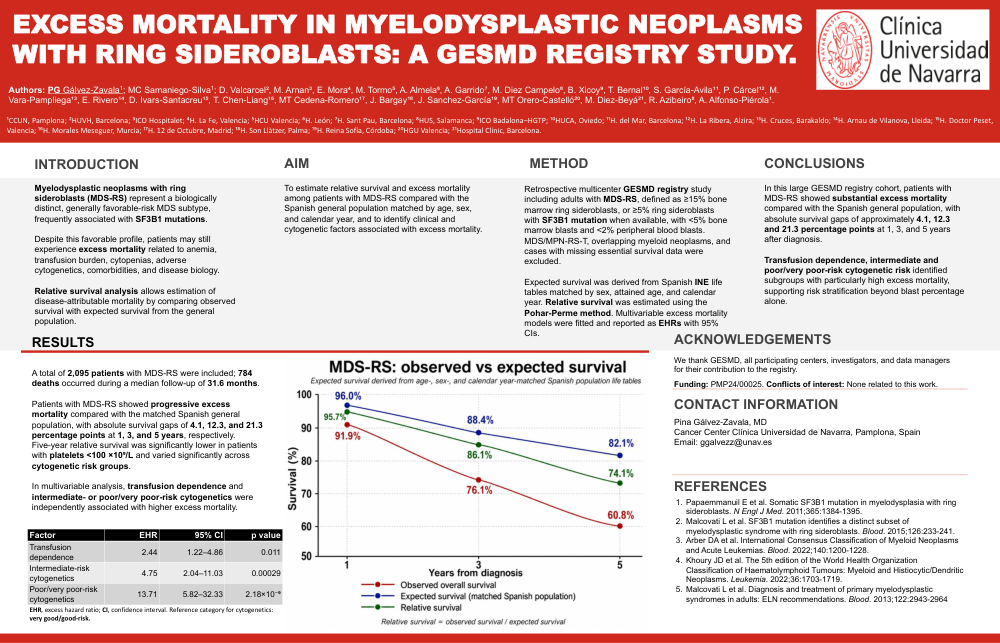
Patients with MDS-RS showed progressive excess mortality compared with the matched Spanish general population, with absolute survival gaps of 4.1, 12.3, and 21.3 percentage points at 1, 3, and 5 years, respectively.
Five-year relative survival was significantly lower in patients with platelets <100 ×10⁹/L and varied significantly across cytogenetic risk groups.
In multivariable analysis, transfusion dependence and intermediate- or poor/very poor-risk cytogenetics were independently associated with higher excess mortality.
CONCLUSIONS
In this large GESMD registry cohort, patients with MDS-RS showed substantial excess mortality compared with the Spanish general population, with absolute survival gaps of approximately 4.1, 12.3 and 21.3 percentage points at 1, 3, and 5 years after diagnosis.
Transfusion dependence, intermediate and poor/very poor-risk cytogenetic risk identified subgroups with particularly high excess mortality, supporting risk stratification beyond blast percentage alone.