1,267 posters, 47 videos, 13 topics, 4 sessions, 853 authors
ePostersLive by SciGen Technologies S.A. All rights reserved.
SOHO 2026 Annual Meeting
September 9 - 12, 2026 | George R. Brown Convention Center, Houston, Texas

IBCL - 683
Histologic Transformation Drives the Adverse Prognosis of POD24 in a Cohort of Patients With Follicular Lymphoma in Mexico
Poster Presenter
Part of Topic
Indolent B-Cell Lymphoma (IBCL)
Histologic transformation drives the adverse prognosis of POD24 in a cohort of patients with follicular lymphoma in Mexico
Background: Progression of disease within 24 months (POD24) and histologic transformation (HT) are established markers of high-risk follicular lymphoma (FL). However, POD24 is biologically and clinically heterogeneous, and the extent to which HT drives its adverse prognosis remains unclear in Latin American populations.
Methods: We retrospectively analyzed adults with FL between 2002 and 2025 at a Mexican tertiary-care center. POD24 was defined as progression or relapse within 24 months from first-line treatment initiation. HT was defined by biopsy-confirmed transformation to aggressive lymphoma during follow-up. Survival (OS) and progression-free survival (PFS) were estimated using Kaplan-Meier methods. POD24 was assessed using a 24-month landmark analysis, and survival among POD24 patients was compared by HT status. Cox regression explored predictors of POD24 and HT.
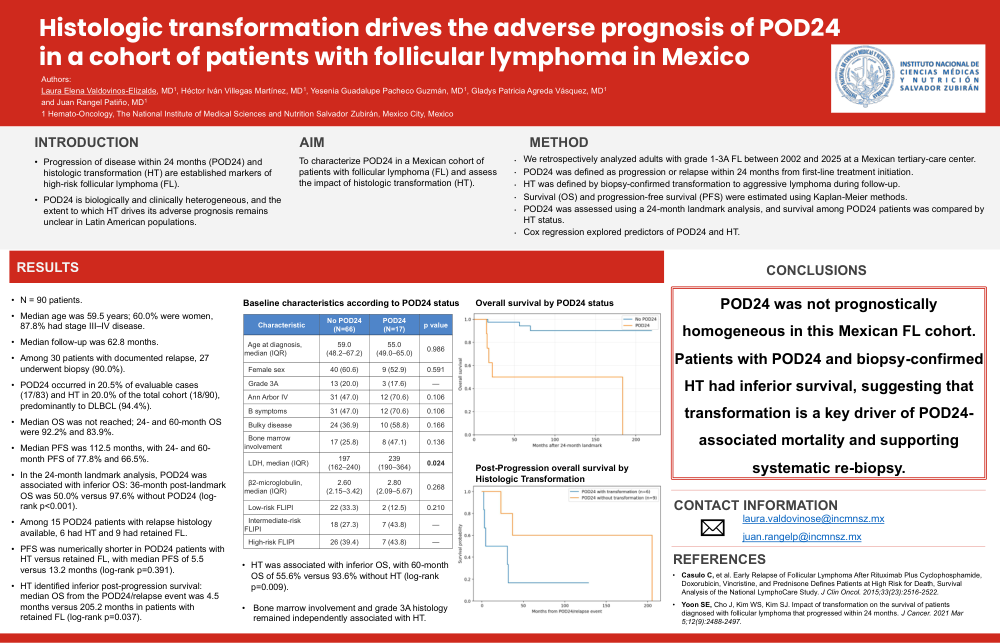
Results: Ninety patients were included. Median age was 59.5 years; 60.0% were women, 87.8% had stage III–IV disease. Median follow-up was 62.8 months. Among 30 patients with documented relapse, 27 underwent biopsy (90.0%). POD24 occurred in 17/83 treated/evaluable patients (20.5%), and HT occurred in 18/90 patients (20.0%). Median OS was not reached; 24- and 60-month OS were 92.2% and 83.9%. Median PFS from diagnosis was 112.5 months, with 24- and 60-month PFS of 77.8% and 66.5%.
In the 24-month landmark analysis, POD24 was associated with inferior OS: 36-month post-landmark OS was 50.0% versus 97.6% without POD24 (log-rank p<0.001). Among 15 POD24 patients with relapse histology available, 6 had HT and 9 had retained FL. PFS was numerically shorter in POD24 patients with HT versus retained FL, with median PFS of 5.5 versus 13.2 months (log-rank p=0.391). HT identified inferior post-progression survival: median OS from the POD24/relapse event was 4.5 months versus 205.2 months in patients with retained FL (log-rank p=0.037). HT was associated with inferior OS, with 60-month OS of 55.6% versus 93.6% without HT (log-rank p=0.009). Bone marrow involvement and grade 3A histology remained independently associated with HT.
Conclusions: POD24 was not prognostically homogeneous in this Mexican FL cohort. Patients with POD24 and biopsy-confirmed HT had inferior survival, suggesting that transformation is a key driver of POD24-associated mortality and supporting systematic re-biopsy.