1,267 posters, 47 videos, 13 topics, 4 sessions, 853 authors
ePostersLive by SciGen Technologies S.A. All rights reserved.
SOHO 2026 Annual Meeting
September 9 - 12, 2026 | George R. Brown Convention Center, Houston, Texas

AML - 648
Molecular Predictors of Response to Venetoclax-Based Therapy in Acute Myeloid Leukemia
Poster Presenter
Authors
Part of Topic
Acute Myeloid Leukemia (AML)
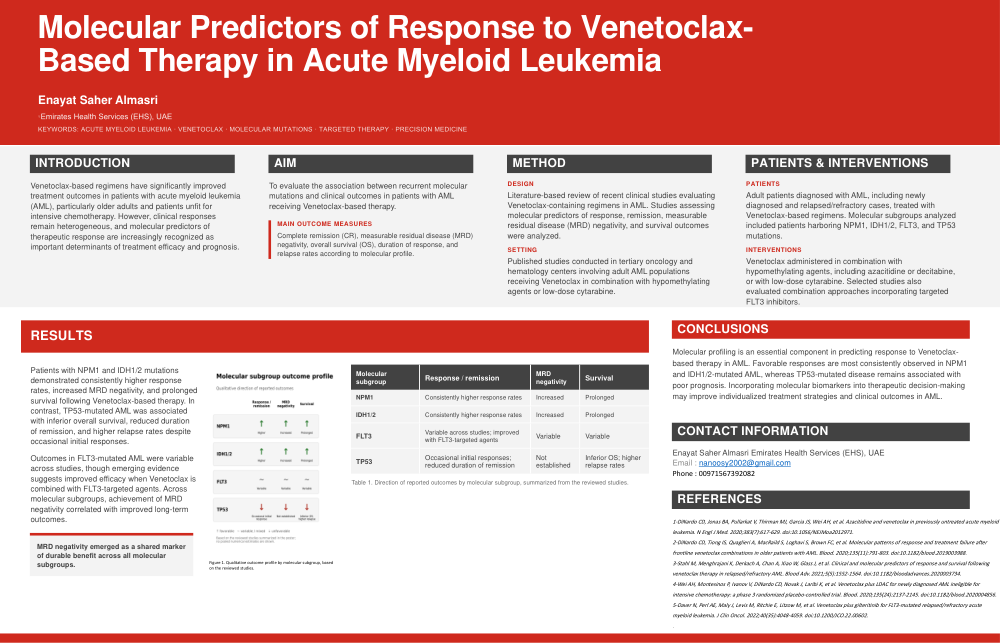
Molecular Predictors of Response to Venetoclax-Based Therapy in Acute Myeloid Leukemia Enayat Saher Almasri 1 ¹ Emirates Health Services (EHS ), UAE KEYWORDS: acute myeloid leukemia, Venetoclax, molecular mutations, targeted therapy, precision medicine CONTEXT: Venetoclax-based regimens have significantly improved treatment outcomes in patients with acute myeloid leukemia (AML), particularly older adults and patients unfit for intensive chemotherapy. However, clinical responses remain heterogeneous, and molecular predictors of therapeutic response are increasingly recognized as important determinants of treatment efficacy and prognosis. OBJECTIVE: To evaluate the association between recurrent molecular mutations and clinical outcomes in patients with AML receiving Venetoclax-based therapy. DESIGN: Literature-based review of recent clinical studies evaluating Venetoclax-containing regimens in AML. Studies assessing molecular predictors of response, remission, measurable residual disease (MRD) negativity, and survival outcomes were analyzed. SETTING: Published studies conducted in tertiary oncology and hematology centers involving adult AML populations receiving Venetoclax in combination with hypomethylating agents or low-dose cytarabine. PATIENTS OR OTHER PARTICIPANTS: Adult patients diagnosed with AML, including newly diagnosed and relapsed/refractory cases, treated with Venetoclax-based regimens. Molecular subgroups analyzed included patients harboring NPM1, IDH1/2, FLT3, and TP53 mutations. INTERVENTIONS: Venetoclax administered in combination with hypomethylating agents, including azacitidine or decitabine, or with low-dose cytarabine. Selected studies also evaluated combination approaches incorporating targeted FLT3 inhibitors. MAIN OUTCOME MEASURES: Complete remission (CR), measurable residual disease (MRD) negativity, overall survival (OS), duration of response, and relapse rates according to molecular profile. RESULTS: Patients with NPM1 and IDH1/2 mutations demonstrated consistently higher response rates, increased MRD negativity, and prolonged survival following Venetoclax-based therapy. In contrast, TP53-mutated AML was associated with inferior overall survival, reduced duration of remission, and higher relapse rates despite occasional initial responses. Outcomes in FLT3 mutated AML were variable across studies, though emerging evidence suggests improved efficacy when Venetoclax is combined with FLT3-targeted agents. Across molecular subgroups, achievement of MRD negativity correlated with improved long-term outcomes. CONCLUSIONS: Molecular profiling is an essential component in predicting response to Venetoclax-based therapy in AML. Favorable responses are most consistently observed in NPM1 and IDH1/2-mutated AML, whereas TP53-mutated disease remains associated with poor prognosis. Incorporating molecular biomarkers into therapeutic decision-making may improve individualized treatment strategies and clinical outcomes in AML.