1,267 posters, 47 videos, 13 topics, 4 sessions, 853 authors
ePostersLive by SciGen Technologies S.A. All rights reserved.
SOHO 2026 Annual Meeting
September 9 - 12, 2026 | George R. Brown Convention Center, Houston, Texas

ALL - 606
High-Dose Methotrexate (HDMTX) Protocol Adherence: A Quality Improvement Study at a Tertiary Cancer Center in Pakistan
Poster Presenter
Authors
Part of Topic
Acute Lymphoblastic Leukemia (ALL)
Title: High-Dose Methotrexate (HDMTX) Protocol Adherence: A Quality Improvement Study at a Tertiary Cancer Center in Pakistan
Authors: Muhammad Sher Ali, Beenish Aqib, Muhammad Imran, Fatima Tariq, Aftab Ahmad, Shehzad Ali Khan, Ehsan Elahi, Usman Ahmed, Syed Waqas Imam Bokhari, Bushra Ahsan
Affiliation: Shaukat Khanum Memorial Cancer Hospital & Research Centre, Lahore, Pakistan
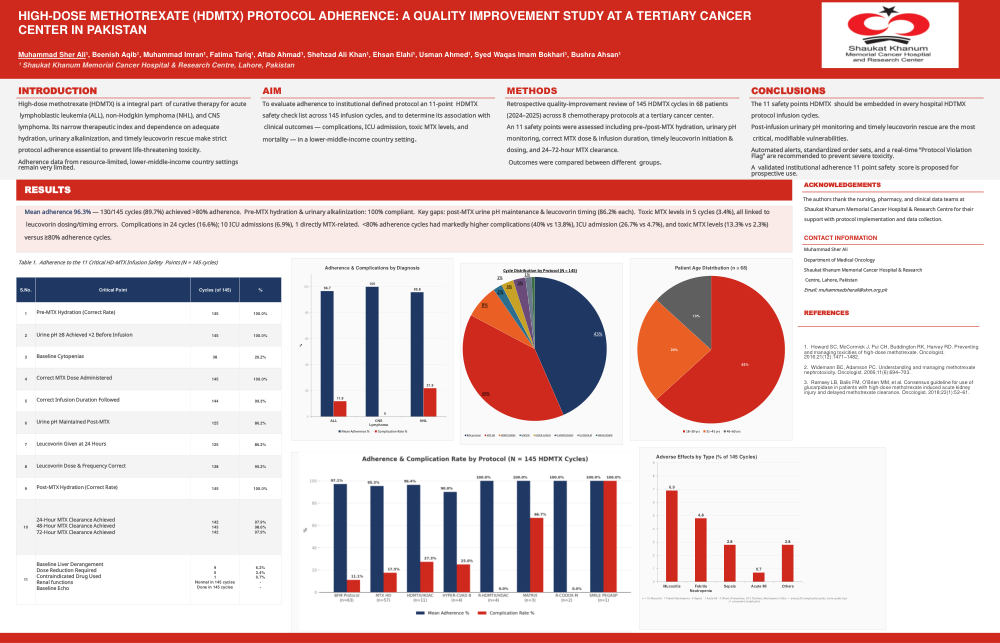
Background: High-dose methotrexate (HDMTX) is an integral part of curative therapy for acute lymphoblastic leukemia (ALL), non-Hodgkin lymphoma (NHL), and CNS lymphoma. Its narrow therapeutic index and dependence on adequate hydration, urinary alkalinization, and timely leucovorin rescue make strict protocol adherence essential to prevent life-threatening toxicity. Adherence data from resource-limited, lower-middle-income country (LMIC) settings remain very limited.
Aim: To evaluate adherence to an institutionally defined 11-point HDMTX safety checklist across 145 infusion cycles, and to determine its association with clinical outcomes — complications, ICU admission, toxic MTX levels, and mortality — in an LMIC setting.
Methods: This retrospective quality-improvement review analyzed 145 HDMTX cycles in 68 patients (2024–2025) across 8 chemotherapy protocols at a tertiary cancer center. Eleven safety points were assessed, including pre-/post-MTX hydration, urinary pH monitoring, correct MTX dose and infusion duration, timely leucovorin initiation and dosing, and 24–72-hour MTX clearance. Outcomes were compared between high- and lower-adherence cycles.
Results: Mean adherence was 96.3%, with 130/145 cycles (89.7%) achieving >80% adherence. Pre-MTX hydration and urinary alkalinization were 100% compliant. The key adherence gaps were post-MTX urine pH maintenance and leucovorin timing (86.2% each). Toxic MTX levels occurred in 5 cycles (3.4%), all linked to leucovorin dosing/timing errors. Complications occurred in 24 cycles (16.6%), most commonly mucositis (6.9%) and febrile neutropenia (4.8%); there were 10 ICU admissions (6.9%), one directly MTX-related. Complication rates varied by diagnosis (NHL 21.9%, ALL 11.9%, CNS lymphoma 0%). Cycles with <80% adherence had markedly worse outcomes than those with ≥80% adherence: complications (40% vs 13.8%), ICU admission (26.7% vs 4.7%), and toxic MTX levels (13.3% vs 2.3%).
Conclusions: The 11-point HDMTX safety checklist should be embedded into every institutional infusion protocol. Post-infusion urinary pH monitoring and timely leucovorin rescue are the most critical, modifiable vulnerabilities. Automated alerts, standardized order sets, and a real-time "Protocol Violation Flag" are recommended to prevent severe toxicity. A validated institutional adherence scoring system is proposed for prospective use.