1,267 posters, 47 videos, 13 topics, 4 sessions, 853 authors
ePostersLive by SciGen Technologies S.A. All rights reserved.
SOHO 2026 Annual Meeting
September 9 - 12, 2026 | George R. Brown Convention Center, Houston, Texas

MM - 578
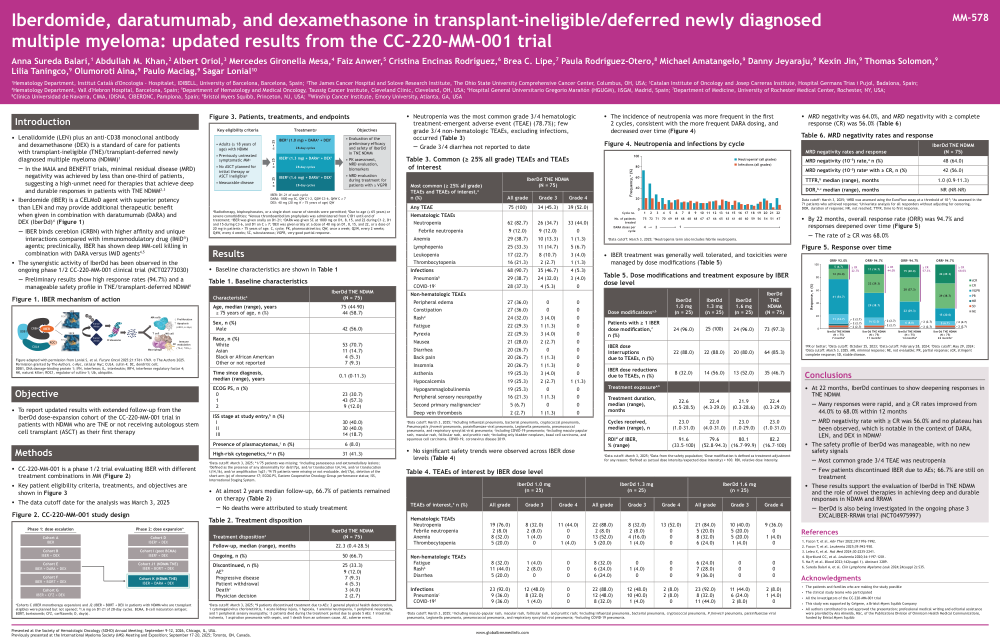
Iberdomide, Daratumumab, and Dexamethasone (IberDd) in Transplant-Ineligible/Deferred (TNE) Newly Diagnosed Multiple Myeloma (NDMM): Updated Results From the CC-220-MM-001 Trial
Poster Presenter
Authors
Part of Topic
Multiple Myeloma (MM)
Introduction
• Lenalidomide (LEN) plus an anti-CD38 monoclonal antibody
and dexamethasone (DEX) is a standard of care for patients
with transplant-ineligible (TNE)/transplant-deferred newly
diagnosed multiple myeloma (NDMM)1
— In the MAIA and BENEFIT trials, minimal residual disease (MRD)
negativity was achieved by less than one-third of patients,
suggesting a high-unmet need for therapies that achieve deep
and durable responses in patients with TNE NDMM2,3
• Iberdomide (IBER) is a CELMoD agent with superior potency
than LEN and may provide additional therapeutic benefit
when given in combination with daratumumab (DARA) and
DEX (IberDd)4 (Figure 1)
— IBER binds cereblon (CRBN) with higher affinity and unique
interactions compared with immunomodulatory drug (IMiD®)
agents; preclinically, IBER has shown deep MM-cell killing in
combination with DARA versus IMiD agents4,5
• The synergistic activity of IberDd has been observed in the
ongoing phase 1/2 CC-220-MM-001 clinical trial (NCT02773030)
— Preliminary results show high response rates (94.7%) and a
manageable safety profile in TNE/transplant-deferred NDMM6
Objective
• To report updated results with extended follow-up from the
IberDd dose-expansion cohort of the CC-220-MM-001 trial in
patients with NDMM who are TNE or not receiving autologous stem
cell transplant (ASCT) as their first therapy
Methods
• CC-220-MM-001 is a phase 1/2 trial evaluating IBER with different
treatment combinations in MM (Figure 2)
• Key patient eligibility criteria, treatments, and objectives are
shown in Figure 3
• The data cutoff date for the analysis was March 3, 2025
Results
• Baseline characteristics are shown in Table 1
• At almost 2 years median follow-up, 66.7% of patients remained
on therapy (Table 2)
— No deaths were attributed to study treatment
• Neutropenia was the most common grade 3/4 hematologic
treatment-emergent adverse event (TEAE) (78.7%); few
grade 3/4 non-hematologic TEAEs, excluding infections,
occurred (Table 3)
— Grade 3/4 diarrhea not reported to date
Conclusions
• At 22 months, IberDd continues to show deepening responses in
TNE NDMM
— Many responses were rapid, and ≥ CR rates improved from
44.0% to 68.0% within 12 months
— MRD negativity rate with ≥ CR was 56.0% and no plateau has
been observed, which is notable in the context of DARA,
LEN, and DEX in NDMM2
• The safety profile of IberDd was manageable, with no new
safety signals
— Most common grade 3/4 TEAE was neutropenia
— Few patients discontinued IBER due to AEs; 66.7% are still on
treatment
• These results support the evaluation of IberDd in TNE NDMM
and the role of novel therapies in achieving deep and durable
responses in NDMM and RRMM
— IberDd is also being investigated in the ongoing