1,267 posters, 47 videos, 13 topics, 4 sessions, 853 authors
ePostersLive by SciGen Technologies S.A. All rights reserved.
SOHO 2026 Annual Meeting
September 9 - 12, 2026 | George R. Brown Convention Center, Houston, Texas

MPN - 556
Mutant Calreticulin-Specific Monoclonal Antibody INCA033989 Produces Molecular Responses That Correlate With Clinical Responses in Patients With Myelofibrosis
Poster Presenter
Authors
Part of Topic
Myeloproliferative Neoplasms (MPN)
Video
CONTEXT: Mutations in the calreticulin gene (mutCALR) occur in 25-30% patients with myelofibrosis; however, complex clonal architectures may impact response. INCA033989, a novel, fully human, Fc-silenced, IgG1 mAb, selectively targets mutCALR complexed with thrombopoietin receptor, inhibiting oncogenic signaling and cell proliferation. INCA033989 is under investigation in two ongoing, first-in-human trials enrolling patients with essential thrombocythemia or myelofibrosis (NCT05936359; NCT06034002).
OBJECTIVE: To evaluate the impact of INCA033989 on mutCALR clones and co-occurring mutations, and correlate with clinical outcomes.
METHODS: Next-generation sequencing (NGS; 37-gene panel) was performed on serial peripheral blood samples from 76 patients with myelofibrosis (>400 samples). Single-cell sequencing on mononuclear cells was performed on available samples (n=33) using 37-gene DNA and 46-protein panels for genotyping and immunophenotyping. Efficacy assessments included spleen volume reduction ≥25% (SVR25), ≥35% (SVR35), and anemia response.
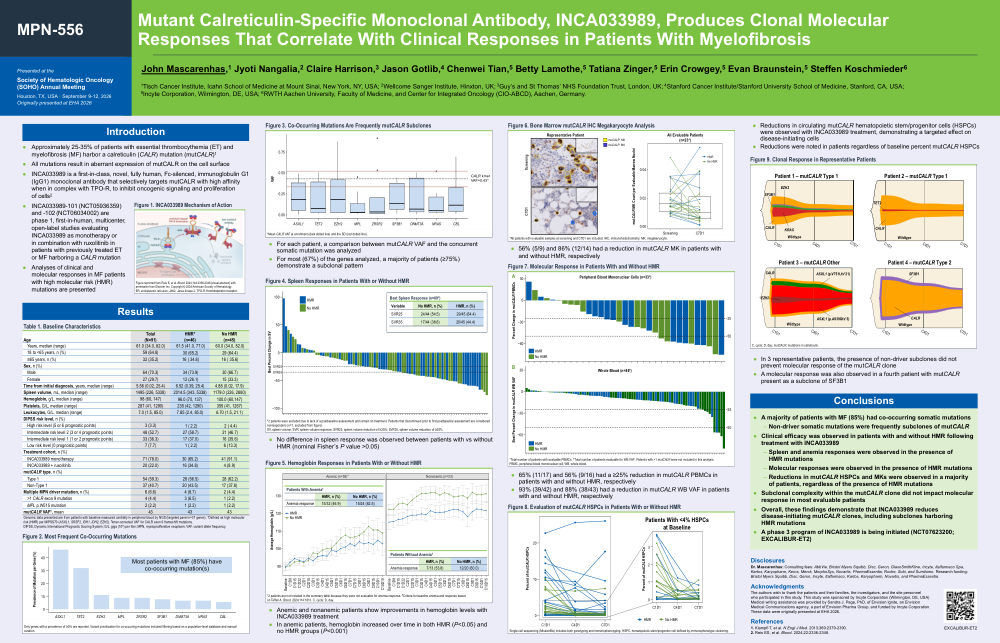
RESULTS: Fifty-seven percent (43/76) had Type1 and 43% (33/76) had non-Type1 mutCALR. Two patients harbored ≥1 mutCALR with distinct VAF, and 2 had a co-occurring MPL p.W515 mutation (VAF, 3% and 9%). Baseline mean mutCALR VAF was 38%. Loss of heterozygosity at CALR loci was inferred in 4 patients; all had Type2 mutCALR. Eighty-six percent of patients had ≥1 co-occurring somatic mutation, most frequently ASXL1 (47%), TET2 (32%), and EZH2 (12%).
Among patients with co-occurring mutations and spleen assessments, 56% (35/63) and 40% (25/63) achieved SVR25 and SVR35 (compared with 57% and 42% in all patients irrespective of co-occurring mutations). Among patients with ASXL1 mutations, 59% (20/34) had SVR25; 47% (16/34) had SVR35. Anemia response occurred in 51% (23/45) of all patients, 54% (21/39) with a co-occurring mutation, and 46% with an ASXL1 mutation. mutCALR VAF reduction occurred in 69/75 patients (92%); 7 achieved ≥25% reduction. mutCALR-positive hematopoietic stem and progenitor cells (HSPCs) were reduced in all patients with SVR25 (n=24). Intrapatient mutCALR clones responded similarly to INCA033989 regardless of co-occurring mutations being present.
CONCLUSIONS: Spleen and anemia responses were comparable regardless of co-occurring somatic mutations being present, suggesting clonal complexity does not limit treatment response. Despite modest mutCALR VAF reduction via peripheral blood NGS, the observed rapid reduction of mutCALR HSPCs supports disease-modifying INCA033989 activity.