1,267 posters, 47 videos, 13 topics, 4 sessions, 853 authors
ePostersLive by SciGen Technologies S.A. All rights reserved.
SOHO 2026 Annual Meeting
September 9 - 12, 2026 | George R. Brown Convention Center, Houston, Texas

MPN - 553
Preclinical Evaluation of INCA035784, a Novel T-Cell-Redirecting Antibody for the Treatment of MutCALR-Driven Myeloproliferative Neoplasms (MPNs)
Poster Presenter
Authors
Part of Topic
Myeloproliferative Neoplasms (MPN)
Video
CONTEXT: Calreticulin mutations (mutCALR) occur in 25% of essential thrombocythemia and 35% of myelofibrosis cases. Cell surface-expressed mutCALR complexed with thrombopoietin receptor (TPOR) is an attractive cancer cell-specific target. INCA035784, a novel T-cell–redirecting antibody that binds the invariant N-domain of mutCALR, may have equipotent efficacy across all variants with C-domain mutations.
OBJECTIVE: To evaluate the ability of INCA035784 to target cells from patients with different mutCALR.
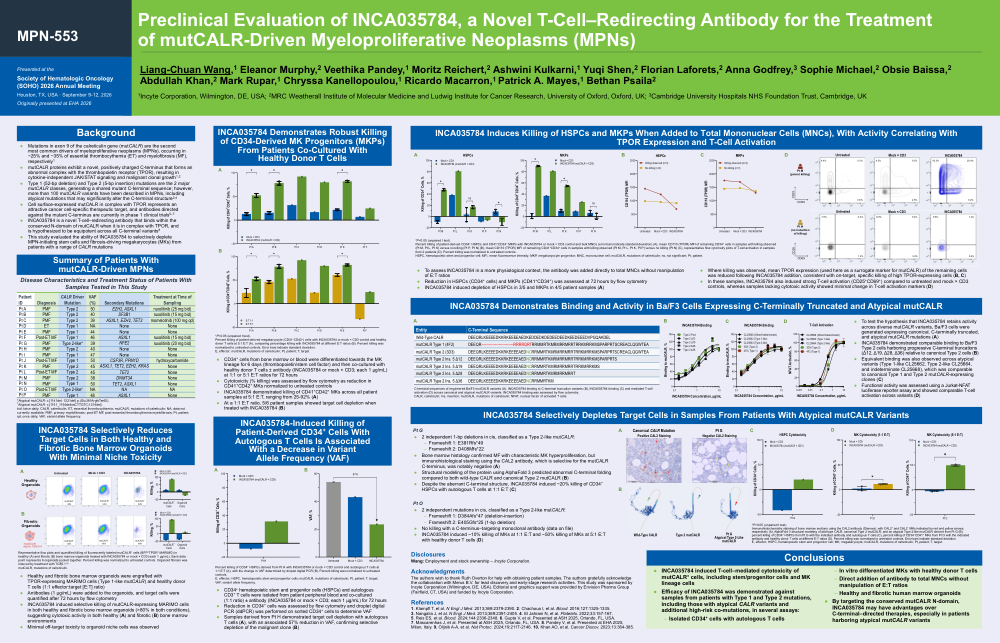
METHODS: INCA035784 was evaluated in cells expressing mutCALR variants (n=9). Cytotoxicity against hematopoietic stem/progenitor cells (HSPC, n=4), and megakaryocyte progenitors (MKP, n=5) was tested using healthy donor-derived and autologous T cells with defined effector-to-target ratios. Physiological activity was assessed using minimally manipulated mononuclear cells (n=2) and bone marrow (BM) organoids. Target cell depletion and T-cell activation were measured by ddPCR and flow cytometry. INCA035784 binding was assessed in Ba/F3 cells expressing atypical Type 1/2 mutations or Type 2 mutCALR variants with different C-terminus truncations using flow cytometry. mutCALR protein structures were modeled using AlphaFold3.
RESULTS: INCA035784 showed selective and equipotent binding to mutCALR cells and induced cytotoxicity and dose-dependent T-cell activation. No binding occurred on cells with wild-type calreticulin, confirming mutCALR-TPOR selectivity. Target cell killing was demonstrated in coculture assays of T cells with CD34 cells and CD34-derived MKPs; efficacy ranged from 20%–90% versus mock×CD3 antibody (n=5) and increased with higher effector-to-target ratios. INCA035784 elicited a 50% variant allele frequency reduction in cells from a patient with Type 2 mutCALR cocultured with autologous T cells. INCA035784-induced killing was observed in healthy and fibrotic human BM organoids. Binding of INCA035784 to Ba/F3 cells harboring atypical Type 1/2 mutations or truncated Type 2 mutCALR variants was retained regardless of these modifications. Modeling patient-derived C-terminal variants identified 4 with structures distinct from canonical Type 2 variants. BM histology from one patient showed myelofibrosis with MK hyperproliferation but no staining with mutant C-terminus specific CAL2 antibody; however,
INCA035784 induced cytotoxicity in CD34 HSPCs with autologous T cells.
CONCLUSIONS: Targeting the conserved mutCALR N-domain with INCA035784 may have advantages over C-terminal–directed therapies, especially in patients harboring atypical mutCALR variants and those with canonical Type 1/2 mutCALR.