1,267 posters, 47 videos, 13 topics, 4 sessions, 853 authors
ePostersLive by SciGen Technologies S.A. All rights reserved.
SOHO 2026 Annual Meeting
September 9 - 12, 2026 | George R. Brown Convention Center, Houston, Texas

AML - 551
Real-World Insights Into Demographic Profiles and Barriers to Hematopoietic Stem Cell Transplantation in Pakistan: A Single-Center Experience
Poster Presenter
Authors
Part of Topic
Acute Myeloid Leukemia (AML)
Real world insights into Demographic Profile and Barriers to Hematopoietic Stem Cell Transplantation in Pakistan: a single center experience
Anam Shafiq, Maleeha Akbar, Sadaf Zulfiqar, Raheel Iftikhar, Jahanzeb ur Rehman, Kashaf ad Duja Awais, Hira Tariq Ammad Akram Chaudhary, Tariq Ghafoor
ABSTRACT:
Background:
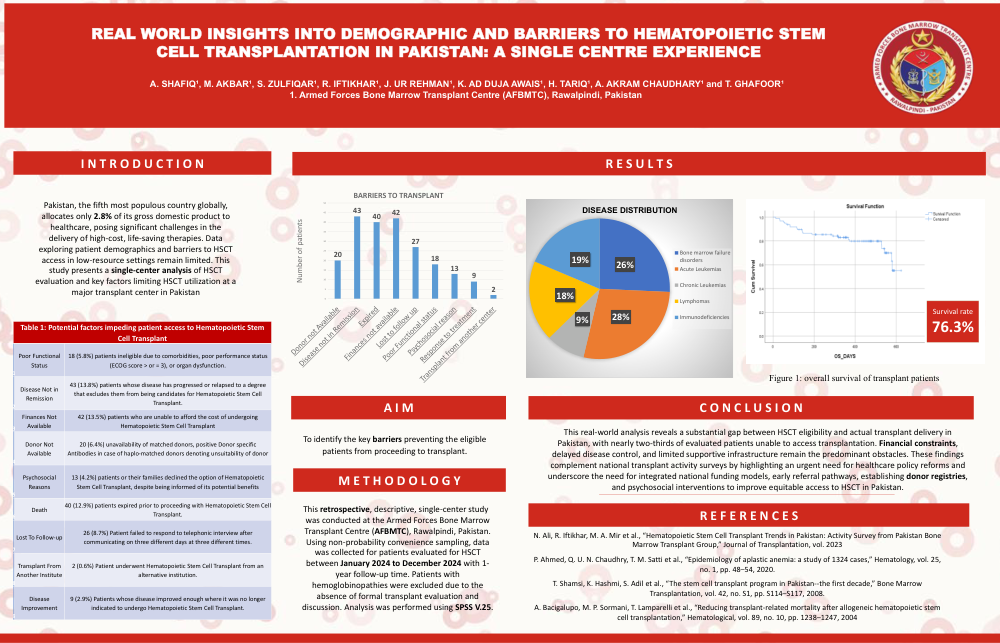
Pakistan, the fifth most populous country globally, allocates only 2.8% of its gross domestic product to healthcare, posing significant challenges in the delivery of high-cost, life-saving therapies. Hematopoietic Stem Cell Transplant (HSCT) remains the definitive curative therapy for several malignant and non-malignant hematological disorders. Data exploring patient demographics and barriers to HSCT access in low-resource settings remain limited. This study presents a single-center analysis of HSCT evaluation and key factors limiting HSCT utilization at a major transplant center in Pakistan.
Methodology:
This retrospective, descriptive, single-center study was conducted at the Armed Forces Bone Marrow Transplant Centre (AFBMTC), Rawalpindi, Pakistan. Using non-probability convenience sampling, data was collected for patients evaluated for HSCT between January, 2024 to December 2024 with 1-year follow-up time. Patients with hemoglobinopathies were excluded due to the absence of formal transplant evaluation and discussion. Analysis was performed using SPSS V.25. Patients deemed eligible by the pre-transplant evaluation committee but not proceeding to HSCT were systematically reviewed to identify access-limiting factors.
Results:
A total of 311 patients were evaluated for HSCT, with a median age of 31.34 years (range: 0.5 months-72 years); 212 (68.2%) were male and 99 (31.8%) were female. Malignant disorders constituted the majority of indications 173 (55.6%), followed by aplastic anemia 80 (25.7%) and immunodeficiency disorders 58(18.6%). Despite eligibility, only 97 patients 31.2% ultimately underwent HSCT. Of the 214 patients (68.8%) who did not proceed to transplant, the principal barriers included disease progression or failure to achieve remission 43 (13.8%), financial constraints 42 (13.5%), pre-transplant mortality 40 (12.9%), donor unavailability 20 (6.4%), poor functional status or comorbidities 18 (5.8%), psychosocial refusal 13(4.2%), and loss to follow-up 27(8.7%). The primary factors impeding access to HSCT were categorized in Table 1. Among patients who underwent transplant, the survival rate was 76.3% with a mean survival of 514 days (Figure 3).
Conclusion:
This real-world analysis reveals a substantial gap between HSCT eligibility and actual transplant delivery in Pakistan, with nearly two-thirds of evaluated patients unable to access transplantation. Financial constraints, delayed disease control, and limited supportive infrastructure remain the predominant obstacles. These findings complement national transplant activity surveys by highlighting an urgent need for healthcare policy reforms and underscore the need for integrated national funding models, early referral pathways, establishing donor registries, and psychosocial interventions to improve equitable access to HSCT in Pakistan.
|
|