1,267 posters, 47 videos, 13 topics, 4 sessions, 853 authors
ePostersLive by SciGen Technologies S.A. All rights reserved.
SOHO 2026 Annual Meeting
September 9 - 12, 2026 | George R. Brown Convention Center, Houston, Texas

MM - 548
Navigating Bispecifics Outpatient Step-Up Dosing: A Roadmap to Help Improve Safety and Access in the Real-World (NORTHSTAR)
Poster Presenter
Authors
Part of Topic
Multiple Myeloma (MM)
Introduction
•Teclistamab and talquetamab are standard-of-care bispecific antibody (BsAb) T-cell engagers that demonstrate deep and durable responses in clinical trials as monotherapy and in combination therapy for patients with relapsed/refractory multiple myeloma (RRMM).1-3
•To mitigate the risk of class-wide adverse events (AEs) associated with BsAbs, particularly cytokine release syndrome (CRS) and immune effector cell-associated neurotoxicity syndrome (ICANS), treatment is initiated using a step-up dosing (SUD) schedule that has traditionally been administered in the inpatient (IP) setting.4,5
•In 2026, the Food and Drug Administration removed the recommendation for hospitalization after the first treatment dose of teclistamab, providing flexibility for administration in outpatient (OP) settings.4
•Growing evidence supports that OP SUD can be administered safely and is an effective approach that may reduce healthcare resource utilization and improve patient access, particularly in community practices which may have limited resources for IP SUD.6
•However, the absence of standardized guidance remains a barrier to broader implementation of OP SUD.
Aim
•To establish expert consensus supporting the safe administration of OP SUD for teclistamab or talquetamab and translate these recommendations into a practical, provider-facing implementation guide.
Methods
Study design and study population
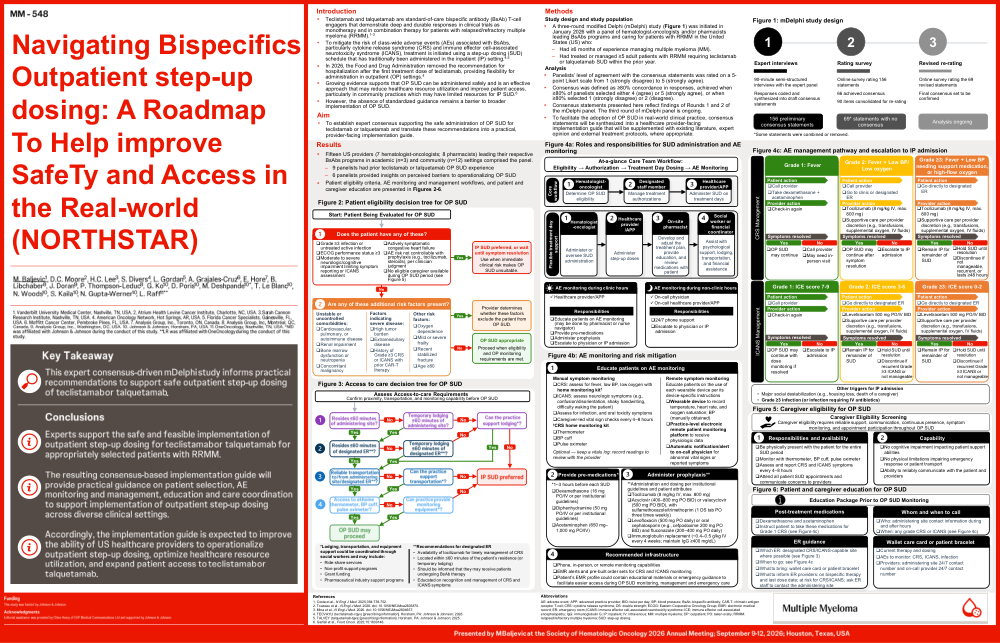
•A three-round modified Delphi (mDelphi) study (Figure 1) was initiated in January 2026 with a panel of hematologist-oncologists and/or pharmacists leading BsAbs programs and caring for patients with RRMM in the United States (US) who:
–Had ≥6 months of experience managing multiple myeloma (MM).
–Had treated or managed ≥5 adult patients with RRMM requiring teclistamab or talquetamab SUD within the prior year.
Analysis
•Panelists’ level of agreement with the consensus statements was rated on a 5-point Likert scale from 1 (strongly disagree) to 5 (strongly agree).
•Consensus was defined as ≥80% concordance in responses, achieved when ≥80% of panelists selected either 4 (agree) or 5 (strongly agree), or when ≥80% selected 1 (strongly disagree) or 2 (disagree).
•Consensus statements presented here reflect findings of Rounds 1 and 2 of the mDelphi panel. The third round of mDelphi panel is ongoing.
•To facilitate the adoption of OP SUD in real-world clinical practice, consensus statements will be synthesized into a healthcare provider-facing implementation guide that will be supplemented with existing literature, expert opinion and external treatment protocols, where appropriate.
Results
•Fifteen US providers (7 hematologist-oncologists; 8 pharmacists) leading their respective BsAbs programs in academic (n=3) and community (n=12) settings comprised the panel.
–9 panelists had prior teclistamab or talquetamab OP SUD experience
–6 panelists provided insights on perceived barriers to operationalizing OP SUD
•Patient eligibility criteria, AE monitoring and management workflows, and patient and caregiver education are presented in Figures 2-6.
Conclusions
•Experts support the safe and feasible implementation of outpatient step-up dosing for teclistamab or talquetamab for appropriately selected patients with RRMM.
•The resulting consensus-based implementation guide will provide practical guidance on patient selection, AE monitoring and management, education and care coordination to support implementation of outpatient step-up dosing across diverse clinical settings.
•Accordingly, the implementation guide is expected to improve the ability of US healthcare providers to operationalize outpatient step-up dosing, optimize healthcare resource utilization, and expand patient access to teclistamab or talquetamab.
Key Takeaway
•This expert consensus-driven mDelphi study informs practical recommendations to support safe outpatient step-up dosing of teclistamab or talquetamab.