1,267 posters, 47 videos, 13 topics, 4 sessions, 853 authors
ePostersLive by SciGen Technologies S.A. All rights reserved.
SOHO 2026 Annual Meeting
September 9 - 12, 2026 | George R. Brown Convention Center, Houston, Texas

MDS - 515
Durable Complete Remission Following HMA Therapy in Higher-Risk MDS Is Not Fully Determined by Baseline Disease Biology
Poster Presenter
Authors
Part of Topic
Myelodysplastic Syndromes (MDS)
Durable Complete Remission Following HMA Therapy in Higher-Risk MDS Is Not Fully Determined by Baseline Disease Biology
Authors: Julie Braish; Najla Al Ali; Zena Komrokji; Zhuoer Xie; Onyee Chan; Andrew T. Kuykendall; Seongseok Yun;Rory M. Shallis; Sam B. Reynolds; Alison R. Walker; Jeffrey E. Lancet; Eric Padron; David A. Sallman; Rami S. Komrokji
Background
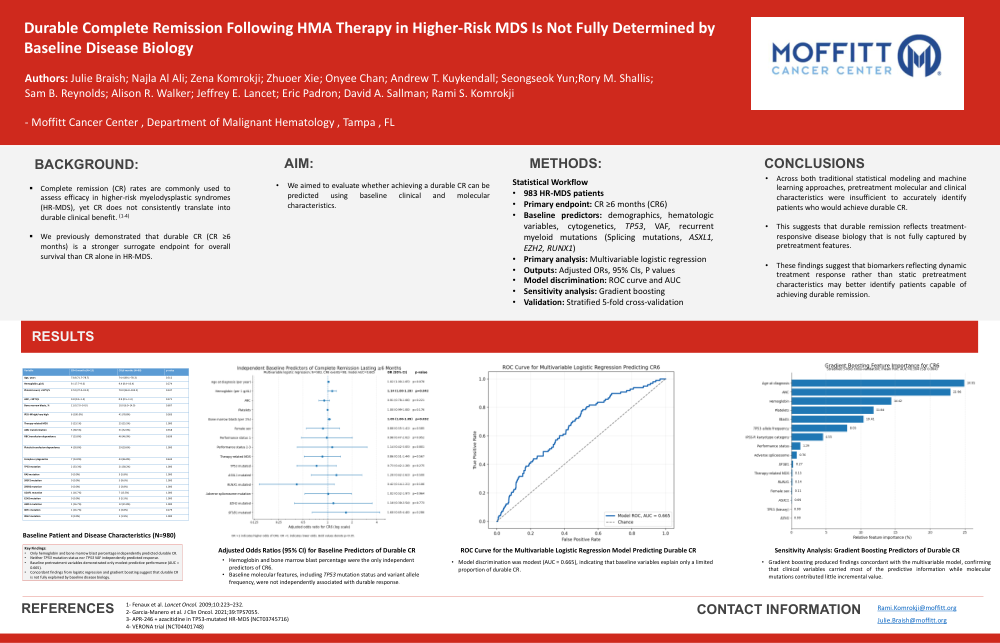
Complete remission (CR) rates are commonly used to assess efficacy in higher-risk myelodysplastic syndromes (HR-MDS), yet CR does not consistently translate into durable clinical benefit. We previously demonstrated that durable CR (CR ≥6 months; CR6) is a stronger surrogate endpoint for overall survival than CR alone. Here, we evaluated whether durable CR can be predicted using baseline clinical and molecular characteristics.
Methods
We retrospectively analyzed 983 patients with HR-MDS treated with first-line hypomethylating agent (HMA)-based therapy. The primary endpoint was CR6. Baseline variables included demographic, hematologic, cytogenetic, and molecular features, including TP53 mutation status, TP53 allele frequency, recurrent myeloid mutations, and IPSS-R cytogenetic risk. Multivariable logistic regression was used to evaluate associations with CR6. Model discrimination was assessed using ROC analysis and area under the curve (AUC). Gradient boosting with stratified 5-fold cross-validation was used as an exploratory sensitivity analysis.
Results
Among 983 patients, 98 (10%) achieved CR6. The logistic regression model demonstrated modest discrimination for CR6 prediction (AUC 0.665).
Higher baseline hemoglobin (OR 1.14, 95% CI 1.005–1.289; p=0.042) and marrow blast percentage (OR 1.05, 95% CI 1.004–1.094; p=0.032) were independently associated with CR6. Age showed a trend toward association (OR 1.02; p=0.078). Recurrent molecular abnormalities, including TP53, ASXL1, RUNX1, EZH2, SF3B1, and adverse spliceosome mutations, were not independently associated with CR6 after adjustment for clinical covariates. TP53 mutation status was not independently predictive of durable CR (OR 0.73, 95% CI 0.42–1.28; p=0.275).
Patients receiving frontline HMA/venetoclax had higher baseline marrow blasts (median 12% vs 8%; p=0.0001), but venetoclax exposure was not independently associated with CR6, and no significant blast–venetoclax interaction was observed.
Gradient boosting demonstrated similarly modest predictive performance (cross-validated mean AUC 0.56), suggesting nonlinear modeling did not substantially improve discrimination.
Conclusions
Baseline clinical and molecular characteristics demonstrated only modest ability to identify patients likely to achieve durable CR following HMA therapy in HR-MDS, even with machine learning approaches. These findings suggest durable CR may reflect treatment-responsive disease biology not fully captured by baseline pretreatment features and support future investigation of early treatment-response dynamics and adaptive biomarkers.