1,267 posters, 47 videos, 13 topics, 4 sessions, 853 authors
ePostersLive by SciGen Technologies S.A. All rights reserved.
SOHO 2026 Annual Meeting
September 9 - 12, 2026 | George R. Brown Convention Center, Houston, Texas

MDS - 456
Improving Survival and Increasing Disease Burden in Chronic Myelomonocytic Leukemia: Population-Based Trends and Projections From SEER, 2000-2022
Poster Presenter
Authors
Part of Topic
Myelodysplastic Syndromes (MDS)
Introduction:
Chronic myelomonocytic leukemia (CMML) is a rare myeloid malignancy associated with limited survival and substantial early mortality.
Contemporary population-level data describing changes in CMML incidence, treatment patterns, and outcomes remain limited.
Aims:
To characterize national trends in CMML incidence, treatment, and survival and project the future burden of CMML in the United States.
Methods:
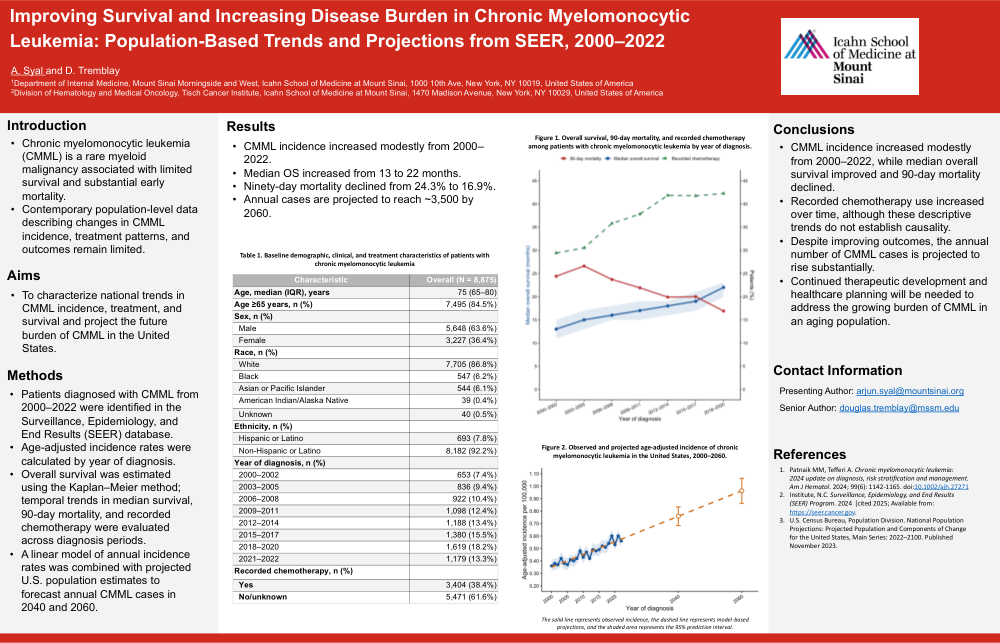
Patients diagnosed with CMML from 2000–2022 were identified in the Surveillance, Epidemiology, and End Results (SEER) database.
Age-adjusted incidence rates were calculated by year of diagnosis.
Overall survival was estimated using the Kaplan–Meier method; temporal trends in median survival, 90-day mortality, and recorded chemotherapy were evaluated across diagnosis periods.
A linear model of annual incidence rates was combined with projected U.S. population estimates to forecast annual CMML cases in 2040 and 2060.
Results:
CMML incidence increased modestly from 2000–2022.
Median OS increased from 13 to 22 months.
Ninety-day mortality declined from 24.3% to 16.9%.
Annual cases are projected to reach approximately 3,500 by 2060.
Conclusions:
CMML incidence increased modestly from 2000–2022, while median overall survival improved and 90-day mortality declined.
Recorded chemotherapy use increased over time, although these descriptive trends do not establish causality.
Despite improving outcomes, the annual number of CMML cases is projected to rise substantially.
Continued therapeutic development and healthcare planning will be needed to address the growing burden of CMML in an aging population.