1,267 posters, 47 videos, 13 topics, 4 sessions, 853 authors
ePostersLive by SciGen Technologies S.A. All rights reserved.
SOHO 2026 Annual Meeting
September 9 - 12, 2026 | George R. Brown Convention Center, Houston, Texas

ABCL - 443
Cross-disease stratification by genetic classifier Lymphly reveals shared molecular programs across B-cell malignancies
Poster Presenter
Authors
Part of Topic
Aggressive B-Cell Lymphoma (ABCL)
Cross-disease stratification by genetic classifier Lymphly reveals shared molecular programs across B-cell malignancies
Context
Biopharmaceutical developers face significant hurdles stratifying heterogeneous diffuse large B-cell lymphoma (DLBCL) cohorts, leading to diluted therapeutic efficacy and stalled clinical trials. While existing subtyping classifiers depend on clinically impractical multi-omics, the shared molecular relationships spanning DLBCL and other B-cell malignancies remain largely unmapped. To break this clinical bottleneck, we developed Lymphly—an evidence-based classifier that integrates pathway-relevant genomic alterations to refine DLBCL subtyping and uncover cross-disease targets.
Objective
Assess Lymphly's ability to identify shared molecular programs across DLBCL and related B-cell lymphomas and to perform clinically relevant cross-disease stratification.
Design
Integrative retrospective analysis of internal and publicly available molecular datasets.
Methods
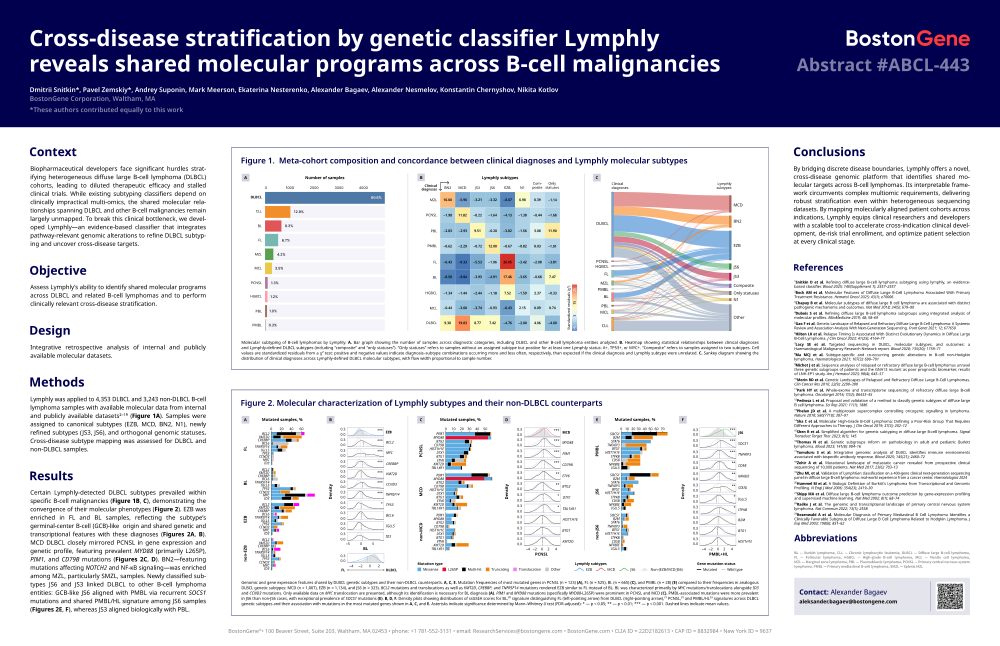
Lymphly was applied to 4,353 DLBCL and 3,243 non-DLBCL B-cell lymphoma samples with available molecular data from internal and publicly available datasets (Figure 1A). Samples were assigned to canonical subtypes (EZB, MCD, BN2, N1), newly refined subtypes (JS3, JS6), and orthogonal genomic statuses. Cross-disease subtype mapping was assessed for DLBCL and non-DLBCL samples.
Results
Certain Lymphly-detected DLBCL subtypes prevailed within specific B-cell malignancies (Figure 1B, C), demonstrating the convergence of their molecular phenotypes (Figure 2). EZB was enriched in FL and BL samples, reflecting the subtype's germinal-center B-cell (GCB)-like origin and shared genetic and transcriptional features with these diagnoses (Figures 2A, B). MCD DLBCL closely mirrored PCNSL in gene expression and genetic profile, featuring prevalent MYD88 (primarily L265P), PIM1, and CD79B mutations (Figures 2C, D). BN2—featuring mutations affecting NOTCH2 and NF-κB signaling—was enriched among MZL, particularly SMZL, samples. Newly classified subtypes JS6 and JS3 linked DLBCL to other B-cell lymphoma entities: GCB-like JS6 aligned with PMBL via recurrent SOCS1 mutations and shared PMBL/HL signature among JS6 samples (Figures 2E, F), whereas JS3 aligned biologically with PBL.
Conclusions
By bridging discrete disease boundaries, Lymphly offers a novel, cross-disease genomic platform that identifies shared molecular targets across B-cell lymphomas. Its interpretable framework circumvents complex multiomic requirements, delivering robust stratification even within heterogeneous sequencing datasets. By mapping molecularly aligned patient cohorts across indications, Lymphly equips clinical researchers and developers with a scalable tool to accelerate cross-indication clinical development, de-risk trial enrollment, and optimize patient selection at every clinical stage.
Figure Legends & Captions
- Figure 1. Meta-cohort composition and concordance between clinical diagnoses and Lymphly molecular subtypes
Molecular subtyping of B-cell lymphomas by Lymphly. A. Bar graph showing the number of samples across diagnostic categories, including DLBCL and other B-cell lymphoma entities analyzed. B. Heatmap showing associated relationships between clinical diagnoses and Lymphly-defined DLBCL subtypes showing "consensus" and "only statistics". "Only statistics" refers to samples without an assigned subtype but positive for at least one Lymphly statistical aspect, or "MCD". "Composite" refers to samples assigned to two subtypes. Cell colors are standardized residuals from a χ² test; positive and negative values indicate diagnostic-subtype combinations occurring more and less often, respectively, than expected if the clinical diagnosis and Lymphly subtype were unrelated. C. Sankey diagram showing the distribution of clinical diagnoses across Lymphly-defined DLBCL molecular subtypes, with flow width proportional to sample number. - Figure 2. Molecular characterization of Lymphly subtypes and their non-DLBCL counterparts
Transcriptional expression shares are shown by DLBCL genetic subtypes and their non-DLBCL counterparts. A,C,E. Mutation frequencies of most recurrent genes in PCNSL (n = 123), FL (n = 575), BL (n = 63), and PMBL (n = 20) compared to their frequencies in respective DLBCL genetic subtypes. MCD (n = 1,067), EZB (n = 1,154), and JS6 (n = 153). GCB markers and membership as well as MYD88, CD79B, and TNFAIP3 mutations reinforced EZB vs FL; instead of BL, BL was characterized primarily by MYC variants and translocations alongside GCB phenotype. Only limited data on MYC translocation are presented, although its identification is necessary for BL diagnosis. PIM1 and structure details is significantly more frequently mutated in PCNSL, while MCD-DLBCL associated mutations were more prevalent in DLBCL cases, with exceptional prevalence of SOCS1 mutations. B, D, F. Density plots showing distributions of cohort scores for MCD signatures distinguishing DLBCL genetic subtypes from DLBCL counterparts. FOXO1 and MYBL2 signatures across DLBCL genetic subtypes and their association with mutations in the most relevant genes shown in A, C and E. Arrow indicators significance derived by Mann-Whitney U test (p < 0.05).